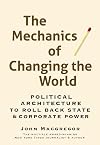
The Mechanics of Changing the World: Political Architecture to Roll Back State & Corporate Power
by John Macgregor
On This Page
Description
Perestroika, Tiananmen, the Arab Spring, Occupy. Great ideals ?yet none built anything lasting. Changing the world needs more than inspired troubleshooting: it needs architecture. "A formidable effort, very learned and extremely wide-ranging. It has certain family resemblances to The Dawn of Everything by David Graeber and David Wengrow, Yuval Noah Harari's three volumes, and books by Steven Pinker and Jared Diamond." - Barry Jones, global best-selling author, former Minister for ScienceTags
Member Reviews
Macgregor’s project is what he refers to as Third Draft Democracy, an effort to chart a path toward reinvigorating the democratic project worldwide. Third Draft is to distinguish it from the original, Athenian version as well as from what we are suffering through now, second draft democracy, which is clogged, somnolent, and in slave almost everywhere to powerful moneyed interests.
In a nutshell, Macgregor advocates for a mass movement which would reactivate democracy at the grassroots level, focusing on deep change which would attack the roots of the current problems, as he sees it, dealing with this system failure at the fundamental, constitutional level, rather than downstream, at the level of their effects and the almost show more unmanageable current polycrisis.
The approach is nothing if not ambitious. It is a deeply insightful and deepy felt project that clearly arises out of long years of thought and research, ranging through history, philosophy, psychology, economics, political science, sociology and anthropology. For those interested in pursuing real change, there is much to consider here.
Macgregor now splits his time between his home in Charters Towers , on the edge of the Australian Outback, and Cambodia, where he helps to design poverty reduction & permaculture projects with the Cambodian-run NGO, Disadvantaged Cambodians Organisation. He spent the years 2015 to 2023 writing the book.
For those who would like to pursue the project further, he is on X and Bluesky, operates the Website: thirddraftdemocracy.com and can also be found on Substack: https://johnmacgregor.substack.
The text is over a thousand pages; the following could serve as a summary:
“Our daily politics is a kind of neurosis—a ‘displacement activity’—substituting for the system redesign that can resolve our crises. War, inequality and environmental overshoot are insoluble within the current framework.
“Power is deployed more adroitly, more fairly and more safely when it is dispersed.
“For a well-functioning society, we need not to swing right or left: we require a political system by which informed majorities can craft a policy mosaic.
“Our present, inefficient form of democracy is likely to be replaced by authoritarianism, which is increasingly efficient. Reinventing democracy is not only desirable: it’s a condition for its survival. (pp 25-26)
Further:
"Threats to entrenched power can be identified by the aura of silence that surrounds them. For the last half-century, the premise of the media-government network seems to be that democracy’s evolution has reached its natural limits. The expansion of democracy is never broached out loud, let alone acted on. Accordingly, ordinary people see the constitution as immovable—like a vast national monument. There is ceaseless analysis of daily politics, and none of the rules and institutions that make it what it is." (p. 21)
According to Macgregor’s analysis, four spheres—monopoly media, political money, skewed electoral machinery and civic alienation—are democracy’s present-day choke points. (p. 26)
To concretize his proposals:
“At the core of the third draft is the Bill of Change—a set of articles of constitutional law that relate to each other via an underlying principle.
“What is the principle?
‘It is that the power of special interests has expanded, and democracy has not: that new institutions are required to undo the plutocracy that has grown up around our democracy, like the brambles round Sleeping Beauty’s castle.
“The Bill is designed to shape a society that satisfies progressives and conservatives alike with its stability, its faith in itself, and its equality of political opportunity. Our present factionalism will not be resolved by one side winning—but by the arrival of decision-making that all respect. Division ends with the birth of a new idea." (p. 27)
Many of his proposals are not earth-shattering: deliberative assemblies, proportional representation, direct democracy, voting by mail, widespread use of referendums, limits on campaign and media spending, for example. They are designed to work together in such a way as to create a synergy – or as he refers to it, syzygy – which strengthens the whole project’s chances of succeeding.
He is an optimist regarding humans:
“…the record of our time on Earth tells us that, under the right conditions, we’re a co-operative, egalitarian and amiable-enough species. We are highly social; we value individual autonomy; we don’t have much time for leaders.” (p. 40)
Fundamentally, he believes that human cooperation is very much a possibility at the direct, grassroots level, once the power of money and their corresponding media narratives can be sidelined:
“The moment constitutional reform becomes a ‘conservative project’ or a ‘progressive project’, it will mobilize the other side against it.
“Humanity’s age-old governance problem does not stem from progressive elites or conservative elites—it stems from elites. Most of the corruption and incompetence in our system come not from the ‘leftwing agenda’ or the ‘rightwing agenda’—but from small groups making decisions for large groups that can neither control them nor monitor them. (p. 752)
Macgregor asks:
“How real is our famous polarization?
“When we focus on issues: not that real. The ‘ideological divide’ isn’t much of a divide at all...
“The real gulf is not between left and right, but between the ruling elite and everyone else—making it necessary to divide ‘everyone else’ into warring camps. (p. 636)
I have my own doubts as to whether oligarchs and billionaires would ever willingly permit this kind of movement to gain any traction. And, correspondingly, whether it would be possible to launch major, or even minor, initiatives in this direction in the face of the current welter of disinformation and slop.
We live in times of enormous mass discouragement; large numbers of those who could be involved in change are overwhelmed with frustration and a sense of hopelessness. It is admirable and inspiring that work like Macgregor’s continues, subterranean though it is. To conclude with a reflection of his, from his Substack, regarding the book:
"Liberate information, purge the vectors of corruption, teach people how to think—and things will gradually straighten out ...The book has had the kind of reviews most authors would die for (sample below)—though sales of only a few hundred. (Such is life.)"
Indeed. show less
In a nutshell, Macgregor advocates for a mass movement which would reactivate democracy at the grassroots level, focusing on deep change which would attack the roots of the current problems, as he sees it, dealing with this system failure at the fundamental, constitutional level, rather than downstream, at the level of their effects and the almost show more unmanageable current polycrisis.
The approach is nothing if not ambitious. It is a deeply insightful and deepy felt project that clearly arises out of long years of thought and research, ranging through history, philosophy, psychology, economics, political science, sociology and anthropology. For those interested in pursuing real change, there is much to consider here.
Macgregor now splits his time between his home in Charters Towers , on the edge of the Australian Outback, and Cambodia, where he helps to design poverty reduction & permaculture projects with the Cambodian-run NGO, Disadvantaged Cambodians Organisation. He spent the years 2015 to 2023 writing the book.
For those who would like to pursue the project further, he is on X and Bluesky, operates the Website: thirddraftdemocracy.com and can also be found on Substack: https://johnmacgregor.substack.
The text is over a thousand pages; the following could serve as a summary:
“Our daily politics is a kind of neurosis—a ‘displacement activity’—substituting for the system redesign that can resolve our crises. War, inequality and environmental overshoot are insoluble within the current framework.
“Power is deployed more adroitly, more fairly and more safely when it is dispersed.
“For a well-functioning society, we need not to swing right or left: we require a political system by which informed majorities can craft a policy mosaic.
“Our present, inefficient form of democracy is likely to be replaced by authoritarianism, which is increasingly efficient. Reinventing democracy is not only desirable: it’s a condition for its survival. (pp 25-26)
Further:
"Threats to entrenched power can be identified by the aura of silence that surrounds them. For the last half-century, the premise of the media-government network seems to be that democracy’s evolution has reached its natural limits. The expansion of democracy is never broached out loud, let alone acted on. Accordingly, ordinary people see the constitution as immovable—like a vast national monument. There is ceaseless analysis of daily politics, and none of the rules and institutions that make it what it is." (p. 21)
According to Macgregor’s analysis, four spheres—monopoly media, political money, skewed electoral machinery and civic alienation—are democracy’s present-day choke points. (p. 26)
To concretize his proposals:
“At the core of the third draft is the Bill of Change—a set of articles of constitutional law that relate to each other via an underlying principle.
“What is the principle?
‘It is that the power of special interests has expanded, and democracy has not: that new institutions are required to undo the plutocracy that has grown up around our democracy, like the brambles round Sleeping Beauty’s castle.
“The Bill is designed to shape a society that satisfies progressives and conservatives alike with its stability, its faith in itself, and its equality of political opportunity. Our present factionalism will not be resolved by one side winning—but by the arrival of decision-making that all respect. Division ends with the birth of a new idea." (p. 27)
Many of his proposals are not earth-shattering: deliberative assemblies, proportional representation, direct democracy, voting by mail, widespread use of referendums, limits on campaign and media spending, for example. They are designed to work together in such a way as to create a synergy – or as he refers to it, syzygy – which strengthens the whole project’s chances of succeeding.
He is an optimist regarding humans:
“…the record of our time on Earth tells us that, under the right conditions, we’re a co-operative, egalitarian and amiable-enough species. We are highly social; we value individual autonomy; we don’t have much time for leaders.” (p. 40)
Fundamentally, he believes that human cooperation is very much a possibility at the direct, grassroots level, once the power of money and their corresponding media narratives can be sidelined:
“The moment constitutional reform becomes a ‘conservative project’ or a ‘progressive project’, it will mobilize the other side against it.
“Humanity’s age-old governance problem does not stem from progressive elites or conservative elites—it stems from elites. Most of the corruption and incompetence in our system come not from the ‘leftwing agenda’ or the ‘rightwing agenda’—but from small groups making decisions for large groups that can neither control them nor monitor them. (p. 752)
Macgregor asks:
“How real is our famous polarization?
“When we focus on issues: not that real. The ‘ideological divide’ isn’t much of a divide at all...
“The real gulf is not between left and right, but between the ruling elite and everyone else—making it necessary to divide ‘everyone else’ into warring camps. (p. 636)
I have my own doubts as to whether oligarchs and billionaires would ever willingly permit this kind of movement to gain any traction. And, correspondingly, whether it would be possible to launch major, or even minor, initiatives in this direction in the face of the current welter of disinformation and slop.
We live in times of enormous mass discouragement; large numbers of those who could be involved in change are overwhelmed with frustration and a sense of hopelessness. It is admirable and inspiring that work like Macgregor’s continues, subterranean though it is. To conclude with a reflection of his, from his Substack, regarding the book:
"Liberate information, purge the vectors of corruption, teach people how to think—and things will gradually straighten out ...The book has had the kind of reviews most authors would die for (sample below)—though sales of only a few hundred. (Such is life.)"
Indeed. show less
 This review was written for LibraryThing Early Reviewers.
The term "changing the world" "begs the question" because NO action (human or nonhuman) is without "consequences" (nearly all of which is unrecognized, most of which is unmeasured).
Book Review: The Mechanics of Changing the World: Political Architecture to Roll Back State & Corporate Power by John Macgregor
Rating: ★★★★★
John Macgregor’s The Mechanics of Changing the World is a compelling exploration of how we might reimagine democracy to solve pressing global issues like war, inequality, and climate change. Rather than relying on traditional activism or isolated political reform, Macgregor argues for a fundamental redesign of democratic structures to create a more resilient and just system—what he calls "third draft show more democracy." This proposed evolution of democratic design offers a suite of reforms aimed at decentralizing power, enhancing transparency, and restoring decision-making to the people.
Macgregor’s analysis is built around the concept that past and current efforts to confront complex global problems have largely failed due to the limitations of our existing political structures. From Occupy to the Arab Spring, he reflects on the impermanence of high-profile movements that, while inspiring, struggled to produce long-term solutions. According to Macgregor, the real change requires systemic "architecture"—a foundational restructuring that can empower societies to address root causes rather than symptoms.
One of the book’s most fascinating arguments is that current systems of state and corporate power are inherently resistant to change, and so genuine democracy must be designed to operate at a fundamental level, dismantling or reshaping these forces. He offers solutions that go beyond typical reform proposals by focusing on practical, interlocking strategies that address the centralization of information, power, and decision-making. The result is a vision of governance that is deeply democratic and reflective of contemporary values.
Macgregor’s writing is clear, direct, and philosophical yet deeply grounded in practicality. His insights draw from a broad understanding of political history and theory, but his message remains accessible for readers who might be new to concepts like “political architecture” or “decontaminating politics.” This makes The Mechanics of Changing the World not only a thought-provoking read but also a motivating one for those interested in lasting, actionable change.
While the scope of Macgregor’s ambition may seem daunting, his approach is refreshingly pragmatic. This book is ideal for readers who believe in democracy’s potential but are frustrated by the limitations of current systems. Rather than calling for incremental fixes, Macgregor invites readers to imagine—and work towards—a radical overhaul.
Ultimately, The Mechanics of Changing the World reads like an inspiring manifesto for those disillusioned with traditional politics but not yet ready to give up on the democratic ideal. It’s composed as a rallying cry for architects of change, equipped with both a blueprint and the philosophical foundation to rethink how we govern ourselves.
https://www.goodreads.com/book/show/217228680-the-mechanics-of-changing-the-worl... show less
Book Review: The Mechanics of Changing the World: Political Architecture to Roll Back State & Corporate Power by John Macgregor
Rating: ★★★★★
John Macgregor’s The Mechanics of Changing the World is a compelling exploration of how we might reimagine democracy to solve pressing global issues like war, inequality, and climate change. Rather than relying on traditional activism or isolated political reform, Macgregor argues for a fundamental redesign of democratic structures to create a more resilient and just system—what he calls "third draft show more democracy." This proposed evolution of democratic design offers a suite of reforms aimed at decentralizing power, enhancing transparency, and restoring decision-making to the people.
Macgregor’s analysis is built around the concept that past and current efforts to confront complex global problems have largely failed due to the limitations of our existing political structures. From Occupy to the Arab Spring, he reflects on the impermanence of high-profile movements that, while inspiring, struggled to produce long-term solutions. According to Macgregor, the real change requires systemic "architecture"—a foundational restructuring that can empower societies to address root causes rather than symptoms.
One of the book’s most fascinating arguments is that current systems of state and corporate power are inherently resistant to change, and so genuine democracy must be designed to operate at a fundamental level, dismantling or reshaping these forces. He offers solutions that go beyond typical reform proposals by focusing on practical, interlocking strategies that address the centralization of information, power, and decision-making. The result is a vision of governance that is deeply democratic and reflective of contemporary values.
Macgregor’s writing is clear, direct, and philosophical yet deeply grounded in practicality. His insights draw from a broad understanding of political history and theory, but his message remains accessible for readers who might be new to concepts like “political architecture” or “decontaminating politics.” This makes The Mechanics of Changing the World not only a thought-provoking read but also a motivating one for those interested in lasting, actionable change.
While the scope of Macgregor’s ambition may seem daunting, his approach is refreshingly pragmatic. This book is ideal for readers who believe in democracy’s potential but are frustrated by the limitations of current systems. Rather than calling for incremental fixes, Macgregor invites readers to imagine—and work towards—a radical overhaul.
Ultimately, The Mechanics of Changing the World reads like an inspiring manifesto for those disillusioned with traditional politics but not yet ready to give up on the democratic ideal. It’s composed as a rallying cry for architects of change, equipped with both a blueprint and the philosophical foundation to rethink how we govern ourselves.
https://www.goodreads.com/book/show/217228680-the-mechanics-of-changing-the-worl... show less
This review was written for LibraryThing Early Reviewers.In the wake of the results of the November 5th, 2024 US election, the party that won already has a blueprint for change, a 920 page Project. This book is nearly diametrically opposed of that agenda. (Disclosure: I received a review copy from the author through LibraryThing.)
Broad coverage and deep dive, this is an ambitious dream. One I like. And one that I think is unfortunately pretty much dead before it starts. This is a case of a majority of the ideas Mr. Macgregor advocates being admirable, perhaps achievable, in a rational world. But the world isn’t rational - and voters certainly aren’t, as evidenced by November. So many across the political continuum are uninformed, underinformed, wrongly informed… and to enact most of the show more third draft democracy will require not only overcoming the mis-and disinformation of the populace, but also the resistance of those in power (Mr. Macgregor does acknowledge that the chief opposition to any of his Articles are the beneficiaries of the things he wants to change). There is also the current state of American politics where anycompromise is a “weakness” (From the book: “Today, nearly every American believes that incivility is a national problem. In politics—or political commentary—these days, one’s opponent is rarely just wrong: he is a liar, a grifter or a moron. The average Thanksgiving meal got shorter after the 2016 election. And incivility breeds incivility.”) and the mindset of the highly partisan deep divide recalls Groucho Marx in “Animal Crackers” singing “I’m against it”.*
The chapters are mostly quite short - Macgregor makes his points quickly and supports them in text with citations to follow if you choose. This is a Who’s Who of What’s Wrong with supporting links - a LOT of supporting documents (I count 1,401 citations!! many with multiple cites bringing the total to nearly 1,600) - and Who they are controlling and What they are doing (the Whys tend to be money related) and How.
And this is a framework of what to do about it and suggestions on how to fix it. Some are a little extreme - examples: eliminate all advertisement funded media for citizen pledge funded; pledge funding political candidates (and no other funding is allowed); dissolving bureaucracy. Some, like automatic voter registration, are working in small pockets, but it will never fly when the goal of one party is to suppress voting.
Mr. Macgregor notes in his Preface, “No reader will agree with everything I’ve written. And to hope for this would be at odds with the spirit of the book. Indeed, some of my facts will prove wrong, along with some of my conclusions. Human judgement is trifling against the vastness of the world.” This is good, as there are many things with which I don’t agree (and many I do.) Example… also in his Preface he says, “A third shorthand I use often is neoliberalism. This word is now used only by neoliberalism’s opponents. Its proponents continue to privatize, cut taxes on the rich, deregulate, lower trade barriers, weaken trade unions, advocate lower wages, financialize the economy and offshore profits—but all of this now lacks a name. As the phenomenon itself hasn’t gone anywhere, I’ve stuck with neoliberalism.”
Neoliberalism? Those actions/positions do not resemble anything “liberal” in the US. It is the so-called “conservatives” who advocate deregulation and trickle-down nonsense (except they now like strong trade barriers).
Another example, [on gerrymandering reform] “In referendums in 2018, large majorities in Michigan, Missouri and Ohio—and a slim one in Utah—supported gerrymandering reform.”
The gerrymandering “reform” of Ohio was not what he thinks - it is highly partisan, ruled unconstitutional multiple times by the state supreme court (and ignored each time by the Republican majority). There was another referendum to fix that 2024, but the wrongwing majority of “Ohio voters rejected a constitutional amendment Tuesday that would have established a citizen-led redistricting commission to replace an existing mapmaking system that repeatedly produced unconstitutional maps.” [AP news] Clearly, at least in Ohio (and really, a vast swath of the US), the voters do NOT want citizen led commissions. It didn’t help that text was deliberately confusing and there was a huge amount of money spent by the Republicans to defeat it, as they are beneficiaries of the existing unconstitutional system.
I don’t think this is a road map. Any one of the problems is monumental to overcome, and they can’t all be done at once - the author knows this** (“The first need is to acknowledge that the present system has no capacity to deliver change.”, and “Once again, the key to success against a bad system with multiple parts is a package—a suite of interlocking reforms.” {my note on this was “And… money (more than a lot) and more than a handful of movers}) - which means they could likely be torn down when focus and resources shift to another. He does talk about strategies to maintain momentum, but where we are has a huge self-preserving inertia. Look at voter suppression in the so-called “red states” of the US: per Leigh McGowan, in her book A Return to Common Sense, “As of 2024, we’ve had 446 restrictive bills passed by a legislative committee, and 119 voter-suppression laws enacted since 2021. Many of the states enacting these laws tend to be states where voting was already restrictive, and prior to the Supreme Court gutting the Voting Rights Act, previously would have required “preclearance” to change their voting laws. “ [btw, I think Ms. McGowan’s ideas are more achievable, if only somewhat less impossible than those outlined here.] There is concerted effort to increase the inertial mass to make it that much harder to overcome. Perhaps once moving, there will be some momentum, but getting that movement…
And, for there to be change, there has to be a want to change, and even though some surveys indicate a majority support for democratic ideals, the recent 2024 US election, the election in Romania, the France election among others, the divisions are too sharp and wide, the “obvious” candidates lose (or barely hang on) to extremist not-left wing parties with results surprising nearly anyone with a brain. (France managed to do what the US didn’t, in keeping the not-leftwing at bay, until...) The apathy, the media deceptions’ influence, the social media effect, the fact that large fractions simply did not show up to act in their best interests show that if there is a “want”, there isn’t a desire to doing anything about it.
Mr. Macgregor cites a spectrum of sources, from some MSM to self-marginalized fringe critics like Glenn Greenwald and Matt Taibbi to even Tucker Carlson (from some of his rare lucid moments)along with a plethora of studies. I found myself surprised, particularly at the selective sampling of Carlson, who is rather extreme in his normal blather.
Several times, he lauds the system of the Swiss of democratic democracy, but I was surprised that he does not mention that women could not vote in federal elections until 1971, and one canton held out denying the vote until forced by the court in 1990.
So…the Articles of the Bill of Change {with my paraphrasing}…
Article I: Decontamination {Get money out of politics}
Article II: Isegoria {Get politics out of media and make sure everyone can be heard}
Article III: Renovating the democratic machinery {Turn the governing to the people (Proportional representation is a nice dream, but again, it won’t happen in somewhere like the US. Apart from each of the 50 states having different rules, the parties in power make laws to ensure they stay in power.)}
Article IV: Teaching the democratic arts {Educate them, damn it!}
In his words:
“If you accept the premises of third draft democracy, the way to set a rational system in motion is to: (i) delete money from politics (ii) decentralize information (iii) democratize decision-making (iv) broaden civic engagement.”
This is obviously a labor of love, and a huge - HUGE - research endeavor. It is impressive, and as I observed, optimistic. One can hope for the future.
* Groucho: “I don't know what they have to say/ It makes no difference anyway
Whatever it is, I'm against it
No matter what it is or who commenced it
I'm against it
Your proposition may be good/ But let's have one thing understood:
Whatever it is, I'm against it
And even when you've changed it or condensed it
I'm against it”
Curated notes (I had nearly 100 notes and highlights of my own, so I’ll selectively select some):
“parlimentarianism is better than presidentialism”
{He gives sound reasoning as to why (reasoning that makes sense, which is why the US will never have it)
“Under an onslaught of large problems, numerous problems, and limitless data, we’ve been paralyzed by a forest of signposts—and have not spotted the well-defined, navigable path lying at our feet.”
{Nice turn of phrase, “forest of signposts”}
[multiple statistics around the world on corruption being a problem] “This is a broad hint that the problem is the reigning democratic model, not the policies of any one country.”
“Our present factionalism will not be resolved by one side winning—but by the arrival of decision-making that all respect. Division ends with the birth of a new idea.”
{I have maintained for years that in the USA, Reagan started the current divide 40+ years ago. Newt Gingrich codified it in 1990 and expanded its explicitly combative division in 1996’s Language: A Key Mechanism of Control. He more than anyone laid the foundations of making compromise and consensus obsolete - parties voted lockstep (Republicans better than Democrats…they even vote against things they want if the opposition proposes it.) Rove and Aisles weaponized it with the deployment of negativity, fabrications and outright lies on a national platform in the late 1990s. DJT benefited from the years of division and incongruously made incivility an accepted, if not embraced, condition. All that means to me that any change hoped for will be little more than a wish, a dream, but I will read this and see if Mr. Macgregor has come up with a way to actually make it happen. }
“In summary, the record of our time on Earth tells us that, under the right conditions, we’re a co-operative, egalitarian and amiable-enough species. We are highly social; we value individual autonomy; we don’t have much time for leaders. With that distinguished backstory, something like democracy might have been inevitable.”
{And in November 2024, it got a black eye.}
[individualism is evolved] “Intriguingly, in the midst of all this egalitarian co-operation [of hunter-gatherer societies in history and current], individualism somehow assumes a key role. Whilst equality was the highest value for the group, for the individual it was autonomy—or what modern Americans call ‘freedom’. Humans did not evolve to live as a homogenous mass.”
{Interesting…}
“In the next four Parts, I propose a series of constitutional reforms by which this can be done. None of them require diminishing the institutions, or the hard-won freedoms, in our constitutions. The connection of war, depression and inequality to these elderly parchments lies not in what they contain but in what they omit.”
{I am only familiar with the US Constitution (so far), and I have had issue with the authors not anticipating that the Enlightenment which informed and emboldened them would die in the early years of the nineteenth century, assuming that intentions clouded in their sometimes vague wording would be understood in the future, such as not explicitly separating state and church. }
[on lobbying] “In Washington, the monitoring of lobbyists is now the job of two small congressional offices, neither of which has the power to investigate breaches of the Lobbying Disclosure Act. The US Attorney’s office in Washington does have the power to pursue breaches—but is yet to pursue one. The office has one full-time employee in its lobbying section: a paralegal responsible for data entry.”
{gosh, it’s almost as if no one wants lobbying to be monitored!}
[the wrongwing “alternative fact BS] “In 2018, Rudolph Giuliani discussed the subject of ‘truth’ with CNN journalist Chris Cuomo:
Giuliani: It's in the eye of the beholder.
Cuomo: No, facts are not in the eye of the beholder.
Giuliani: Yes they are. Nowadays they are.”
{yes, he said it and they believe it}
[pledge supported efforts, in this case for media, to get advertising-driven direction out] “The pledge system—which has been championed by Robert McChesney and others for some years—isn’t complex. Each year, a citizen pledges (say) $200 to the media outlet(s) of his choice. An outlet begins life when it attracts a threshold amount in pledges—say $15,000. No outlet can receive more than 10% of the total.l
{Mr. Macgregor suggests this pledge thing will work for most of his remedies. And how does “no more than 10%” work? That can only be through regulation and that is what all of the entities will fight against. }
[epigraph for Part Five, Renovating the democratic machinery] “Written in 1787, ratified in 1788, and in operation since 1789, the United States Constitution is the world's longest surviving written charter of government. Its first three words—‘We the People’—affirm that the government of the United States exists to serve its citizens.
- Website of the United States Senate”
{The citation links to a Constitution Day article found on web.archive.org, because this doesn’t exist on the Senate website anymore. Avoids irony that way.}
[on government and media cooperation on censorship] “Former Republican State Department official Mike Benz believes the present methods descend from the Defense Advanced Research Projects Agency’s history in countering ISIS recruiting online: What DARPA was doing for counterinsurgency and counterterrorism in 2014-2015 is what the National Science Foundation is doing for conservative sentiment or COVID skepticism now.”
{I’m going to disagree with Benz. I read the interview and that’s a reach. In what universe (okay, planet) does the National Science Foundation have any real influence on the general population? Trust in science is alarmingly receding and there was no lack of platform for virus/vaccine deniers (rarely skepticism; deniers deny in the face of evidence). And that the NSF is targeting “conservative sentiments” is laughable. Yes, there are studies on the distrust of science (spoiler alert: those tend to identify as “conservative”, even if they can’t define it).}
[on citizen deliberation] “In 2019, Professors James Fishkin & Larry Diamond organized America’s largest-ever deliberative assembly. 523 ‘citizen delegates’ discussed five polarizing issues—alternating between small, moderated groups & large plenary sessions. A 55-page briefing book was provided, including ‘for’ & ‘against’ arguments. A bipartisan panel of experts answered questions—as did no less than five presidential candidates. Most participants moved toward the centre on nearly all issues: more extreme policies lost support on both the right & left. Those who thought the other side had ‘good reasons’ for their views grew from 34% to 54% throughout. Most of the changed attitudes had ‘stuck’ one year later.”
{Interesting. In the US, post-2024 election views changed almost immediately for the winning side from “elections are rigged” to “no, the elections were fair”, and the losing side changed their views to the opposite. Also, Mr. Macgregor’s citizen-led ideals don’t work because one side always wants to stick it to the other, passing laws to ensure that they remain in power, or at least making it very difficult for the others to have a say. }
[pledging, for reform initiatives] “Again, corporate money can be replaced by the pledge system. Pledges for initiatives might be limited to, say, $20 per voter per referendum cycle, and provided from the financial transactions tax.”
{Citizens United made the corporations’ influence stronger. They aren’t going to give that back. }
[after discussing “the worship of jackals by jackasses”] “It’s at this grim juncture that the analysis generally goes wrong: the dismal facts are paired with a flawed conclusion.
The flawed conclusion is that the populace must be ignorant—is ignorant by nature.
We know this is wrong. Firstly, there have been several deeply engaged, well-informed democratic populaces. These include the first one in Athens (regardless of what Aristophanes thought), the early American republic, and the modern-day Swiss. Secondly, as we saw in Part Five, there is a suite of well-tested democratic tools that bring civic engagement to life in the real world.”
{I think a few exceptions do not make the rule.}
“The data tells us that our voting blocs are increasingly ‘sorted’ into demographic groups based on race, age, religious attendance and education; and that, in time, these groups tend to coalesce geographically. Among societies that aren’t enduring actual civil war, this fragmentation is today most identified with the United States. “
{spot on}
“The good news is that cognitive biases generally fall apart under challenge. The more we’re required to explain the factual basis of our beliefs, the less solid they become. Teaching about cognitive biases, and exploding them in classrooms—via videos, slideshows, exercises and games—might do wonders for civic life.”
[I taught a class on logical fallacies and cognitive biases to high school aged young adults. It’s rare to see them taught anywhere (as evidenced by comments on social media.}
[relabeling the divide] lThe real gulf is not between left and right, but between the ruling elite and everyone else—making it necessary to divide ‘everyone else’ into warring camps.”
{I think this makes great sense. And is going to continue, sadly, likely getting worse.}
“new electorate that generally agrees on most issues but is nevertheless increasingly biased, active, and angry”
{yep}
[the special few maintaining the divide) “The public is not to see where power lies, how it shapes policy, and for what ends. Rather, people are to hate and fear one another.
- Noam Chomsky”
{rhetoric wins}
** “I argue that political contamination, information capture, biased electoral mechanics and an excluded public are the architectural flaws that supply most of the defects in our democratic ‘house’. And that these four issues, therefore, are ripe for constitutionalization. That is, because they’re our ‘wellspring inequities’—those that give rise to most others—they’re innately constitutional matters. Because isolated reforms are fragile, third draft democracy has four elements. Each of these elements not only adds to the weight of the others, but helps to protect the others from harm: they have what I call syzygy. To illustrate: There’s no point in eradicating money from politics if big media can campaign to restore it. There’s no point in legislation to restructure the media if legislators can be paid off to repeal it. The fairest, most perfectly engineered electoral system will be captured if civic consciousness is not raised. Conversely, the new civics will be meaningless if the content is a broken system.”
“Moreover, the researchers identified what they call the ‘Exhausted Majority’—diverse in policy views, but in full agreement on one thing: They overwhelmingly believe that the American government is rigged to serve the rich and influential, and they want things to change.”
{And yet they voted in that which they supposedly hate.}
“People want an end to extremism.”
{And yet, they voted in ….”
“Plutocratic confidence is waning.”
{And yet…”} show less
Broad coverage and deep dive, this is an ambitious dream. One I like. And one that I think is unfortunately pretty much dead before it starts. This is a case of a majority of the ideas Mr. Macgregor advocates being admirable, perhaps achievable, in a rational world. But the world isn’t rational - and voters certainly aren’t, as evidenced by November. So many across the political continuum are uninformed, underinformed, wrongly informed… and to enact most of the show more third draft democracy will require not only overcoming the mis-and disinformation of the populace, but also the resistance of those in power (Mr. Macgregor does acknowledge that the chief opposition to any of his Articles are the beneficiaries of the things he wants to change). There is also the current state of American politics where anycompromise is a “weakness” (From the book: “Today, nearly every American believes that incivility is a national problem. In politics—or political commentary—these days, one’s opponent is rarely just wrong: he is a liar, a grifter or a moron. The average Thanksgiving meal got shorter after the 2016 election. And incivility breeds incivility.”) and the mindset of the highly partisan deep divide recalls Groucho Marx in “Animal Crackers” singing “I’m against it”.*
The chapters are mostly quite short - Macgregor makes his points quickly and supports them in text with citations to follow if you choose. This is a Who’s Who of What’s Wrong with supporting links - a LOT of supporting documents (I count 1,401 citations!! many with multiple cites bringing the total to nearly 1,600) - and Who they are controlling and What they are doing (the Whys tend to be money related) and How.
And this is a framework of what to do about it and suggestions on how to fix it. Some are a little extreme - examples: eliminate all advertisement funded media for citizen pledge funded; pledge funding political candidates (and no other funding is allowed); dissolving bureaucracy. Some, like automatic voter registration, are working in small pockets, but it will never fly when the goal of one party is to suppress voting.
Mr. Macgregor notes in his Preface, “No reader will agree with everything I’ve written. And to hope for this would be at odds with the spirit of the book. Indeed, some of my facts will prove wrong, along with some of my conclusions. Human judgement is trifling against the vastness of the world.” This is good, as there are many things with which I don’t agree (and many I do.) Example… also in his Preface he says, “A third shorthand I use often is neoliberalism. This word is now used only by neoliberalism’s opponents. Its proponents continue to privatize, cut taxes on the rich, deregulate, lower trade barriers, weaken trade unions, advocate lower wages, financialize the economy and offshore profits—but all of this now lacks a name. As the phenomenon itself hasn’t gone anywhere, I’ve stuck with neoliberalism.”
Neoliberalism? Those actions/positions do not resemble anything “liberal” in the US. It is the so-called “conservatives” who advocate deregulation and trickle-down nonsense (except they now like strong trade barriers).
Another example, [on gerrymandering reform] “In referendums in 2018, large majorities in Michigan, Missouri and Ohio—and a slim one in Utah—supported gerrymandering reform.”
The gerrymandering “reform” of Ohio was not what he thinks - it is highly partisan, ruled unconstitutional multiple times by the state supreme court (and ignored each time by the Republican majority). There was another referendum to fix that 2024, but the wrongwing majority of “Ohio voters rejected a constitutional amendment Tuesday that would have established a citizen-led redistricting commission to replace an existing mapmaking system that repeatedly produced unconstitutional maps.” [AP news] Clearly, at least in Ohio (and really, a vast swath of the US), the voters do NOT want citizen led commissions. It didn’t help that text was deliberately confusing and there was a huge amount of money spent by the Republicans to defeat it, as they are beneficiaries of the existing unconstitutional system.
I don’t think this is a road map. Any one of the problems is monumental to overcome, and they can’t all be done at once - the author knows this** (“The first need is to acknowledge that the present system has no capacity to deliver change.”, and “Once again, the key to success against a bad system with multiple parts is a package—a suite of interlocking reforms.” {my note on this was “And… money (more than a lot) and more than a handful of movers}) - which means they could likely be torn down when focus and resources shift to another. He does talk about strategies to maintain momentum, but where we are has a huge self-preserving inertia. Look at voter suppression in the so-called “red states” of the US: per Leigh McGowan, in her book A Return to Common Sense, “As of 2024, we’ve had 446 restrictive bills passed by a legislative committee, and 119 voter-suppression laws enacted since 2021. Many of the states enacting these laws tend to be states where voting was already restrictive, and prior to the Supreme Court gutting the Voting Rights Act, previously would have required “preclearance” to change their voting laws. “ [btw, I think Ms. McGowan’s ideas are more achievable, if only somewhat less impossible than those outlined here.] There is concerted effort to increase the inertial mass to make it that much harder to overcome. Perhaps once moving, there will be some momentum, but getting that movement…
And, for there to be change, there has to be a want to change, and even though some surveys indicate a majority support for democratic ideals, the recent 2024 US election, the election in Romania, the France election among others, the divisions are too sharp and wide, the “obvious” candidates lose (or barely hang on) to extremist not-left wing parties with results surprising nearly anyone with a brain. (France managed to do what the US didn’t, in keeping the not-leftwing at bay, until...) The apathy, the media deceptions’ influence, the social media effect, the fact that large fractions simply did not show up to act in their best interests show that if there is a “want”, there isn’t a desire to doing anything about it.
Mr. Macgregor cites a spectrum of sources, from some MSM to self-marginalized fringe critics like Glenn Greenwald and Matt Taibbi to even Tucker Carlson (from some of his rare lucid moments)along with a plethora of studies. I found myself surprised, particularly at the selective sampling of Carlson, who is rather extreme in his normal blather.
Several times, he lauds the system of the Swiss of democratic democracy, but I was surprised that he does not mention that women could not vote in federal elections until 1971, and one canton held out denying the vote until forced by the court in 1990.
So…the Articles of the Bill of Change {with my paraphrasing}…
Article I: Decontamination {Get money out of politics}
Article II: Isegoria {Get politics out of media and make sure everyone can be heard}
Article III: Renovating the democratic machinery {Turn the governing to the people (Proportional representation is a nice dream, but again, it won’t happen in somewhere like the US. Apart from each of the 50 states having different rules, the parties in power make laws to ensure they stay in power.)}
Article IV: Teaching the democratic arts {Educate them, damn it!}
In his words:
“If you accept the premises of third draft democracy, the way to set a rational system in motion is to: (i) delete money from politics (ii) decentralize information (iii) democratize decision-making (iv) broaden civic engagement.”
This is obviously a labor of love, and a huge - HUGE - research endeavor. It is impressive, and as I observed, optimistic. One can hope for the future.
* Groucho: “I don't know what they have to say/ It makes no difference anyway
Whatever it is, I'm against it
No matter what it is or who commenced it
I'm against it
Your proposition may be good/ But let's have one thing understood:
Whatever it is, I'm against it
And even when you've changed it or condensed it
I'm against it”
Curated notes (I had nearly 100 notes and highlights of my own, so I’ll selectively select some):
“parlimentarianism is better than presidentialism”
{He gives sound reasoning as to why (reasoning that makes sense, which is why the US will never have it)
“Under an onslaught of large problems, numerous problems, and limitless data, we’ve been paralyzed by a forest of signposts—and have not spotted the well-defined, navigable path lying at our feet.”
{Nice turn of phrase, “forest of signposts”}
[multiple statistics around the world on corruption being a problem] “This is a broad hint that the problem is the reigning democratic model, not the policies of any one country.”
“Our present factionalism will not be resolved by one side winning—but by the arrival of decision-making that all respect. Division ends with the birth of a new idea.”
{I have maintained for years that in the USA, Reagan started the current divide 40+ years ago. Newt Gingrich codified it in 1990 and expanded its explicitly combative division in 1996’s Language: A Key Mechanism of Control. He more than anyone laid the foundations of making compromise and consensus obsolete - parties voted lockstep (Republicans better than Democrats…they even vote against things they want if the opposition proposes it.) Rove and Aisles weaponized it with the deployment of negativity, fabrications and outright lies on a national platform in the late 1990s. DJT benefited from the years of division and incongruously made incivility an accepted, if not embraced, condition. All that means to me that any change hoped for will be little more than a wish, a dream, but I will read this and see if Mr. Macgregor has come up with a way to actually make it happen. }
“In summary, the record of our time on Earth tells us that, under the right conditions, we’re a co-operative, egalitarian and amiable-enough species. We are highly social; we value individual autonomy; we don’t have much time for leaders. With that distinguished backstory, something like democracy might have been inevitable.”
{And in November 2024, it got a black eye.}
[individualism is evolved] “Intriguingly, in the midst of all this egalitarian co-operation [of hunter-gatherer societies in history and current], individualism somehow assumes a key role. Whilst equality was the highest value for the group, for the individual it was autonomy—or what modern Americans call ‘freedom’. Humans did not evolve to live as a homogenous mass.”
{Interesting…}
“In the next four Parts, I propose a series of constitutional reforms by which this can be done. None of them require diminishing the institutions, or the hard-won freedoms, in our constitutions. The connection of war, depression and inequality to these elderly parchments lies not in what they contain but in what they omit.”
{I am only familiar with the US Constitution (so far), and I have had issue with the authors not anticipating that the Enlightenment which informed and emboldened them would die in the early years of the nineteenth century, assuming that intentions clouded in their sometimes vague wording would be understood in the future, such as not explicitly separating state and church. }
[on lobbying] “In Washington, the monitoring of lobbyists is now the job of two small congressional offices, neither of which has the power to investigate breaches of the Lobbying Disclosure Act. The US Attorney’s office in Washington does have the power to pursue breaches—but is yet to pursue one. The office has one full-time employee in its lobbying section: a paralegal responsible for data entry.”
{gosh, it’s almost as if no one wants lobbying to be monitored!}
[the wrongwing “alternative fact BS] “In 2018, Rudolph Giuliani discussed the subject of ‘truth’ with CNN journalist Chris Cuomo:
Giuliani: It's in the eye of the beholder.
Cuomo: No, facts are not in the eye of the beholder.
Giuliani: Yes they are. Nowadays they are.”
{yes, he said it and they believe it}
[pledge supported efforts, in this case for media, to get advertising-driven direction out] “The pledge system—which has been championed by Robert McChesney and others for some years—isn’t complex. Each year, a citizen pledges (say) $200 to the media outlet(s) of his choice. An outlet begins life when it attracts a threshold amount in pledges—say $15,000. No outlet can receive more than 10% of the total.l
{Mr. Macgregor suggests this pledge thing will work for most of his remedies. And how does “no more than 10%” work? That can only be through regulation and that is what all of the entities will fight against. }
[epigraph for Part Five, Renovating the democratic machinery] “Written in 1787, ratified in 1788, and in operation since 1789, the United States Constitution is the world's longest surviving written charter of government. Its first three words—‘We the People’—affirm that the government of the United States exists to serve its citizens.
- Website of the United States Senate”
{The citation links to a Constitution Day article found on web.archive.org, because this doesn’t exist on the Senate website anymore. Avoids irony that way.}
[on government and media cooperation on censorship] “Former Republican State Department official Mike Benz believes the present methods descend from the Defense Advanced Research Projects Agency’s history in countering ISIS recruiting online: What DARPA was doing for counterinsurgency and counterterrorism in 2014-2015 is what the National Science Foundation is doing for conservative sentiment or COVID skepticism now.”
{I’m going to disagree with Benz. I read the interview and that’s a reach. In what universe (okay, planet) does the National Science Foundation have any real influence on the general population? Trust in science is alarmingly receding and there was no lack of platform for virus/vaccine deniers (rarely skepticism; deniers deny in the face of evidence). And that the NSF is targeting “conservative sentiments” is laughable. Yes, there are studies on the distrust of science (spoiler alert: those tend to identify as “conservative”, even if they can’t define it).}
[on citizen deliberation] “In 2019, Professors James Fishkin & Larry Diamond organized America’s largest-ever deliberative assembly. 523 ‘citizen delegates’ discussed five polarizing issues—alternating between small, moderated groups & large plenary sessions. A 55-page briefing book was provided, including ‘for’ & ‘against’ arguments. A bipartisan panel of experts answered questions—as did no less than five presidential candidates. Most participants moved toward the centre on nearly all issues: more extreme policies lost support on both the right & left. Those who thought the other side had ‘good reasons’ for their views grew from 34% to 54% throughout. Most of the changed attitudes had ‘stuck’ one year later.”
{Interesting. In the US, post-2024 election views changed almost immediately for the winning side from “elections are rigged” to “no, the elections were fair”, and the losing side changed their views to the opposite. Also, Mr. Macgregor’s citizen-led ideals don’t work because one side always wants to stick it to the other, passing laws to ensure that they remain in power, or at least making it very difficult for the others to have a say. }
[pledging, for reform initiatives] “Again, corporate money can be replaced by the pledge system. Pledges for initiatives might be limited to, say, $20 per voter per referendum cycle, and provided from the financial transactions tax.”
{Citizens United made the corporations’ influence stronger. They aren’t going to give that back. }
[after discussing “the worship of jackals by jackasses”] “It’s at this grim juncture that the analysis generally goes wrong: the dismal facts are paired with a flawed conclusion.
The flawed conclusion is that the populace must be ignorant—is ignorant by nature.
We know this is wrong. Firstly, there have been several deeply engaged, well-informed democratic populaces. These include the first one in Athens (regardless of what Aristophanes thought), the early American republic, and the modern-day Swiss. Secondly, as we saw in Part Five, there is a suite of well-tested democratic tools that bring civic engagement to life in the real world.”
{I think a few exceptions do not make the rule.}
“The data tells us that our voting blocs are increasingly ‘sorted’ into demographic groups based on race, age, religious attendance and education; and that, in time, these groups tend to coalesce geographically. Among societies that aren’t enduring actual civil war, this fragmentation is today most identified with the United States. “
{spot on}
“The good news is that cognitive biases generally fall apart under challenge. The more we’re required to explain the factual basis of our beliefs, the less solid they become. Teaching about cognitive biases, and exploding them in classrooms—via videos, slideshows, exercises and games—might do wonders for civic life.”
[I taught a class on logical fallacies and cognitive biases to high school aged young adults. It’s rare to see them taught anywhere (as evidenced by comments on social media.}
[relabeling the divide] lThe real gulf is not between left and right, but between the ruling elite and everyone else—making it necessary to divide ‘everyone else’ into warring camps.”
{I think this makes great sense. And is going to continue, sadly, likely getting worse.}
“new electorate that generally agrees on most issues but is nevertheless increasingly biased, active, and angry”
{yep}
[the special few maintaining the divide) “The public is not to see where power lies, how it shapes policy, and for what ends. Rather, people are to hate and fear one another.
- Noam Chomsky”
{rhetoric wins}
** “I argue that political contamination, information capture, biased electoral mechanics and an excluded public are the architectural flaws that supply most of the defects in our democratic ‘house’. And that these four issues, therefore, are ripe for constitutionalization. That is, because they’re our ‘wellspring inequities’—those that give rise to most others—they’re innately constitutional matters. Because isolated reforms are fragile, third draft democracy has four elements. Each of these elements not only adds to the weight of the others, but helps to protect the others from harm: they have what I call syzygy. To illustrate: There’s no point in eradicating money from politics if big media can campaign to restore it. There’s no point in legislation to restructure the media if legislators can be paid off to repeal it. The fairest, most perfectly engineered electoral system will be captured if civic consciousness is not raised. Conversely, the new civics will be meaningless if the content is a broken system.”
“Moreover, the researchers identified what they call the ‘Exhausted Majority’—diverse in policy views, but in full agreement on one thing: They overwhelmingly believe that the American government is rigged to serve the rich and influential, and they want things to change.”
{And yet they voted in that which they supposedly hate.}
“People want an end to extremism.”
{And yet, they voted in ….”
“Plutocratic confidence is waning.”
{And yet…”} show less
This review was written for LibraryThing Early Reviewers.Democracy is withering. A majority of people in democracies like America, France and others believe that corruption is widespread in government. How has this come about? Author John MacGregor believes it is because our constitutions are rooted in a world no living person can remember, where liberties, elections and separation of powers are defined but in the gaps there has arisen a capture by an elite which governs more for their own self-interest than for the public good.
MacGregor reminds us of the birth of recorded democracy in the 6th Century BC Athens, followed by a rebirth in the last century. But now the time has come for what he calls ‘third draft democracy’.
He argues that current day democracies suffer in four interrelated show more ways: political money, monopoly media, skewed electoral machinery and civic alienation.
At the core of Third Draft Democracy is a Bill of Change – the subject of his book. What is refreshing about MacGregor’s book is that it’s not merely an identification of the ills of democracy and how they came about, but it goes on to propose detailed remedies to overcome them, and does so without needing to resort to left or right politics but rather to a fundamentally citizen-centric view.
It is a highly ambitious book, meticulously researched and well argued.
Given that one of MacGregor’s proposed reforms involves learning the Democratic Arts, we would all do well to read his book as part of that journey. show less
MacGregor reminds us of the birth of recorded democracy in the 6th Century BC Athens, followed by a rebirth in the last century. But now the time has come for what he calls ‘third draft democracy’.
He argues that current day democracies suffer in four interrelated show more ways: political money, monopoly media, skewed electoral machinery and civic alienation.
At the core of Third Draft Democracy is a Bill of Change – the subject of his book. What is refreshing about MacGregor’s book is that it’s not merely an identification of the ills of democracy and how they came about, but it goes on to propose detailed remedies to overcome them, and does so without needing to resort to left or right politics but rather to a fundamentally citizen-centric view.
It is a highly ambitious book, meticulously researched and well argued.
Given that one of MacGregor’s proposed reforms involves learning the Democratic Arts, we would all do well to read his book as part of that journey. show less
This review was written for LibraryThing Early Reviewers.Members
- Recently Added By
Published Reviews
This book is a brilliant road map to genuine democratic reform, and a must-read for anyone interested in the future of our governments.
added by JohnMac11
Lists

Absent from the Merrimack Valley Library Consortium libraries
192 works; 1 member

Absent from Massachusetts Libraries
93 works; 1 member
Author Information
2 Works 26 Members
Common Knowledge
- First words
- The subject of democratic decline has now begun making its way up humanity's ever-growing list of anxieties. Hundreds of books, articles and TED Talks on the state of democracy tell us where we are—A—in contrast to where ... (show all)we should be (B). However, none suggest with any precision how to get from one to the other: C. I thought it was time for a book about C.
- Last words
- (Click to show. Warning: May contain spoilers.)Single crises might be dealt with in single campaigns, but the terrain on which we fight a web of crises is the system—the constitutional environment. A one-off reform—even one as vast as abolishing nuclear weapons—will lack the synergies needed to reshape the system as a whole. Only doing that can prevent the next calamity from stepping into the shoes of the last.
Classifications
Statistics
- Members
- 8
- Popularity
- 2,507,962
- Reviews
- 4
- Rating
- (5.00)
- Languages
- English
- Media
- Paper, Ebook
- ISBNs
- 2
- ASINs
- 2