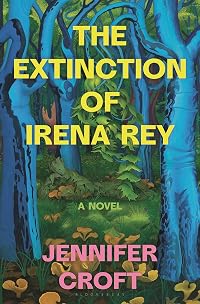
The Extinction of Irena Rey
by Jennifer Croft
On This Page
Description
From the International Booker Prize-winning translator and Women's Prize finalist, an utterly beguiling novel about eight translators and their search for a world-renowned author who goes missing in a primeval Polish forest. Eight translators arrive at a house in a primeval Polish forest on the border of Belarus. It belongs to the world-renowned author Irena Rey, and they are there to translate her magnum opus, Gray Eminence. But within days of their arrival, Irena disappears without a show more trace. The translators, who hail from eight different countries but share the same reverence for their beloved author, begin to investigate where she may have gone while proceeding with work on her masterpiece. They explore this ancient wooded refuge with its intoxicating slime molds and lichens and study her exotic belongings and layered texts for clues. But doing so reveals secrets-and deceptions-of Irena Rey's that they are utterly unprepared for. Forced to face their differences as they grow increasingly paranoid in this fever dream of isolation and obsession, soon the translators are tangled up in a web of rivalries and desire, threatening not only their work but the fate of their beloved author herself. This hilarious, thought-provoking debut novel is a brilliant examination of art, celebrity, the natural world, and the power of language. It is an unforgettable, unputdownable adventure with a small but global cast of characters shaken by the shocks of love, destruction, and creation in one of Europe's last great wildernesses. show lessTags
Recommendations





Member Reviews
The premise--a translation of a story about translators and translation authored by a translator--is clever, yes. What I didn't expect was the humor that springs up like an unexpected mushroom in a field of moss. That gives it a 3. 75 for me.
There are moments of meta-translation like:
"Her face was the white of a freshly laundered sheet that someone other than me had laundered. (My laundry always turns out beige or gray.)" In this humble offering from Emi, we see how imagery in translation always connects to experience in one way or the other (remembering that the text we are reading was in fact written in Spanish, and we are reading it translated into English). Croft skillfully uses the slightly askew simile to call out some of the show more challenges of translation. But this is all operating on a deeper level, and occasionally detracts from surface-level enjoyment of the book.
The book is complex, sometimes overly so, and the narrator becomes increasingly unlikeable in her high-school level emotional intelligence (this is, however, somewhat soothed by the occasional footquips (as opposed to footnotes) from the translator (Alexis), who is somewhat of an arch-nemesis figure for the author (Emi) throughout most of the book (although the reason why is never totally clear, save for Emi's need to assign blame somewhere)). Apologies for the excessive parentheses in the previous sentence. The descriptions of nature and fungi are beautiful, but we are quickly yanked out of any idyll of the primeval Polish forest toward a speculative fiction that resembles Mr. Toad's Wild Ride. There's a lot of ideological whiplash and flights of fancy that did not enrich my experience of the book, clever thought it is. There's a mystery too -- the titular Irena Rey goes missing-- but I stopped caring too soon in the book.
I am glad I read it, and there were definitely parts of the book I thought were glorious in prose and imagination. But at the end I felt I had finished putting together a piece of furniture, and found myself looking at several screws and bolt or two that were "left over." show less
There are moments of meta-translation like:
"Her face was the white of a freshly laundered sheet that someone other than me had laundered. (My laundry always turns out beige or gray.)" In this humble offering from Emi, we see how imagery in translation always connects to experience in one way or the other (remembering that the text we are reading was in fact written in Spanish, and we are reading it translated into English). Croft skillfully uses the slightly askew simile to call out some of the show more challenges of translation. But this is all operating on a deeper level, and occasionally detracts from surface-level enjoyment of the book.
The book is complex, sometimes overly so, and the narrator becomes increasingly unlikeable in her high-school level emotional intelligence (this is, however, somewhat soothed by the occasional footquips (as opposed to footnotes) from the translator (Alexis), who is somewhat of an arch-nemesis figure for the author (Emi) throughout most of the book (although the reason why is never totally clear, save for Emi's need to assign blame somewhere)). Apologies for the excessive parentheses in the previous sentence. The descriptions of nature and fungi are beautiful, but we are quickly yanked out of any idyll of the primeval Polish forest toward a speculative fiction that resembles Mr. Toad's Wild Ride. There's a lot of ideological whiplash and flights of fancy that did not enrich my experience of the book, clever thought it is. There's a mystery too -- the titular Irena Rey goes missing-- but I stopped caring too soon in the book.
I am glad I read it, and there were definitely parts of the book I thought were glorious in prose and imagination. But at the end I felt I had finished putting together a piece of furniture, and found myself looking at several screws and bolt or two that were "left over." show less
Unreliable Author & Translator Mystery Fun
Review of the Bloomsbury Publishing hardcover & eBook (March 5, 2024) read via a NetGalley Kindle ARC (downloaded February 14, 2024).
You may be familiar with the unreliable narrator trope in literature but what if the author and their translators themselves are the unreliable ones? The Extinction of Irena Rey finds eight translators attending a translator ‘summit’ at the residence of their star Polish author Irena Rey in the primeval forest in Białowieża, Poland nearby to the border with Belarus. They are there to supposedly translate the author’s 10th work and expected magnum opus Grey Eminence, but soon after their arrival the author disappears. Can the translators be relied upon to show more accurately complete their work unsupervised?
Initially the translators are named only by their languages, so we meet the characters: English, Spanish, Swedish, German, French, Serbian, Slovenian and Ukrainian. Soon we learn their names, of which Emilia (aka Spanish) and Alexis (aka English) are most prominent. The whole book is Emilia’s memoir of the 2017 summit, written in Polish and translated in English by Alexis a decade after the event. Emilia sees Alexis as a rival however, due to competing translation styles but also for the affection of Freddie (aka Swedish). Events spiral out of control with attempted assassinations, pistols at dawn duels, false flag instagrams and author impersonations piling on until a cross-country journey leads to a final revelation.
Crazed lustful translators who battle with other translators eager to assume the identity of their mutual author make for one bizarre and fun literary novel. There is the especial delight of the often sardonic footnotes provided by Alexis who thereby seeks to correct her portrayal as the villainess translator by Emilia. The whole package is enhanced by obviously being a comic satire inspired by Croft’s own real-life experiences translating eminent Polish author Olga Tokarczuk and their mutual win of the 2018 International Booker Prize leading up to Tokarczuk’s 2018 Nobel Prize for Literature. Tokarczuk’s own ‘magnum opus’ The Books of Jacob (2014) appeared soon after in English translation by Croft in 2021.
My thanks to author Jennifer Croft, publisher Bloomsbury Publishing and NetGalley for the opportunity to read this preview ARC, in exchange for which I provide this honest review.
Other Reviews
Eight Translators Lost in a Forest by Carey O’Grady, The Guardian, March 2, 2024.
Soundtrack
I didn’t have to look very far at all for this one. Direct from the author’s acknowledgements is listed “an album titled The Suspended Harp of Babel by Vox Clamantis (an Estonian choir) and Jaan-Eik Tulve (who directed the choir), which I must have listened to ten thousand times over the course of creating The Extinction of Irena Rey”.
You can listen to a sample track composed by Estonian composer Cyrillus Kreek (1889-1962) “Päeval ei pea päikene“ (The Sun Shall Not Smite Thee) here.
Trivia and Link
Jennifer Croft is interviewed about the novel on NPR which you can read or listen to here on Author Interviews with Scott Simon, March 2, 2024. show less
Review of the Bloomsbury Publishing hardcover & eBook (March 5, 2024) read via a NetGalley Kindle ARC (downloaded February 14, 2024).
You may be familiar with the unreliable narrator trope in literature but what if the author and their translators themselves are the unreliable ones? The Extinction of Irena Rey finds eight translators attending a translator ‘summit’ at the residence of their star Polish author Irena Rey in the primeval forest in Białowieża, Poland nearby to the border with Belarus. They are there to supposedly translate the author’s 10th work and expected magnum opus Grey Eminence, but soon after their arrival the author disappears. Can the translators be relied upon to show more accurately complete their work unsupervised?
Initially the translators are named only by their languages, so we meet the characters: English, Spanish, Swedish, German, French, Serbian, Slovenian and Ukrainian. Soon we learn their names, of which Emilia (aka Spanish) and Alexis (aka English) are most prominent. The whole book is Emilia’s memoir of the 2017 summit, written in Polish and translated in English by Alexis a decade after the event. Emilia sees Alexis as a rival however, due to competing translation styles but also for the affection of Freddie (aka Swedish). Events spiral out of control with attempted assassinations, pistols at dawn duels, false flag instagrams and author impersonations piling on until a cross-country journey leads to a final revelation.
Crazed lustful translators who battle with other translators eager to assume the identity of their mutual author make for one bizarre and fun literary novel. There is the especial delight of the often sardonic footnotes provided by Alexis who thereby seeks to correct her portrayal as the villainess translator by Emilia. The whole package is enhanced by obviously being a comic satire inspired by Croft’s own real-life experiences translating eminent Polish author Olga Tokarczuk and their mutual win of the 2018 International Booker Prize leading up to Tokarczuk’s 2018 Nobel Prize for Literature. Tokarczuk’s own ‘magnum opus’ The Books of Jacob (2014) appeared soon after in English translation by Croft in 2021.
My thanks to author Jennifer Croft, publisher Bloomsbury Publishing and NetGalley for the opportunity to read this preview ARC, in exchange for which I provide this honest review.
Other Reviews
Eight Translators Lost in a Forest by Carey O’Grady, The Guardian, March 2, 2024.
Soundtrack
I didn’t have to look very far at all for this one. Direct from the author’s acknowledgements is listed “an album titled The Suspended Harp of Babel by Vox Clamantis (an Estonian choir) and Jaan-Eik Tulve (who directed the choir), which I must have listened to ten thousand times over the course of creating The Extinction of Irena Rey”.
You can listen to a sample track composed by Estonian composer Cyrillus Kreek (1889-1962) “Päeval ei pea päikene“ (The Sun Shall Not Smite Thee) here.
Trivia and Link
Jennifer Croft is interviewed about the novel on NPR which you can read or listen to here on Author Interviews with Scott Simon, March 2, 2024. show less
An extremely compelling setup for a novel, not just within the confines of the fictional story itself but due to the biography of the author: Jennifer Croft is an award winning translator of Polish novels, including from the Nobel winning Olga Tokarczuk; her book tells the fictional tale of a group of translators who have arrived in Bialowieza for a summit to translate the newest novel from a Nobel-favorite novelist who demands complete loyalty (the demand to only translate her works, as well as follow several esoteric rules) but keeps a host of secrets from each of them. Even more cleverly, the author of this fictional account is the Spanish translator, while the work we are reading is ostensibly translated into English by another show more translator who happens to be the subject of much scrutiny from said author, and is only given the space of a handful of translators footnotes with which to defends herself (as well as the possibility that she is maybe skewing the translation to make her into more of a victim). What follows is a compelling mystery not only concerning the disappearance of the novelist shortly after the summit begins, but also how much of this account is skewed to the point of view of either to Spanish author or the English translator, with a lot to think about regarding the very nature of translation itself. show less
This is a novel written by a translator about a translator who writes about her experiences and her story is given to another translator to translate into English for us to read. The English translator is also a character in the translator's story, and not just a translator, the villain of the story.
From the Translator's note:
Part of the plot is inspired by true events, and although I can't say which part, I can say that my partner is a lawyer--an excellent lawyer, with extensive experience in criminal defense--and that we live in Mongolia, which has no extradition treaty with Poland, or, for that matter, the United States.
Eight translators arrive at the home of the famous Polish author, they have spent their careers translating, a home show more located on the edge of the Białowieża forest, ready to work on her latest novel. Soon after they arrive, she disappears and the translators set out to solve the mystery. Is she somewhere in the mysterious, fungi-ridden forest, or is she in the house or in some European city? They explore the town, talk to the hostile villagers, sort through her belongings and begin working on the translation as strange things happen and relationships form or grow hostile. Our protagonist, the Spanish-language translator, is attracted to the newest translator from Sweden and sees the English translator as her rival. Things get wild, often literally so.
I often don't enjoy novels like this. If things go off the rails and events seem random, I have a hard time being invested in a story. What are the stakes if some random weirdness can show up to move the plot along? But somehow, for me, this novel toed the line but didn't cross it and I was entertained by the antics and the self-obsessed nature of the main character, which may have been how she was or also how the English translator chose to portray her. There were fun layers to this one. show less
From the Translator's note:
Part of the plot is inspired by true events, and although I can't say which part, I can say that my partner is a lawyer--an excellent lawyer, with extensive experience in criminal defense--and that we live in Mongolia, which has no extradition treaty with Poland, or, for that matter, the United States.
Eight translators arrive at the home of the famous Polish author, they have spent their careers translating, a home show more located on the edge of the Białowieża forest, ready to work on her latest novel. Soon after they arrive, she disappears and the translators set out to solve the mystery. Is she somewhere in the mysterious, fungi-ridden forest, or is she in the house or in some European city? They explore the town, talk to the hostile villagers, sort through her belongings and begin working on the translation as strange things happen and relationships form or grow hostile. Our protagonist, the Spanish-language translator, is attracted to the newest translator from Sweden and sees the English translator as her rival. Things get wild, often literally so.
I often don't enjoy novels like this. If things go off the rails and events seem random, I have a hard time being invested in a story. What are the stakes if some random weirdness can show up to move the plot along? But somehow, for me, this novel toed the line but didn't cross it and I was entertained by the antics and the self-obsessed nature of the main character, which may have been how she was or also how the English translator chose to portray her. There were fun layers to this one. show less
This has gotten mixed reviews, but I loved it. A group of translators to work on the newest novel of a eminent Polish novelist. A number of events ensue, involving crime, deception, and fungi. The story is told by the Spanish translator, who is from Argentina. This is translated by the English translator, an American. The two don't get along at all, and the English translator includes a number of footnotes commenting on the unreliability of the storyteller. So it's double, or maybe triple, unreliable narrator, and one is left still unclear about what actually happened. Lots to think about in terms of the role of translators and also of hero-worship and who owns a story.
Eight translators, at first known only by the languages they translate into, gather at the home of their beloved author Irena Rey to translate her forthcoming magnum opus. But Irena goes missing, and the translators run amok in increasingly bizarre and absurd ways. The book, actually written by translator Jennifer Croft, purports to be written in Polish by one of the translators (Spanish) and is being translated by her arch-nemesis English, who leaves little nastygrams in footnotes to the text. It was a fun romp with some more serious points about climate change, despoiling the environment, the sixth mass extinction, and appropriation. But it was too zany and absurd for me to take it entirely seriously.
This story has rented a room in my mind and plans to stay there for a while. It's memorable and so unique! The multiple POVs are fantastic and play into the "who's the reliable narrator?" thoughts the reader entertains throughout. Some readers will dislike the ending; however, I LOVED it!!
My complaint about this book is that it moved a little too slowly, and I wanted more from the Polish mythology elements introduced.
My complaint about this book is that it moved a little too slowly, and I wanted more from the Polish mythology elements introduced.
Members
- Recently Added By
Lists

Novels featuring language professionals
98 works; 12 members

2025 Tournament of Books
18 works; 8 members

Books We Discovered On LibraryThing
530 works; 130 members
Top Five Books of 2025
954 works; 303 members

2025 Christmas Gifts
70 works; 19 members
Author Information
2+ Works 445 Members
Awards and Honors
Awards
Distinctions
The Guardian Book of the Day (2024-03-05)
The Guardian Book of the Day (2024-03-02)
Common Knowledge
- Original publication date
- 2024
- Important places
- Białowieża, Poland
- Epigraph
- And so, they forged their duality into a oneness, thereby making a forest.
—SUZANNE SIMARD - Dedication
- A Nora Insúa
- First words
- This has been the hardest book I've ever had to translate.
- Last words
- (Click to show. Warning: May contain spoilers.)She was elsewhere, safe now, and the world would be hearing from her soon.
Classifications
Statistics
- Members
- 339
- Popularity
- 93,536
- Reviews
- 19
- Rating
- (3.50)
- Languages
- English, Spanish
- Media
- Paper, Audiobook, Ebook
- ISBNs
- 11
- ASINs
- 3