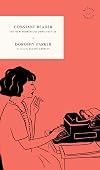
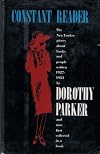
Constant Reader
by Dorothy Parker
On This Page
Description
"Thirty-one, in part or in full, of the forty-six Constant Reader pieces are gathered here for the first time in book form. They not only belong with the body of her work, but also express the essence of the period in a telling way"--Front jacket flap.Tags
Recommendations


















Member Reviews
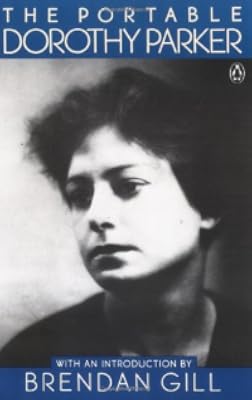
After I read The Portable Dorothy Parker - and this time finished the whole thing - I really wanted more of Parker's book reviews. Although the Portable Parker edition I had said it contained all of them, I somehow couldn't help but hope I'd missed some. So when I saw the (now out of print) Constant Reader on Amazon I couldn't resist.
This is a collection of 31 of Parker's columns reviewing books in The New Yorker, from 1927 through 1933. The book's introduction says there are 46 in total, so I must recheck how many the Portable Parker contains.
From the introduction/Publisher's Note:
A now few quotes from the reviews, to give you a taste of why I wish there were more.
From a review of the book, Happiness, by (Professor) William Lyon Phelps, words in parentheses are also Parker's. Review title: The Professor Goes in for Sweetness and Light; November 5, 1927:
[I am now doomed to think of all of those authors as Happiness Boys forever after, and giggle over it.]
Review of the book, It, by Elinor Glyn. Review title: Madame Glyn Lectures on "It," with Illustrations; November 26, 1927. All you need to know about this is that it's a romance novel (sort of):
[Ok, I have to go on and add these bits on the vibrating, because I laughed to the point of making an unattractive snorting noise:]
Review of the books, Favorite Jokes of Famous People, by Bruce Barton; The Technique of the Love Affair by "A Gentlewoman." (Actually by Doris Langley Moore.) Review title: Wallflower's Lament; November 17, 1928. Again, that's Parker within the parenthesis too:
I loved her even more for poking fun at herself for not using the first person. She'd been using third person for several paragraphs before - and it's hard to transition from that gracefully.
I should assure you at this point that Parker does review some good books, it's just that to give you the best idea of the fun it's too tempting to pull out the ones she mocks or was bored with. She seems to enjoy those quite a bit herself - which probably has something to do with why I like reading these so much.. show less
This is a collection of 31 of Parker's columns reviewing books in The New Yorker, from 1927 through 1933. The book's introduction says there are 46 in total, so I must recheck how many the Portable Parker contains.
From the introduction/Publisher's Note:
p. v "...It was an open secret that "Constant Reader" was Dorothy Parker, though her name never appeared. Her original books of poems and short stories wereshow more
being published in those same years, but no one collected the Constant Reader pieces - partly, perhaps, because of the convention of pseudonymity, which would have prevented the use of her name.
A now few quotes from the reviews, to give you a taste of why I wish there were more.
From a review of the book, Happiness, by (Professor) William Lyon Phelps, words in parentheses are also Parker's. Review title: The Professor Goes in for Sweetness and Light; November 5, 1927:
p. 19-20 "..."Hence," goes on the professor, "definitions of happiness are interesting." I suppose the best thing to do with that is to let is pass. Me, I never saw a definition of happiness that could detain me after train-time, but that may be a matter of lack of opportunity, of inattention, or of congenital rough luck. If definitions of happiness can keep Professor Phelps on his toes, that is little short of dandy. We might just as well get on along to the next statement, which goes like this: "One of the best" (we are still on definitions of happiness) "was given in my Senior year at college by Professor Timothy Dwight: 'The happiest person is the person who thinks the most interesting thoughts.'" Promptly one starts recalling such Happiness Boys as Nietzche, Socrates, de Maupassant, Jean-Jacques Rousseau, William Blake, and Poe."
[I am now doomed to think of all of those authors as Happiness Boys forever after, and giggle over it.]
Review of the book, It, by Elinor Glyn. Review title: Madame Glyn Lectures on "It," with Illustrations; November 26, 1927. All you need to know about this is that it's a romance novel (sort of):
p. 23-24 "...I have read but little of Madame Glyn. I did not know that things like "It" were going on. I have misspent my days. When I think of all those hours I flung away in reading William James and Santayana, when I might have been reading of life, throbbing, beating, perfumed life, I practically break down. Where, I ask you, have I been, that no true word of Madame Glyn's literary feats has come to me?
But even those far, far better informed than I must work a bit over the opening sentence of Madame Glyn's foreword to her novel" "This is not," she says, drawing her emeralds warmly about her, "the story of the moving picture entitled It, but a full character study of the story It, which the people in the picture read and discuss." I could go mad, in a nice way, straining to figure that out."
[Ok, I have to go on and add these bits on the vibrating, because I laughed to the point of making an unattractive snorting noise:]
p. 26-27 "...Well it turns out that Ava and John meet, and he begins promptly to "vibrate with passion." ...
...It goes on for nearly three hundred pages, with both of them vibrating away like steam launches."
Review of the books, Favorite Jokes of Famous People, by Bruce Barton; The Technique of the Love Affair by "A Gentlewoman." (Actually by Doris Langley Moore.) Review title: Wallflower's Lament; November 17, 1928. Again, that's Parker within the parenthesis too:
p. 103 "...It's not that she has not tried to improve her condition before acknowledging its hopelessness. (Oh, come on, let's get the hell out of this, and get into the first person.) I have sought, by study, to better my form and make myself Society's Darling. You see, I had been fed, in my youth, a lot of old wives' tales about the way men would instantly forsake a beautiful woman to flock about a brilliant one. It is but fair to say that, after getting out in the world, I had never seen this happen, but I thought that maybe I might be the girl to start the vogue. I would become brilliant. I would sparkle. I would hold whole dinner tables spellbound. I would have throngs fighting to come within hearing distance of me while the weakest, elbowed mercilessly to the outskirts, would cry "What did she say?" or "Oh, please ask her to tell it again." That's what I would do. Oh I could just hear myself."
I loved her even more for poking fun at herself for not using the first person. She'd been using third person for several paragraphs before - and it's hard to transition from that gracefully.
I should assure you at this point that Parker does review some good books, it's just that to give you the best idea of the fun it's too tempting to pull out the ones she mocks or was bored with. She seems to enjoy those quite a bit herself - which probably has something to do with why I like reading these so much.. show less
Dorothy Parker's complete New Yorker columns from 1927 to 1928. What can I say but she had a unique voice. A real character. She wasn't an intellectual, but she WAS pretty damn hilarious and very, very clever.
Parker's writing hits the spot.
Ratings
Members
- Recently Added By
Lists

READ 2025
190 works; 1 member

Books Read in 2025
4,128 works; 98 members
Author Information

147+ Works 10,284 Members
Poet and short story writer Dorothy Parker was born in New Jersey on August 22, 1893. When she was 5, her mother died and her father, a clothes salesman, remarried. Parker had a great antipathy toward her stepmother and refused to speak to her. She attended parochial school and Miss Dana's school in Morristown, New Jersey, for a brief time before show more dropping out at age 14. A voracious reader, she decided to pursue a career in literature. She began her career by writing verse as well as captions for a fashion magazine. During the years of her greatest fame, Dorothy Parker was known primarily as a writer of light verse, an essential member of the Algonquin Round Table, and a caustic and witty critic of literature and society. She is remembered now as an almost legendary figure of the 1920s and 1930s. Her reviews and staff contributions to three of the most sophisticated magazines of this century, Vanity Fair, the New Yorker, and Esquire, were notable for their put-downs. For all her highbrow wit, however, Dorothy Parker was liberal, even radical, in her political views, and the hard veneer of brittle toughness that she showed to the world was often a shield for frustrated idealism and soft sensibilities. The best of her fiction is marked by a balance of ironic detachment and sympathetic compassion, as in "Big Blonde," which won the O. Henry Award for 1929 and is still her best-remembered and most frequently anthologized story. The best of Dorothy Parker is readily and compactly accessible in The Portable Dorothy Parker. Her own selection of stories and verse for the original edition of that compilation, published in 1944, remains intact in the revised edition, but included also are additional stories, reviews, and articles. Parker died of a heart attack at the age of 73 in 1967. In her will, she bequeathed her estate to the Dr. Martin Luther King, Jr. foundation. Following King's death, her estate was passed on to the NAACP. (Bowker Author Biography) show less
Series
Belongs to Publisher Series
McNally Editions (34)
Classifications
- Genres
- Nonfiction, Literature Studies and Criticism, General Nonfiction
- DDC/MDS
- 081 — Computer science, information & general works Anthologies and Quotations General collections in American English
- LCC
- PS3531 .A5855 .A6 — Language and Literature American literature American literature Individual authors 1900-1960
- BISAC
Statistics
- Members
- 139
- Popularity
- 235,940
- Reviews
- 3
- Rating
- (4.10)
- Languages
- English
- Media
- Paper, Ebook
- ISBNs
- 3
- ASINs
- 2