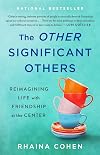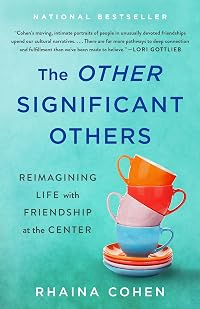
The Other Significant Others: Reimagining Life with Friendship at the Center
by Rhaina Cohen
On This Page
Description
Why do we place romantic partnership on a pedestal? What do we lose when we expect one person to meet all our needs? And what can we learn about commitment, love, and family from people who put deep friendship at the center of their lives? In "The Other Significant Others", NPR's Rhaina Cohen invites us into the lives of people who have defied convention by choosing a friend as a life partner. Their riveting stories unsettle widespread assumptions about relationships, including the idea that show more sex is a defining feature of partnership and that people who raise kids together should be in a romantic relationship. Platonic partners from different walks of life-spanning age and religion, gender and sexuality and more-reveal the freedom and challenges of embracing a relationship model that society doesn't recognize. And they show that orienting your world around friends isn't just the stuff of daydreams and episodes of The Golden Girls, but possible in real life. Based on years of original reporting and drawing on striking social science research, Cohen argues that we make romantic relationships more fragile by expecting too much of them, while we undermine friendships by expecting too little of them. She traces how, throughout history, our society hasn't always fixated on marriage as the greatest source of meaning, or even love. At a time when many Americans are spending large stretches of their lives single, widowed, or divorced, or feeling the effects of the "loneliness epidemic," Cohen makes the case that one model of a flourishing adulthood-lifelong romantic partnership-isn't enough. A rousing and incisive book, "The Other Significant Others" challenges us to ask what we want from our relationships-not just what we're supposed to want-and transforms how we define a fulfilling life. show lessTags
Recommendations














Member Reviews
This book explores the essential roles that non-romantic partnerships play in our lives. Through a series of detailed examples, it describes the deep connections we share with friends and platonic partners, relationships that are often undervalued by legal systems and social norms. This book addresses the limitations of language, as we lack terms to describe these powerful connections properly, and she challenges the assumption that intimacy must involve a sexual component. I was especially moved by the discussion on co-parenting without a romantic foundation and the unique grief that comes with losing a best friend, grief that we don’t often recognize as equal to that of a romantic partner. Listening to this inspired me to appreciate show more my friendships more deeply. Thought-provoking and accessible, this book is a great reminder to value all meaningful connections. show less
Rhaina Cohen is a journalist who has taken her own experience of friendship as a stepping off point to write this wonderful treatise on friendship and how it should be, is already, at the core of how people get through life. But what is really important is how she raises awareness of how the law and our institutions should change to recognise this movement.
There are many touching and mind-blowing examples of friendship - between older people, about the stand-in parent friend, about the person who helps a sick friend.
(An aside) My heart sank when I began the book and realised the author was reading it in her staccato voice but I decided to push on. It took maybe 30 mins to stop finding it jarring and another 30 mins not to notice it too show more much.
All I can say, once again, is, publishers! no matter how much you might argue that authenticity is the way to go - wrong! This listener will always prefer a trained actor's voice and delivery, and it will always do more for the author's reputation and the book's contents.
(Later) I've just read your comment below, Griffin_Reads. It's a good point you make that this book is about platonic relationships that move into the partner role. The book is not about the usual platonic relationship, the everyday sort of friendships that we usually think of if I said I was reading a book about friendship.
That fact agreed, that's exactly what intrigued me - to see friendships push into that partner realm.
It's not that I haven't seen that - I've even experienced it myself - I just hadn't thought of a central platonic relationship in the way that Cohen puts it - that it might be, perhaps should be, regarded as equal to a "partner". The life partner/significant other role can be filled by a platonic friend, not a romantic partner. (The Other Significant Other is a great title).
Another example is from the author's own life: she and her husband live in a home that's shared with another couple, and their children. Here, it is not the role usually filled by a romantic partner that is replaced by close platonic friends, but nuclear family members.
I feel stupid - not seeing, or naming, that the partner/significant other role can be filled by people acknowledged as "close platonic friends". When I think about it, an awful lot of romantic partners, ie husbands and wives, evolve into being platonic friend partners, and "romance" plays a very minor role, if any. However, I guess I've been blinkered by associating a level of intimacy, physical and mental, between these type of "friends" because they started out in a different place, ie as romantic partners, and somehow more truly partners?
The platonic friends who get to partner status, or nuclear family status, in Cohen's examples, have come in through a different door. Still, the level of love - caring, tenderness, regard, self-sacrifice - is no less potent. show less
There are many touching and mind-blowing examples of friendship - between older people, about the stand-in parent friend, about the person who helps a sick friend.
(An aside) My heart sank when I began the book and realised the author was reading it in her staccato voice but I decided to push on. It took maybe 30 mins to stop finding it jarring and another 30 mins not to notice it too show more much.
All I can say, once again, is, publishers! no matter how much you might argue that authenticity is the way to go - wrong! This listener will always prefer a trained actor's voice and delivery, and it will always do more for the author's reputation and the book's contents.
(Later) I've just read your comment below, Griffin_Reads. It's a good point you make that this book is about platonic relationships that move into the partner role. The book is not about the usual platonic relationship, the everyday sort of friendships that we usually think of if I said I was reading a book about friendship.
That fact agreed, that's exactly what intrigued me - to see friendships push into that partner realm.
It's not that I haven't seen that - I've even experienced it myself - I just hadn't thought of a central platonic relationship in the way that Cohen puts it - that it might be, perhaps should be, regarded as equal to a "partner". The life partner/significant other role can be filled by a platonic friend, not a romantic partner. (The Other Significant Other is a great title).
Another example is from the author's own life: she and her husband live in a home that's shared with another couple, and their children. Here, it is not the role usually filled by a romantic partner that is replaced by close platonic friends, but nuclear family members.
I feel stupid - not seeing, or naming, that the partner/significant other role can be filled by people acknowledged as "close platonic friends". When I think about it, an awful lot of romantic partners, ie husbands and wives, evolve into being platonic friend partners, and "romance" plays a very minor role, if any. However, I guess I've been blinkered by associating a level of intimacy, physical and mental, between these type of "friends" because they started out in a different place, ie as romantic partners, and somehow more truly partners?
The platonic friends who get to partner status, or nuclear family status, in Cohen's examples, have come in through a different door. Still, the level of love - caring, tenderness, regard, self-sacrifice - is no less potent. show less
Overall, The Other Significant Others was decent, but slightly mis-marketed.
It was nice hearing about the stories of these different people and how they came to build a friendship outside of the status quo. The information and stories presented were good and effective, and I agreed with many of Cohen's topics and arguments throughout the book.
The use of the word "Reimagining" in the title, though, can imply a sort-of "how-to." It was definitely geared more towards people who have been in the status-quo but are less than thrilled with it and looking to learn how other people live their lives and new practices to incorporate into their own. But, it only tells the reader that these closer friendships are okay, and doesn't explore how to show more actually go about deepening those friendships. It also has a very heavy lean on queer platonic relationships and legal rights surrounding children, medical decisions, and inheritance of those relationships, and does not focus on relationships which may not want to incorporate a more "partner" role or "legal" role.
As someone who knows more about polyamory and queer platonic relationships, this book presented nothing new. While they were good stories, it's all stuff I've heard before. show less
It was nice hearing about the stories of these different people and how they came to build a friendship outside of the status quo. The information and stories presented were good and effective, and I agreed with many of Cohen's topics and arguments throughout the book.
The use of the word "Reimagining" in the title, though, can imply a sort-of "how-to." It was definitely geared more towards people who have been in the status-quo but are less than thrilled with it and looking to learn how other people live their lives and new practices to incorporate into their own. But, it only tells the reader that these closer friendships are okay, and doesn't explore how to show more actually go about deepening those friendships. It also has a very heavy lean on queer platonic relationships and legal rights surrounding children, medical decisions, and inheritance of those relationships, and does not focus on relationships which may not want to incorporate a more "partner" role or "legal" role.
As someone who knows more about polyamory and queer platonic relationships, this book presented nothing new. While they were good stories, it's all stuff I've heard before. show less
4.5⭐️ rounded up
Ratings
Members
- Recently Added By
Lists

The Best LGBTQ Nonfiction
125 works; 51 members
Author Information
1 Work 150 Members
Awards and Honors
Awards
Distinctions
Notable Lists
Classifications
- Genres
- Sociology, Philosophy, General Nonfiction, Nonfiction, Biography & Memoir
- DDC/MDS
- 177.62 — Philosophy & psychology Ethics Ethics of social relations Friendship - Courtship - Coquetry Friendship
- LCC
- BF575 .F66 .C634 — Philosophy, Psychology and Religion Psychology Psychology Affection. Feeling. Emotion
- BISAC
Statistics
- Members
- 150
- Popularity
- 217,693
- Reviews
- 4
- Rating
- (4.13)
- Languages
- English
- Media
- Paper, Audiobook, Ebook
- ISBNs
- 4
- ASINs
- 2