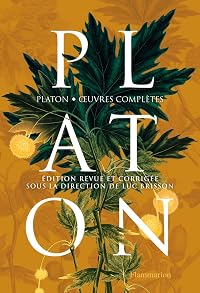
Œuvres complètes
by Plato (Author), Luc Brisson (Editor)
On This Page
Tags
Members
- Recently Added By
Author Information

Plato was born c. 427 B.C. in Athens, Greece, to an aristocratic family very much involved in political government. Pericles, famous ruler of Athens during its golden age, was Plato's stepfather. Plato was well educated and studied under Socrates, with whom he developed a close friendship. When Socrates was publically executed in 399 B.C., Plato show more finally distanced himself from a career in Athenian politics, instead becoming one of the greatest philosophers of Western civilization. Plato extended Socrates's inquiries to his students, one of the most famous being Aristotle. Plato's The Republic is an enduring work, discussing justice, the importance of education, and the qualities needed for rulers to succeed. Plato felt governors must be philosophers so they may govern wisely and effectively. Plato founded the Academy, an educational institution dedicated to pursuing philosophic truth. The Academy lasted well into the 6th century A.D., and is the model for all western universities. Its formation is along the lines Plato laid out in The Republic. Many of Plato's essays and writings survive to this day. Plato died in 347 B.C. at the age of 80. (Bowker Author Biography) show less

Common Knowledge
- Canonical title*
- Oeuvres complètes
- Original publication date
- xxxx; 2008-10-06 (1e édition française, Flammarion) (1e édition française, Flammarion); 2023-05-24 (Nouvelle édition française revue et révisée, Flammarion) (Nouvelle édition française revue et révisée, Flammarion)
- First words*
- Platon pour notre temps
Platon est un auteur classique que l'on prend plaisir à relire, un écrivain hors pair. Lui qui donna au terme « philosophie » le sens qui est toujours le sien aujourd'hui reste, aprè... (show all)s plus de deux millénaires, le philosophe par excellence. Après le XXe siècle, qui fut le siècle des idéologies, du prêt-à-penser, il semble que nous devions désormais tout reprendre à zéro : nous redevenons les contemporains de Socrate qui, dans les rues d'Athènes et sur la place publique, discutait avec ceux qui l'entouraient de ce qui fait la valeur d'une vie humaine, de ce qui motive telle ou telle action individuelle ou civique, des buts que poursuivent l'individu et la cité. [...] - Original language*
- Grec ancien
- Disambiguation notice*
- Nouvelle édition revue et corrigée, 2023
Contient :
Alcibiade - Second Alcibiade - Alcyon - Apologie de Socrate - Axiochos - Le Banquet - Charmide - Clitophon - Cratyle - Critias - Criton - Définitions - D... (show all)émodocos - Épigrammes - Épinomis - Eryxias - Euthydème - Euthyphron - Gorgias - Hipparque - Hippias majeur - Hippias mineur - Ion - Sur le Juste - Lachès - Lettres - Les Lois - Lysis - Ménexène - Ménon - Minos - Parménide - Phédon - Phèdre - Philèbe - Le Politique - Protagoras - La République - Les Rivaux - Sisyphe - Le Sophiste - Théagès - Théétète - Timée - Sur la Vertu
*Some information comes from Common Knowledge in other languages. Click "Edit" for more information.
Classifications
Statistics
- Members
- 4
- Popularity
- 3,966,396
- Languages
- French
- Media
- Paper
- ISBNs
- 1