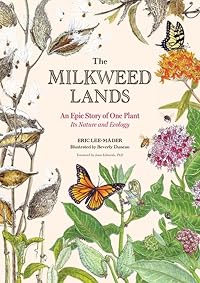
The Milkweed Lands: An Epic Story of One Plant: Its Nature and Ecology
by Eric Lee-Mäder
On This Page
Description
"Ecologist Eric Lee-Mäder and noted botanical artist Beverly Duncan have teamed up to create this unique exploration of the complex ecosystem that is supported by the remarkable milkweed plant"-- Follow a year in the life of milkweed, and discover the remarkable role this often-overlooked plant plays in sustaining the meadow ecosystem. The text by Lee-Mäder celebrates the resilience and significance of this native North American plant and the many lives that depend on it, from bees on the show more blossoms and monarch caterpillars on the leaves to beetles in the silken pods. -- adapted from back cover. show lessTags
Recommendations










Member Reviews
The Milkweed Lands is a love letter to all milkweed plants. Written as both a natural history primer of milkweed and its ecosystem as well as the author's personal memories of milkweed and the environments it grows in creates a more personal text than strictly science text, reminding me of a nature journal. The beautiful illustrations reinforce this with amazingly annotated watercolors to showcase milkweeds, animals, habitats and scientific illustrations. Broken up into four sections, one for each season, the author takes us through the entire lifecycle of a milkweed plant as well as the many factors that affect it. I learned about milkweed as a food to humans, homes to mice, the vast soil community it supports as well as a whole host show more of other insects dependent on milkweeds other than monarchs. I also learned about the many threats to milkweeds as well as, more importantly, it's incredible resilience and ability to survive in many different environments and conditions.
This book was received for free in return for an honest review. show less
This book was received for free in return for an honest review. show less
Rating: two stars
*My thanks to NetGalley for an e-ARC in exchange for an honest review
This book is a gorgeously illustrated volume on Milkweed and its ecology. I simply cannot praise the illustrations enough, almost every other page was a delightful, engaging and accurate representation of the subject matter. The charming watercolors reminded me of a lot of books from my childhood, and maybe that made me nostalgic (?) but I stand by my assessment. Sadly, in spite of the excellent illustrations, the text itself was lackluster; being prone to unnecessary and unsupported digressions and never delved into the Milkweed, its history or ecology in depth.
This book is geared towards casual readers of ecology (such as myself), and accordingly show more the text was dumbed down quite a bit. However, more than one page read as a slightly glorified Instagram or Tumblr post, complete with vapid and insipid descriptions and analyses. I picked up this book expecting to learn about Milkweed and its ecology, not about the ‘plight’ and ‘malignment’ of the species. While this can be a valuable piece of information, the author never extended the discussion beyond casual emotional appeals and poorly executed argumentation. The usage of such language, while it most certainly could be justified, wasn’t, and appeared as little more than surface tribute to the verbiage of virtue signaling. As a successful fusion of good writing, ecology, environmental and social commentary, see Dr. Suzanne Simard’s excellent book Finding the Mother Tree.
Cross-posted on my blog show less
*My thanks to NetGalley for an e-ARC in exchange for an honest review
This book is a gorgeously illustrated volume on Milkweed and its ecology. I simply cannot praise the illustrations enough, almost every other page was a delightful, engaging and accurate representation of the subject matter. The charming watercolors reminded me of a lot of books from my childhood, and maybe that made me nostalgic (?) but I stand by my assessment. Sadly, in spite of the excellent illustrations, the text itself was lackluster; being prone to unnecessary and unsupported digressions and never delved into the Milkweed, its history or ecology in depth.
This book is geared towards casual readers of ecology (such as myself), and accordingly show more the text was dumbed down quite a bit. However, more than one page read as a slightly glorified Instagram or Tumblr post, complete with vapid and insipid descriptions and analyses. I picked up this book expecting to learn about Milkweed and its ecology, not about the ‘plight’ and ‘malignment’ of the species. While this can be a valuable piece of information, the author never extended the discussion beyond casual emotional appeals and poorly executed argumentation. The usage of such language, while it most certainly could be justified, wasn’t, and appeared as little more than surface tribute to the verbiage of virtue signaling. As a successful fusion of good writing, ecology, environmental and social commentary, see Dr. Suzanne Simard’s excellent book Finding the Mother Tree.
Cross-posted on my blog show less
Ratings
Members
- Recently Added By
Lists

Habitat Hero books
37 works; 1 member
Author Information
1 Work 45 Members
Awards and Honors
Classifications
Statistics
- Members
- 45
- Popularity
- 662,910
- Reviews
- 2
- Rating
- (4.14)
- Languages
- English
- Media
- Paper, Ebook
- ISBNs
- 1
- ASINs
- 1