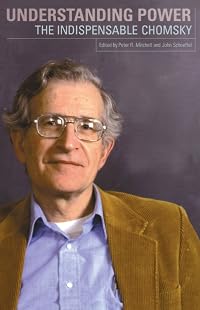
Understanding Power: The Indispensable Chomsky
by Peter R. Mitchell (Editor), Noam Chomsky, John Schoeffel (Editor)
On This Page
Description
An introduction to Noam Chomsky's views on the politics of power discusses third-party politics in the United States, the suppression of dissent, U.S. foreign and domestic policy, and the role of the media.Tags
Recommendations

Member Reviews
Before reading Understanding Power, I knew of Noam Chomsky only by his (formidable) reputation as a linguist and author of Manufacturing Consent, which I had not, at the time, read. In truth, I was prompted to buy Understanding Power - said to be a good collection of his works, having read, and been perplexed by, Chomsky's effusive praise of a less-than-convincing book about the nastiness of corporations ("The Corporation", by Joel Bakan.) I was curious as to how such a respected, academic, intelligent commentator could come to be praising such a bone-headed book.
Well, I am curious no more.
This is a nicely edited, packaged edition, which benefits from the fact that it seems to contain mostly transcripts of Socratic-style "teach-ins" show more (love-ins, more like) that Chomsky has conducted over the last few years. It's conversational and very easy to read: far from being weighed down by the carefully premeditated prose of a stuffy academic, Understanding Power positively zings with invective, humour, and oratory. Parts of it are funny (not always intentionally so), parts fascinating, Chomsky's command of the "received" facts of recent political history (and his self-declared "true" ones) is consistently impressive.
Not only does this book give you a very clear exposition of Chomsky's perspective, it is very entertaining as it does it. Credit, therefore, to the editors who have presumably sifted through weeks of audio tape, and have cleaned up and contextualised to add to the reading pleasure. They've also compiled footnotes of greater length than the text, which are available for spods online.
While his facts maybe impeccably marshalled, many of the conclusions at which Chomsky arrives - particular in the field of economics - are obviously baloney (it is basically conspiracy and paranoia writ on a scale even James Ellroy would baulk at) but it's maddeningly difficult to nail down exactly why. But this evening, in a taxi on the way home from my wage-slavery (ahem), on page 216, I nailed it: Chomsky's richest polemic is almost all unfalsifiable. There are no conceivable facts you could present to Chomsky that would lead him to say, "You know what? You're right! I've got this all completely wrong!" Arguing against Noam Chomsky would be like arguing against a born-again Christian. Facts are construed to fit the theory, and not the other way around.
That quality - falsifiability - is what distinguishes valid argument from dogma. The fact that something is capable of being proven false is what gives it explanatory traction in the world. If a statement is true for all possible circumstances, it's either circular, tautological or it bears no relation to the world we live in.
So when the stooges in his audience meekly suggest that his proposal for how to really manage an economy (namely: everyone pulls together and works towards the common good, no-one fights, no-one wants more than their fair share, everyone co-operates - utterly brilliant, isn't it?) has been tried in a few places, and it fell apart pretty quickly, Chomsky's retort is 'but that wasn't REALLY socialism! That was actually disguised CAPITALISM!' hence - objection is defined away, as opposed to being defended.
Nonetheless, there are still some glaring facts which Chomsky can't explain away: The most obvious is that if the media and corporate elites are so indoctrinated, so suppressive of "dissident" views like Chomsky's, then how can Chomsky himself have been such a roaring success? A search within Amazon on "Noam Chomsky" lists 536 books (ten times as many as for "Rush Limbaugh", five times as many as for "P J O'Rourke", and only 8 fewer than for "George Bush"!). Chomsky is a global superstar, an arch propagandist, a fantastic brand, and though he commends his disciples not to take his word for it, legions of them (most notably the slurpers who sit cross-legged at his feet in the pages of this book) simply do. No-one subjects his patter to sustained criticism - possibly because it is no more fun than arguing with a born-again Christian. I suspect what sticks in Chomsky's craw more than anything else isn't that he's suppressed by his political opponents - he simply isn't - it's that he's happily tolerated and, for the most part, ignored.
And it's not really hard to see why. On one hand, Chomsky has little enough faith in the intellectual integrity of his common man to blame the prevalence of consumerism and capitalism on his brainwashing by the media and the corporate elite, but enough faith in it to suppose that some sort of anarcho-syndicalist communal form of existence for humankind is even remotely viable. He may well be right in his first assessment (but if they're happy, so what, actually?); the second is ludicrous. But it's the only solution he can come up with - such is the poverty of his constructive analysis. It is one thing to criticise, quite another to propose a constructive alternative - and I'm afraid consensual, non coercive, state-free social planning (if by that you don't mean naked capitalism, and trust me, Chomsky doesn't) just ain't it.
Lest you think I'm exaggerating about Chomsky's skills as a propagandist, check out this little piece of disinformation: The dust jacket of Understanding Power quotes the New York Times as describing Chomsky as "arguably the most important intellectual alive". Well, if you read the book, you'll know that Chomsky is no fan of the New York Times, so I was surprised by this quote - surprised enough to Google on it to see if I could find the original. And I did: properly contextualised, it reads "...Noam Chomsky is arguably the most important intellectual alive today. He is also a disturbingly divided intellectual. On the one hand there is a large body of revolutionary and highly technical linguistic scholarship, much of it too difficult for anyone but the professional linguist or philosopher; on the other, an equally substantial body of political writings, accessible to any literate person but often maddeningly simple-minded".
Haha, Professor Chomsky: Caught red-handed! *Now* who is "manufacturing consent"?
At the end of the day, the most withering criticism of Noam Chomsky's political outlook comes not from the New York Times, but from the much-beloved satire on the anarcho-syndicalist peasant in Monty Python and the Holy Grail quoted in the title of this review.
I must say, I tend to side with King Arthur's ultimate view, as he trudges away, bored and frustrated with totally pointless conversation.
Python Afficionados will know what I mean.
Olly Buxton
*******
Clarification: When reading the book I had assumed that Chomsky was some sort of cognitive relativist. I've since spent quite a lot of time reading around Chomsky, and it turns out that he's anything but: The linguistic "nativism" championed by Noam Chomsky and Steven Pinker is perhaps the last bastion of intellectual support for moral and cognitive objectivism, and this world view is apparent (ironically) in Chomsky's political writing. My fault: I guess I just couldn't credit that anyone still seriously advanced this perspective, especially from the Left.
For when Chomsky says "seemingly unobjectionable state of affairs X is actually a malicious conspiracy Y", his criticism relies on the *falsehood* of explanation X and the *truth* of explanation Y. Cognitive relativism is no friend of Chomsky's at all: On the contrary, it undermines his position by saying that explanations X and Y are alternative descriptions of the same state of affairs, and *in the absence of data which are inconsistent with one or other explanation* ones subscription to one or the other is almost certainly a matter of historical contingency, and (*in the absence of contrary data*) there is no means of adjudicating between those explanations.
Chomsky's explanations tend to rely on "hidden hands" (conspiracies between capitalists, government agencies and so forth) which are characterised by nothing so much as their lack of evidence - indeed, this very lack of evidence of conspiracy is often the "clincher" by which Chomsky claims the conspiracy must exist. show less
Well, I am curious no more.
This is a nicely edited, packaged edition, which benefits from the fact that it seems to contain mostly transcripts of Socratic-style "teach-ins" show more (love-ins, more like) that Chomsky has conducted over the last few years. It's conversational and very easy to read: far from being weighed down by the carefully premeditated prose of a stuffy academic, Understanding Power positively zings with invective, humour, and oratory. Parts of it are funny (not always intentionally so), parts fascinating, Chomsky's command of the "received" facts of recent political history (and his self-declared "true" ones) is consistently impressive.
Not only does this book give you a very clear exposition of Chomsky's perspective, it is very entertaining as it does it. Credit, therefore, to the editors who have presumably sifted through weeks of audio tape, and have cleaned up and contextualised to add to the reading pleasure. They've also compiled footnotes of greater length than the text, which are available for spods online.
While his facts maybe impeccably marshalled, many of the conclusions at which Chomsky arrives - particular in the field of economics - are obviously baloney (it is basically conspiracy and paranoia writ on a scale even James Ellroy would baulk at) but it's maddeningly difficult to nail down exactly why. But this evening, in a taxi on the way home from my wage-slavery (ahem), on page 216, I nailed it: Chomsky's richest polemic is almost all unfalsifiable. There are no conceivable facts you could present to Chomsky that would lead him to say, "You know what? You're right! I've got this all completely wrong!" Arguing against Noam Chomsky would be like arguing against a born-again Christian. Facts are construed to fit the theory, and not the other way around.
That quality - falsifiability - is what distinguishes valid argument from dogma. The fact that something is capable of being proven false is what gives it explanatory traction in the world. If a statement is true for all possible circumstances, it's either circular, tautological or it bears no relation to the world we live in.
So when the stooges in his audience meekly suggest that his proposal for how to really manage an economy (namely: everyone pulls together and works towards the common good, no-one fights, no-one wants more than their fair share, everyone co-operates - utterly brilliant, isn't it?) has been tried in a few places, and it fell apart pretty quickly, Chomsky's retort is 'but that wasn't REALLY socialism! That was actually disguised CAPITALISM!' hence - objection is defined away, as opposed to being defended.
Nonetheless, there are still some glaring facts which Chomsky can't explain away: The most obvious is that if the media and corporate elites are so indoctrinated, so suppressive of "dissident" views like Chomsky's, then how can Chomsky himself have been such a roaring success? A search within Amazon on "Noam Chomsky" lists 536 books (ten times as many as for "Rush Limbaugh", five times as many as for "P J O'Rourke", and only 8 fewer than for "George Bush"!). Chomsky is a global superstar, an arch propagandist, a fantastic brand, and though he commends his disciples not to take his word for it, legions of them (most notably the slurpers who sit cross-legged at his feet in the pages of this book) simply do. No-one subjects his patter to sustained criticism - possibly because it is no more fun than arguing with a born-again Christian. I suspect what sticks in Chomsky's craw more than anything else isn't that he's suppressed by his political opponents - he simply isn't - it's that he's happily tolerated and, for the most part, ignored.
And it's not really hard to see why. On one hand, Chomsky has little enough faith in the intellectual integrity of his common man to blame the prevalence of consumerism and capitalism on his brainwashing by the media and the corporate elite, but enough faith in it to suppose that some sort of anarcho-syndicalist communal form of existence for humankind is even remotely viable. He may well be right in his first assessment (but if they're happy, so what, actually?); the second is ludicrous. But it's the only solution he can come up with - such is the poverty of his constructive analysis. It is one thing to criticise, quite another to propose a constructive alternative - and I'm afraid consensual, non coercive, state-free social planning (if by that you don't mean naked capitalism, and trust me, Chomsky doesn't) just ain't it.
Lest you think I'm exaggerating about Chomsky's skills as a propagandist, check out this little piece of disinformation: The dust jacket of Understanding Power quotes the New York Times as describing Chomsky as "arguably the most important intellectual alive". Well, if you read the book, you'll know that Chomsky is no fan of the New York Times, so I was surprised by this quote - surprised enough to Google on it to see if I could find the original. And I did: properly contextualised, it reads "...Noam Chomsky is arguably the most important intellectual alive today. He is also a disturbingly divided intellectual. On the one hand there is a large body of revolutionary and highly technical linguistic scholarship, much of it too difficult for anyone but the professional linguist or philosopher; on the other, an equally substantial body of political writings, accessible to any literate person but often maddeningly simple-minded".
Haha, Professor Chomsky: Caught red-handed! *Now* who is "manufacturing consent"?
At the end of the day, the most withering criticism of Noam Chomsky's political outlook comes not from the New York Times, but from the much-beloved satire on the anarcho-syndicalist peasant in Monty Python and the Holy Grail quoted in the title of this review.
I must say, I tend to side with King Arthur's ultimate view, as he trudges away, bored and frustrated with totally pointless conversation.
Python Afficionados will know what I mean.
Olly Buxton
*******
Clarification: When reading the book I had assumed that Chomsky was some sort of cognitive relativist. I've since spent quite a lot of time reading around Chomsky, and it turns out that he's anything but: The linguistic "nativism" championed by Noam Chomsky and Steven Pinker is perhaps the last bastion of intellectual support for moral and cognitive objectivism, and this world view is apparent (ironically) in Chomsky's political writing. My fault: I guess I just couldn't credit that anyone still seriously advanced this perspective, especially from the Left.
For when Chomsky says "seemingly unobjectionable state of affairs X is actually a malicious conspiracy Y", his criticism relies on the *falsehood* of explanation X and the *truth* of explanation Y. Cognitive relativism is no friend of Chomsky's at all: On the contrary, it undermines his position by saying that explanations X and Y are alternative descriptions of the same state of affairs, and *in the absence of data which are inconsistent with one or other explanation* ones subscription to one or the other is almost certainly a matter of historical contingency, and (*in the absence of contrary data*) there is no means of adjudicating between those explanations.
Chomsky's explanations tend to rely on "hidden hands" (conspiracies between capitalists, government agencies and so forth) which are characterised by nothing so much as their lack of evidence - indeed, this very lack of evidence of conspiracy is often the "clincher" by which Chomsky claims the conspiracy must exist. show less
4.5/5
A superbly dense and expansive look at Chomsky's views on labor, power, terrorism, and history through the mid 90's. Understanding Power is based on a number of talks that Chomsky gave from the early 80's through about 1997, and most of it functions like the Q & A sections after such a talk, where individuals ask questions that might have no through line between them. As such, there is hardly any structure to speak of, only that which the editors managed through grouping some of these conversation together. If you are looking for something with a structure, with rhythm, pace, or anything like a narrative, this isn't it. It doesn't try to be, that isn't the goal, but I would be lying if I said that this didn't impede me at least to show more some degree. In spite of this structure, I grew to appreciate the extensive footnotes from the editors that provide context, references, and further sources of reading if you are particularly interested in some topic, which frequently I found myself being. Sometimes the editors even insert bracketed text to explain references that may not be within the modern readers knowledge, and while I could see this being annoying for someone who lived and was aware of their circumstances through this era (1930-1990), for someone like myself it was useful to not always have to go back into the footnotes to figure out certain specifics.
Chomsky is at his best when discussing history, specifically American history, labor history, that sort of thing. His examples are plentiful and damning, and it seems like his mind has some sort of eidetic memory for all of the minutia pertaining to American foreign policy (terrorism), economic policy, and the like that goes on every day but which the mainstream media doesn't cover, at least in the way that draws people attention and gets them talking. A point I really connected with was his argument that the media is only allow to present news within a certain framework or perspective, that whatever America is doing, it's always with people's best interests at heart.
I'm not sure if I agree with him on his broad generalizations against the validity of the social sciences, despite his case. I'm also not a fan of his repeated attempts to make it clear that he thinks all of this is very simple and easy to understand. I get his point, that there isn't a prerequisite to having a valid opinion on social or political structure, and to pretend that their is one prevents workers from organizing and having belief that change can happen. We don't need these leaders that get put on pedestal to tell us what to do, but his wholesale rejection of sociology, political science, and any kind of academic thought of that nature seems brash to me.
Towards the end of these conversations there's a trend that someone will say that his perspective is quiet bleak, what can we do about all of this, is there hope, followed by Chomsky saying that there has indeed been lots of progress despite the rise of corporate power and government that is designed to aid it more than working people. I do agree with him in many ways on this point, but I'm interested to read a more contemporary work of his to see his perspective on the rise of christian nationalism. It seems that Chomsky was already sniffing a lot of these recent trends out in the 90's, especially when it comes to the authoritarian right, the neoliberal left, and the impacts of advances in technology like the internet. I doubt that we'll get another work from Chomsky, but I'm curious if still to this day he still has the same streak of optimism that we should all strive for. show less
A superbly dense and expansive look at Chomsky's views on labor, power, terrorism, and history through the mid 90's. Understanding Power is based on a number of talks that Chomsky gave from the early 80's through about 1997, and most of it functions like the Q & A sections after such a talk, where individuals ask questions that might have no through line between them. As such, there is hardly any structure to speak of, only that which the editors managed through grouping some of these conversation together. If you are looking for something with a structure, with rhythm, pace, or anything like a narrative, this isn't it. It doesn't try to be, that isn't the goal, but I would be lying if I said that this didn't impede me at least to show more some degree. In spite of this structure, I grew to appreciate the extensive footnotes from the editors that provide context, references, and further sources of reading if you are particularly interested in some topic, which frequently I found myself being. Sometimes the editors even insert bracketed text to explain references that may not be within the modern readers knowledge, and while I could see this being annoying for someone who lived and was aware of their circumstances through this era (1930-1990), for someone like myself it was useful to not always have to go back into the footnotes to figure out certain specifics.
Chomsky is at his best when discussing history, specifically American history, labor history, that sort of thing. His examples are plentiful and damning, and it seems like his mind has some sort of eidetic memory for all of the minutia pertaining to American foreign policy (terrorism), economic policy, and the like that goes on every day but which the mainstream media doesn't cover, at least in the way that draws people attention and gets them talking. A point I really connected with was his argument that the media is only allow to present news within a certain framework or perspective, that whatever America is doing, it's always with people's best interests at heart.
I'm not sure if I agree with him on his broad generalizations against the validity of the social sciences, despite his case. I'm also not a fan of his repeated attempts to make it clear that he thinks all of this is very simple and easy to understand. I get his point, that there isn't a prerequisite to having a valid opinion on social or political structure, and to pretend that their is one prevents workers from organizing and having belief that change can happen. We don't need these leaders that get put on pedestal to tell us what to do, but his wholesale rejection of sociology, political science, and any kind of academic thought of that nature seems brash to me.
Towards the end of these conversations there's a trend that someone will say that his perspective is quiet bleak, what can we do about all of this, is there hope, followed by Chomsky saying that there has indeed been lots of progress despite the rise of corporate power and government that is designed to aid it more than working people. I do agree with him in many ways on this point, but I'm interested to read a more contemporary work of his to see his perspective on the rise of christian nationalism. It seems that Chomsky was already sniffing a lot of these recent trends out in the 90's, especially when it comes to the authoritarian right, the neoliberal left, and the impacts of advances in technology like the internet. I doubt that we'll get another work from Chomsky, but I'm curious if still to this day he still has the same streak of optimism that we should all strive for. show less
This was an eye-opener for me - a politically interested person, who used to believe in partisan/labelled politics - left over right, secularism over fundamentalism, and so on.
This book should be mandatory reading for every person even slightly interested in politics and activism - it will make you realize there is no such thing as left/right (both are equally morally bankrupt), 'news' (media coverage is extensively covered in the book), and fundamentalism.
It will be an absolute disservice to label the book as simply 'eye-opening'. It will be more accurate to say that you begin to see things in color, rather than simply black and white. And that is simply the gift that keeps on giving,
This book should be mandatory reading for every person even slightly interested in politics and activism - it will make you realize there is no such thing as left/right (both are equally morally bankrupt), 'news' (media coverage is extensively covered in the book), and fundamentalism.
It will be an absolute disservice to label the book as simply 'eye-opening'. It will be more accurate to say that you begin to see things in color, rather than simply black and white. And that is simply the gift that keeps on giving,
Required reading.
It is pretty much a given that Chomsky's ideas are compelling, whether you agree or not. The extraordinary value-add in this book is the editing job. It is obvious and gigantic. The authors have organized Chomsky's talks into logically flowing, highly documented, and parallel-structured snippets of one to three pages each - and there are a couple of hundred of them. Most of them open with an audience question, and a quick retort by Chomsky. This is followed by a key word: Look, Actually, or See, after which Chomsky goes into huge depth and detail, never straying from the focus. Again, the editing is what makes it all compelling, useful, and evenly paced. The amount of work that went into tearing apart years of talks, show more conversations and lectures, and then organizing them in complementary sections, making them fit a format that allows the reader to breeze through (well relatively breeze through) the densely packed insights of Noam Chomsky deserves some sort of award.
The footnotes are the most useful and detailed I have ever seen. They are a monumental standalone work in and of themselves. I only wish THEY were indexed like the book is - after all, there are 449 pages of them, compared to 401 pages in the book.
While Chomsky comes off as extraordinarily insightful, there are weaknesses - holes you could really exploit if you ever had the privilege of arguing with him. His knowledge of financial markets and foreign currency exchange, hedge funds and such is not only superficial, but sometimes just plain wrong. Sometimes he generalizes immense conclusions from a few superficial and specifically chosen facts that ignore the complexity of the situation. This kind of inductive reasoning befits the ranting fundamentalists (of all stripes) he belittles, and is surprising from someone as "fair" as Noam Chomsky. He also completely misunderstands the power of celebrity and familiarity, missing and even denying his own leverage. In other words, he is human after all!
Perhaps then, there is actually less here than meets the eye? I don't think so. I think this book is so well edited, it actually allows the reader to surgically inspect the workings of this fine mind, to put things in frames of reference and perspective, and even to claim the occasional victory over Noam Chomsky in the safety of one's own home and without a half hour rebuttal.
If you're up for the wild ride to places in your own back yard, Understanding Power is very highly recommended. show less
It is pretty much a given that Chomsky's ideas are compelling, whether you agree or not. The extraordinary value-add in this book is the editing job. It is obvious and gigantic. The authors have organized Chomsky's talks into logically flowing, highly documented, and parallel-structured snippets of one to three pages each - and there are a couple of hundred of them. Most of them open with an audience question, and a quick retort by Chomsky. This is followed by a key word: Look, Actually, or See, after which Chomsky goes into huge depth and detail, never straying from the focus. Again, the editing is what makes it all compelling, useful, and evenly paced. The amount of work that went into tearing apart years of talks, show more conversations and lectures, and then organizing them in complementary sections, making them fit a format that allows the reader to breeze through (well relatively breeze through) the densely packed insights of Noam Chomsky deserves some sort of award.
The footnotes are the most useful and detailed I have ever seen. They are a monumental standalone work in and of themselves. I only wish THEY were indexed like the book is - after all, there are 449 pages of them, compared to 401 pages in the book.
While Chomsky comes off as extraordinarily insightful, there are weaknesses - holes you could really exploit if you ever had the privilege of arguing with him. His knowledge of financial markets and foreign currency exchange, hedge funds and such is not only superficial, but sometimes just plain wrong. Sometimes he generalizes immense conclusions from a few superficial and specifically chosen facts that ignore the complexity of the situation. This kind of inductive reasoning befits the ranting fundamentalists (of all stripes) he belittles, and is surprising from someone as "fair" as Noam Chomsky. He also completely misunderstands the power of celebrity and familiarity, missing and even denying his own leverage. In other words, he is human after all!
Perhaps then, there is actually less here than meets the eye? I don't think so. I think this book is so well edited, it actually allows the reader to surgically inspect the workings of this fine mind, to put things in frames of reference and perspective, and even to claim the occasional victory over Noam Chomsky in the safety of one's own home and without a half hour rebuttal.
If you're up for the wild ride to places in your own back yard, Understanding Power is very highly recommended. show less
A prelude to 21st century politics, Noam Chomsky's Q&A conversations over the years with others encapsulates the changes seen in the second half of the 20th century in American world and domestic politics and policies. I have heard much about the man and heard his words narrated in an audiobook over 22 hours, some of which felt repetitious, though that is to be expected over multiple Q&As. Chomsky's skepticism is refreshingly humble, it being grounded in a focus on absolute truth, insofar as truth can be absolute/objective, a bonus. Particular highlights are the concept of neo-imperialism and media censorship/convenient omissions of facts to skew, which continue to this day. Where Chomsky wavers is an inability to commit or show more self-reflect, turning questions which ask for specifics or change of thought on their heads, cleverly avoiding answering them. He makes a valid point in not following any one person as means to an end, it is ideology and collective activism rather than one figurehead to follow blindly. Ironically, it appears people follow Chomsky's opinions as blindly. Understanding Power is about understanding context and reading critically for yourself, and in that, it succeeds in motivating me in asking the larger questions. show less
First contact with Chomsky. He managed to put words on so many ideas I've been feeling.
Conferences up until 1997 but his predictions about Climate, Extremists, 2016 Election, Internet have been on point so far.
Bleak yet hopeful. What a journey. In the end, his ideas are not important, just starting to think from first principle is the key to seing the world as it is: Humans have not achieved true democracy yet.
Conferences up until 1997 but his predictions about Climate, Extremists, 2016 Election, Internet have been on point so far.
Bleak yet hopeful. What a journey. In the end, his ideas are not important, just starting to think from first principle is the key to seing the world as it is: Humans have not achieved true democracy yet.
I have strong feelings moving in both ways on this book, as whilst Chomsky does make very good points on multiple issues, his attempts at modesty occasionally fall flat as it becomes apparent that he thinks he understands the whole world order more than he does. I do feel that his analysis of the media is by and large correct - if one is funded by advertisers, those advertisers must be pleased and they will not be pleased if you run the wrong messages. I know plenty of people who simply swallow assumed 'common sense' knowledge without questioning it and this is in part indoctrination. As Chomsky notes, governments have in the past been relatively open about the need for propaganda to keep the public doing what they should and keep them show more from interfering in politics.
The reviewer below me crowingly states:
" "...Noam Chomsky is arguably the most important intellectual alive today. He is also a disturbingly divided intellectual. On the one hand there is a large body of revolutionary and highly technical linguistic scholarship, much of it too difficult for anyone but the professional linguist or philosopher; on the other, an equally substantial body of political writings, accessible to any literate person but often maddeningly simple-minded".
Haha, Professor Chomsky: Caught red-handed! *Now* who is "manufacturing consent"? "
Unfortunately said reviewer does not seem to have picked up that in the film 'Manufacturing Consent', Chomsky makes exactly the same point and laughingly explains that the publishers insisted on using that quote on the back and that the NYT actually slated him. Indeed he also explains in several places in the book and film responses to the criticism that he does get a lot of coverage in the media. The idea that Chomsky is not allowed to point out that anti-socialists pick inappropriate examples (i.e. not socialist countries, just countries that call themselves socialist) seems to be missing the point entirely to me.
As I say at the beginning of my review, I do not believe Chomsky is the be all and end all - he over-generalises and he writes off some theorists as being ridiculous because they are not directly useful for campaigning, whilst showing in a similar example that the 'hard sciences' work in the same way entirely with his support. This is just one example, but my overall view is that anyone who follows the 'bible of Chomsky' without critically engaging and coming up with their own version has made a big mistake. But then that is something on which both Chomsky and I would wholeheartedly agree upon. show less
The reviewer below me crowingly states:
" "...Noam Chomsky is arguably the most important intellectual alive today. He is also a disturbingly divided intellectual. On the one hand there is a large body of revolutionary and highly technical linguistic scholarship, much of it too difficult for anyone but the professional linguist or philosopher; on the other, an equally substantial body of political writings, accessible to any literate person but often maddeningly simple-minded".
Haha, Professor Chomsky: Caught red-handed! *Now* who is "manufacturing consent"? "
Unfortunately said reviewer does not seem to have picked up that in the film 'Manufacturing Consent', Chomsky makes exactly the same point and laughingly explains that the publishers insisted on using that quote on the back and that the NYT actually slated him. Indeed he also explains in several places in the book and film responses to the criticism that he does get a lot of coverage in the media. The idea that Chomsky is not allowed to point out that anti-socialists pick inappropriate examples (i.e. not socialist countries, just countries that call themselves socialist) seems to be missing the point entirely to me.
As I say at the beginning of my review, I do not believe Chomsky is the be all and end all - he over-generalises and he writes off some theorists as being ridiculous because they are not directly useful for campaigning, whilst showing in a similar example that the 'hard sciences' work in the same way entirely with his support. This is just one example, but my overall view is that anyone who follows the 'bible of Chomsky' without critically engaging and coming up with their own version has made a big mistake. But then that is something on which both Chomsky and I would wholeheartedly agree upon. show less
Members
- Recently Added By
Lists

Non-Fiction Worth Reading
1,015 works; 261 members

Best Environmental Books
32 works; 2 members

Ten Books That Have Stayed With Me
160 works; 30 members

Filosofía - Clásicos
217 works; 1 member

Blue Pyramid 1,276 Best Books of All Time
1,248 works; 32 members

History is a Weapon Recommended Reading List
43 works; 3 members

Mo's Reading List
218 works; 1 member

Mo's Reading List (Abridged)
75 works; 1 member

The Complete Rory Gilmore Reading List
506 works; 5 members
Author Information

581+ Works 47,513 Members
Noam Chomsky was born in Philadelphia, Pennsylvania on December 7, 1928. Son of a Russian emigrant who was a Hebrew scholar, Chomsky was exposed at a young age to the study of language and principles of grammar. During the 1940s, he began developing socialist political leanings through his encounters with the New York Jewish intellectual show more community. Chomsky received his Ph.D. from the University of Pennsylvania, where he studied linguistics, mathematics, and philosophy. He conducted much of his research at Harvard University. In 1955, he began teaching at MIT, eventually holding the Ferrari P. Ward Chair of Modern Language and Linguistics. Today Chomsky is highly regarded as both one of America's most prominent linguists and most notorious social critics and political activists. His academic reputation began with the publication of Syntactic Structures in 1957. Within a decade, he became known as an outspoken intellectual opponent of the Vietnam War. Chomsky has written many books on the links between language, human creativity, and intelligence, including Language and Mind (1967) and Knowledge of Language: Its Nature, Origin, and Use (1985). He also has written dozens of political analyses, including Manufacturing Consent: The Political Economy of the Mass Media (1988), Chronicles of Dissent (1992), and The Prosperous Few and the Restless Many (1993). (Bowker Author Biography) show less
Some Editions
Awards and Honors
Notable Lists
Common Knowledge
- Original publication date
- 2002
- People/Characters
- Noam Chomsky
Classifications
Statistics
- Members
- 1,923
- Popularity
- 11,075
- Reviews
- 13
- Rating
- (4.16)
- Languages
- 8 — English, French, German, Italian, Portuguese, Spanish, Swedish, Turkish
- Media
- Paper, Audiobook, Ebook
- ISBNs
- 23
- ASINs
- 10
