All the Faces of Me
by Laura Alary
On This Page
Description
"Nana's nesting dolls are all exactly the same. White frills, rosy cheeks, and six perfect smiles. Except for the smallest one--unpainted, it is a raw peanut. So she decides to pull out her markers and give it a face. But then, looking at the others, she realizes all of their perfectly matching smiles don't feel quite right. She has many faces for each of her emotions. So, she decides to use her marker to fix them too. But, when Nana sees her dolls, she is furious. She believes that the show more dolls are ruined, but her granddaughter doesn't agree. "If those dolls were me," the little girl says, "no two would be alike." Sometimes she is happy, sometimes silly, sad, or reflective. The girl inherently recognizes that people are not composed of one emotion or expression, and that understanding your many emotions is a good thing. When her nana considers what her granddaughter is telling her, she begins to understand. She tells her granddaughter that she sees that the dolls are even more beautiful now, with each of their many faces, but that next time she should ask before making an art project out of her personal things. They embrace, and Nana's hug is big enough to hold all of her. Together they learn lessons about honoring your own emotions, while also respecting the feelings of your loved ones."-- show lessTags
Member Reviews
In a Nutshell: Has a good premise, but needed some fine-tuning in the execution. Will work better for classroom discussions.
~~~~~~~~~~~~~~~~~~~~~~~~~~~~
Story Synopsis:
I do like the intent of the story. The concept of a little girl realising show more that she is not always smiling, that there are varying moods inside of her, and each of the emotions is an important part of her identity, is excellent. Not everyone is happy all the time, though the world expects them to. This misrepresentation of human emotions is especially worse in these social-media dominated days when everyone shares a multitude of smiling “happy family” photos online, which creates feelings of inadequacy and envy in others who might not be going through a satisfying family phase.
However, the intent needs to be converted into a more refined storyline. A few things felt too rushed, and too much was left unsaid.
I am never a fan of stories that let children get away with inappropriate behaviour. I liked that Nana is clear about how the Matryoshka dolls were *hers* and how her granddaughter should have asked her before sketching those new faces on her beloved dolls. However, after the little one’s explanation about how those varied faces are all parts of her, Nana cools down almost immediately and forgives her granddaughter without any further fuss. The granddaughter doesn’t even offer an apology for damaging her grandma’s personal possessions without permission. This doesn’t sit right by me. Justification isn’t a substitute for reparation, and children ought to be taught how to respect others’ belongings and to apologise when they make a mistake.
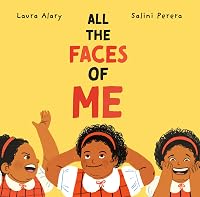
The illustrations are decent. I liked the granddaughter’s varying expressions and also the pet Persian cat who is cute and fluffy. But Nana was drawn too white for my liking. (I don’t mean ‘white’ as in her race, but her hair and skin was literally coloured a bright white that hurt my eyes. The little girl is of a different race (I couldn’t figure out whether she was Black or brown), but an explanation for her biracial background is provided in the photos on Nana’s windowsill. This was a nice touch, though the text doesn’t explore the biracial aspect further.
The story is written in simple prose, with not more than 4-5 lines per page. The vocabulary is quite simple, and will work well for ages 5-7.
This might be a good book for classroom discussions as it offers quite a few important topics to talk about. I am not sure if I could recommend it for personal collections.
2.75 stars.
My thanks to Owlkids Books and NetGalley for the DRC of “All the Faces of Me”. This review is voluntary and contains my honest opinion about the book.
~~~~~~~~~~~~~~~~~~~~~~~~~~~~
Connect with me through:
My Blog | The StoryGraph | Instagram | Facebook | Twitter show less
~~~~~~~~~~~~~~~~~~~~~~~~~~~~
Story Synopsis:
Written in the first person perspective of a little girl, the story tells us of how her Nana has six wooden dolls sitting side by side on her window sill. The five bigger dolls have the same fixed smling expression, but the sixth one, the smallest of the lot, is entirely unpainted. The narrator decides to colour in an expression on the sixth doll, and while doing so, she also draws on the other dolls different expressions. Needless to say, Nana is furious at her dolls being defaced. What happens next?
I do like the intent of the story. The concept of a little girl realising show more that she is not always smiling, that there are varying moods inside of her, and each of the emotions is an important part of her identity, is excellent. Not everyone is happy all the time, though the world expects them to. This misrepresentation of human emotions is especially worse in these social-media dominated days when everyone shares a multitude of smiling “happy family” photos online, which creates feelings of inadequacy and envy in others who might not be going through a satisfying family phase.
However, the intent needs to be converted into a more refined storyline. A few things felt too rushed, and too much was left unsaid.
I am never a fan of stories that let children get away with inappropriate behaviour. I liked that Nana is clear about how the Matryoshka dolls were *hers* and how her granddaughter should have asked her before sketching those new faces on her beloved dolls. However, after the little one’s explanation about how those varied faces are all parts of her, Nana cools down almost immediately and forgives her granddaughter without any further fuss. The granddaughter doesn’t even offer an apology for damaging her grandma’s personal possessions without permission. This doesn’t sit right by me. Justification isn’t a substitute for reparation, and children ought to be taught how to respect others’ belongings and to apologise when they make a mistake.
The illustrations are decent. I liked the granddaughter’s varying expressions and also the pet Persian cat who is cute and fluffy. But Nana was drawn too white for my liking. (I don’t mean ‘white’ as in her race, but her hair and skin was literally coloured a bright white that hurt my eyes. The little girl is of a different race (I couldn’t figure out whether she was Black or brown), but an explanation for her biracial background is provided in the photos on Nana’s windowsill. This was a nice touch, though the text doesn’t explore the biracial aspect further.
The story is written in simple prose, with not more than 4-5 lines per page. The vocabulary is quite simple, and will work well for ages 5-7.
This might be a good book for classroom discussions as it offers quite a few important topics to talk about. I am not sure if I could recommend it for personal collections.
2.75 stars.
My thanks to Owlkids Books and NetGalley for the DRC of “All the Faces of Me”. This review is voluntary and contains my honest opinion about the book.
~~~~~~~~~~~~~~~~~~~~~~~~~~~~
Connect with me through:
My Blog | The StoryGraph | Instagram | Facebook | Twitter show less
Members
- Recently Added By
Author Information
23 Works 498 Members
Awards and Honors
Classifications
Statistics
- Members
- 7
- Popularity
- 2,741,159
- Reviews
- 1
- Rating
- (3.00)
- Languages
- English
- Media
- Paper
- ISBNs
- 1