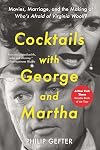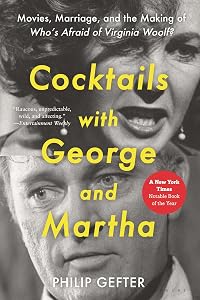
Cocktails with George and Martha: Movies, Marriage, and the Making of Who’s Afraid of Virginia Woolf?
by Philip Gefter
On This Page
Description
An award-winning author presents the history and impact of both the theatrical and cinematic versions of Who's Afraid of Virginia Woolf? and how it forced audiences to confront deeply-held concepts about relationships, sex and family.Tags
Recommendations





Member Reviews
Even with such abundant material - the play, the movie, the playwright, the director (first film ever, second was The Graduate), and the stars - there's no guarantee that a thorough examination of a 1962 play and a 1966 movie, each with a debut over sixty years ago, would be of interest to anyone but boomers. Which is why I urge anyone who loves theatre and film to grab this one. I DEVOURED IT. From Edward Albee's miserable life as a neglected adoptee; to director Mike Nichols, insecure despite his brilliance as a comedy partner with Elaine May; and especially to Ernest Lehman, the film producer whose strong hand and daily journaling provide the critical details. And then there are Elizabeth and Richard a/k/a Martha and George - she, show more tagged as the beauty with no particular talent; he, obsessed with childhood acne scars and his rivalries with Gielgud, Richardson, Olivier - their third movie since exploding their marriages and their bold decision to risk their reputations - everyone's reputations. The reader cannot help but cheer the film’s towering success and to give Edward Albee the biggest accolades for writing such a magnificent theatrical experience, and to commend the author, Philip Gefter, for creating such an absorbing journey, from the dying late ‘50s to the raging late '60s, especially for women who went from reading Betty Friedan and "the problem that has no name", to recognizing the damage caused by the prevailing patriarchy and rallying for dynamic change.
Quotes: "There was a chasm in the cultural life of America. There tended to be only one predominant public conversation, and it was calibrated to a narrow frequency of white middle-class Babbitry. Yet there were plenty of educated people of different ethnic and racial backgrounds starved for reflections of themselves in a more honest and intelligent social dialogue about actual human experience."
"While theatre relies on the voice, the screen relies on the face. On the screen, film magnifies a face as if it were an entire stage; the infinitesimal adjustments in a facial expression can have the same narrative impact as a character's soliloquy in a play." show less
Quotes: "There was a chasm in the cultural life of America. There tended to be only one predominant public conversation, and it was calibrated to a narrow frequency of white middle-class Babbitry. Yet there were plenty of educated people of different ethnic and racial backgrounds starved for reflections of themselves in a more honest and intelligent social dialogue about actual human experience."
"While theatre relies on the voice, the screen relies on the face. On the screen, film magnifies a face as if it were an entire stage; the infinitesimal adjustments in a facial expression can have the same narrative impact as a character's soliloquy in a play." show less
A "making of" history of the film Who's Afraid of Virginia Woolf?.
Gefter begins with a quick bio of playwright Edward Albee and a summary of his pre-Woolf career, and moves on to the play's Broadway success before diving into the heart of the book, the film version.
The central characters, and frequent antagonists, are director Mike Nichols and screenwriter/producer Ernest Lehman. Nichols was an unexpected choice; at this point in his career, he was known as a comic performer and a stage director of light comedy. He'd never directed a movie, and he'd never tackled material as serious or as demanding as Woolf.
But he knew what he wanted, and fought Lehman on the issues that mattered most to him -- making the movie in black and white; show more sticking as closely to Albee's words as possible, which meant cutting away anything Lehman had added and not cutting the oaths and obscenities.
He was working with his good friends Richard Burton and Elizabeth Taylor in the lead roles. Like everyone else, he worried that Taylor was too young to play Martha, and might not be up to the challenge. (Casting Taylor, he complained, was "like asking a chocolate milkshake to do the work of a double martini.") It was by far the most demanding role she's ever attempted, and even a more accomplished dramatic actress of her age would find it difficult to understand the disillusionment and frustration that can come after decades of marriage.
Gefter's history of the movie is entertaining. Much of it has been covered elsewhere (I would point you to Mark Harris's superb biography of Mike Nichols), but it's useful to have all of the different perspectives in one place.
I am always particularly fascinated by might-have-been casting details, so I enjoyed learning that Albee's producers hoped for Katharine Hepburn and Henry Fonda for the original Broadway production, and that Albee's dream pairing for the film was Bette Davis and James Mason. (Hepburn turned down the play, saying that she wasn't a good enough actress. Fonda's agent never even sent him script, thinking it was too vulgar for him; Fonda was furious when he found out, and later said that never getting to play George was one of the major disappointments of his career. Davis was apparently told, or at least believed, that she was going to make the movie, and was crushed when it went to Taylor.)
Gefter is on less solid ground in his commentary on the play as a commentary on the challenges and meaning of marriage in general. It's rarely a good idea to attempt to use an author's work as a psychoanalytic tool, and Gefter is working far too hard to find connections and correspondences between Albee's play and Albee's life.
Skim the psycho-commentary; enjoy the tick-tock. show less
Gefter begins with a quick bio of playwright Edward Albee and a summary of his pre-Woolf career, and moves on to the play's Broadway success before diving into the heart of the book, the film version.
The central characters, and frequent antagonists, are director Mike Nichols and screenwriter/producer Ernest Lehman. Nichols was an unexpected choice; at this point in his career, he was known as a comic performer and a stage director of light comedy. He'd never directed a movie, and he'd never tackled material as serious or as demanding as Woolf.
But he knew what he wanted, and fought Lehman on the issues that mattered most to him -- making the movie in black and white; show more sticking as closely to Albee's words as possible, which meant cutting away anything Lehman had added and not cutting the oaths and obscenities.
He was working with his good friends Richard Burton and Elizabeth Taylor in the lead roles. Like everyone else, he worried that Taylor was too young to play Martha, and might not be up to the challenge. (Casting Taylor, he complained, was "like asking a chocolate milkshake to do the work of a double martini.") It was by far the most demanding role she's ever attempted, and even a more accomplished dramatic actress of her age would find it difficult to understand the disillusionment and frustration that can come after decades of marriage.
Gefter's history of the movie is entertaining. Much of it has been covered elsewhere (I would point you to Mark Harris's superb biography of Mike Nichols), but it's useful to have all of the different perspectives in one place.
I am always particularly fascinated by might-have-been casting details, so I enjoyed learning that Albee's producers hoped for Katharine Hepburn and Henry Fonda for the original Broadway production, and that Albee's dream pairing for the film was Bette Davis and James Mason. (Hepburn turned down the play, saying that she wasn't a good enough actress. Fonda's agent never even sent him script, thinking it was too vulgar for him; Fonda was furious when he found out, and later said that never getting to play George was one of the major disappointments of his career. Davis was apparently told, or at least believed, that she was going to make the movie, and was crushed when it went to Taylor.)
Gefter is on less solid ground in his commentary on the play as a commentary on the challenges and meaning of marriage in general. It's rarely a good idea to attempt to use an author's work as a psychoanalytic tool, and Gefter is working far too hard to find connections and correspondences between Albee's play and Albee's life.
Skim the psycho-commentary; enjoy the tick-tock. show less
Ratings
Members
- Recently Added By
Published Reviews
Author Philip Gefter recounts the making of the movie, released in 1966, in “Cocktails With George and Martha,” a lively, well-researched book that displays great affection for the film and the highly gifted and vastly troublesome people who made it. Gefter, whose books include a biography of Richard Avedon, makes a convincing case that “Virginia Woolf” marked “the dawn of a new show more age” and that both the play and the movie would “challenge the hypocrisies of mainstream America, herald the sexual revolution, and register an entirely new psychological dimension to the public discourse.” show less
added by Lemeritus
What a document dump!
The most delicious parts of “Cocktails With George and Martha,” Philip Gefter’s unapologetically obsessive new book about “Who’s Afraid of Virginia Woolf?” — the dark ’n’ stormy, oft-revived 1962 Broadway hit by Edward Albee that became a moneymaking movie and an eternal marriage meme — are diary excerpts from the screenwriter Ernest Lehman.... Gefter, show more a former Times picture editor, has written formal biographies.... This is something different: a shot glass filled with one work that, alongside contemporaneous books like Richard Yates’s novel “Revolutionary Road” and Betty Friedan’s polemic “The Feminine Mystique,” showed how the “cartoon versions of marriage” long served up by American popular culture — Doris Day movies, the Cleavers, etc. — always came with a secret side of bitters. show less
The most delicious parts of “Cocktails With George and Martha,” Philip Gefter’s unapologetically obsessive new book about “Who’s Afraid of Virginia Woolf?” — the dark ’n’ stormy, oft-revived 1962 Broadway hit by Edward Albee that became a moneymaking movie and an eternal marriage meme — are diary excerpts from the screenwriter Ernest Lehman.... Gefter, show more a former Times picture editor, has written formal biographies.... This is something different: a shot glass filled with one work that, alongside contemporaneous books like Richard Yates’s novel “Revolutionary Road” and Betty Friedan’s polemic “The Feminine Mystique,” showed how the “cartoon versions of marriage” long served up by American popular culture — Doris Day movies, the Cleavers, etc. — always came with a secret side of bitters. show less
added by Lemeritus
Lists

Books Read in 2023
5,547 works; 145 members

Favorite Books 2024
25 works; 1 member
Author Information
6 Works 287 Members
Philip Gefter was on staff at The New York Times for over fifteen years, where he wrote regularly about photography. His essays are collected in the book Photography After Frank. He lives in New York City.
Awards and Honors
Distinctions
Common Knowledge
- Epigraph
- Tevye
Do you love me?
Golde
Do I what?
FROM "DO YOU LOVE ME," FIDDLER ON THE ROOF 1964 - Dedication
- For Peter and Leah
- First words
- "What a dump."
Edward Albee's Who's Afraid of Virginia Woolf? begins with these three words. They are a proclamation and a provocation. Albee might as well be Beethoven taking the podium to commence a performanc... (show all)e of his own Fifth Symphony. A flick of the baton. A breath:
Da da da DUM.
What a dump.
-Prologue
One evening in 1954, a young, unknown writer sat down in a neighborhood bar and ordered a beer. In the back of the bar hung a mirror on which patrons scrawled comments, in the manner of graffiti written on a public bathroom w... (show all)all. Because the bar was in Greenwich Village and the clientele was bohemian, the comments on the mirror were more ironic than salacious. That night, Edward Albee's eyes fell on one quip written out with dry soap near the bottom of the mirror: "Who's Afraid of Virginia Woolf?" It's a witty turn of phrase, granting a nursey rhyme the intellectual heft of a famous author's name, the singsong itself making a mockery of the lofty play on words. He made a mental note of it, letting it drift into the vapors of his unconscious. -Chapter 1, The College of Complexes - Quotations
- “For most of the people in [my] class, art was the truth about life—and life itself, as they saw it, was more or less a lie,” he wrote. “If civilization could be thought of as having a sexuality, art was its sexuality... (show all).”
The success of Who's Afraid of Virginia Woolf? exposed a chasm in the cultural life of America. The media was finite then, with only three national television networks, two major newsweeklies, and a handful of national featur... (show all)e magazines. There tended to be only one predominant public conversation, and it was calibrated to a narrow frequency of white middle-class Babbittry. Yet there were plenty of educated people of different ethnic and racial backgrounds starved for reflections of themselves in a more honest and intelligent social dialogue about actual human experience. The historical conditions that determined the midcentury cultural mood varied widely. Cold War threats of nuclear annihilation were brought dangerously close to home by the Cuban missile crisis—where nuclear-armed Soviet missiles were pointed directly at the U.S., ninety miles offshore—which erupted three days after the opening of Virginia Woolf on Broadway. The production was also shadowed by the apparent suicide of the thirty-six-year-old Marilyn Monroe two months prior—the iconic power of her international stardom cutting deep into the American psyche, as the entire culture mourned the loss of the postwar symbol of sexualized optimism she personified. Despite the shattered illusions left in the wake of those disparate events, the media set a steady, anodyne pitch of everything-will-be-fine fortitude—an illusion of its own.
In film, so much of the work is visual first. The burden of storytelling is foregrounded by the image before the story unfolds. While the theater relies on the voice, the screen relies on the face. On the screen, film magnifi... (show all)es a face as if it were an entire stage; the infinitesimal adjustments in a facial expression can have the same narrative impact as a character's soliloquy in a play. In film, each scene is created specifically for the camera, often shot out of sequence, and later constructed into an edited series of clips. The film director creates a cohesive narrative from a different set of moving parts, coming together not in a living moment but assembled over the course of time.
“He just thought we are all part of this marvelous civilization at its best, and he was sensitive to the fact that civilization at its worst was happening simultaneously just out of sight.”
George, a college professor, is cerebral. Martha, an intelligent and educated (prefeminist) housewife, is visceral. Martha is passionate and wild, a “party girl” at heart. George is reflective, reserved, and intellectual.... (show all) Martha wants more stimulation in her life, more meaning. She, like the Bette Davis character she described, is discontent. George, withdrawn and seemingly unambitious, is a disappointment to her, but the question lingers: Was he drained of his lifelong ambition by Martha's overbearing demands, or did he withhold the achievement she expected of him just to spite her?
She's discontented because George no longer seems worthy of her respect, no longer worth the effort and the energy. “If you existed, I'd divorce you,” she tells him. But that is because he has not only failed her expectat... (show all)ions of him; he has also failed, primarily, to simply make her feel loved. - Last words
- (Click to show. Warning: May contain spoilers.)It starts out as a fairy tale and ends up a labyrinth of emotional, psychological, circumstantial, and ethical challenges. It takes work. And it takes love. But is it worth it? Well, if you ask George and Martha - representative of so many couples, for better or worse, in sickness and in health - they would probably say it depends on the day. -Marriage in Relief: An Epilogue
- Canonical DDC/MDS
- 791.43
- Canonical LCC
- PN1997.W45
Classifications
- Genres
- Nonfiction, General Nonfiction
- DDC/MDS
- 791.43 — Arts & recreation Recreation, sports, and performing arts Movies, TV, Video Motion pictures, radio, television, podcasting Motion pictures
- LCC
- PN1997 .W45 — Language and Literature Literature (General) Literature (General) Drama Motion pictures Plays, scenarios, etc.
- BISAC
Statistics
- Members
- 74
- Popularity
- 424,967
- Reviews
- 2
- Rating
- (3.73)
- Languages
- English
- Media
- Paper, Audiobook, Ebook
- ISBNs
- 4
- ASINs
- 2