
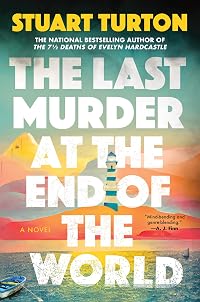
The Last Murder at the End of the World
by Stuart Turton
On This Page
Description
Outside the island there is nothing: the world was destroyed by a fog that swept the planet, killing anyone it touched. On the island: it is idyllic. One hundred and twenty-two villagers and three scientists, living in peaceful harmony. The villagers are content to fish, farm and feast, to obey their nightly curfew, to do what they're told by the scientists. Until, to the horror of the islanders, one of their beloved scientists is found brutally stabbed to death. And then they learn that show more the murder has triggered a lowering of the security system around the island, the only thing that was keeping the fog at bay. If the murder isn't solved within 92 hours, the fog will smother the island--and everyone on it. But the security system has also wiped everyone's memories of exactly what happened the night before, which means that someone on the island is a murderer--and they don't even know it... show lessTags
Recommendations




Member Reviews
90 years ago the world suffered a catastrophic event. Sinkholes appeared from nowhere and a fog began to blanket the Earth causing most of the population to perish. A small number of people were able to escape to an island where the fog surrounded but did not reach.
Run by the "Elders" - three people who were around when the world collapsed and now don't seem to age - the island operates like a machine. Everyone has something they contribute to the overall wellbeing of the people and the island. Although some, like Emory, would say that the villagers trust too much in the Elders. After all, her husband was one such casualty of the Elder's demanding experiments.
Plus, in order to keep the population under control, no one lives past sixty show more years old (barring of course the aforementioned Elders). So it is on the eve of her grandfather's death that Emory finds a revived sense of wariness where the Elders are concerned. Truthfully, she's always been curious and not one to let a question go unasked - even though she rarely gets a straight answer. This sense of curiosity has made Emory somewhat of an outlier within the village. No one wants to look too hard at their situation, they just want to continue living their lives.
So maybe it's fitting that when one of the Elders is discovered brutally murdered, Emory is the perfect one to lead the investigation. But she's on the clock as the surrounding fog is slowly starting to encroach upon the island.
This book took a bit for me to get into. To the point where I picked it up and started and just wasn't connecting with it so I put it down. When I started listening to the audiobook, that made it unfold better for me, and then once we get to a certain point, I'd say maybe about 15 to 20 percent into the story is when you realize that everything going on has more depth than people simply surviving and rebuilding after collapse of civilization.
Adding to all this is the fact that the story is told to us from the perspective of Abi. An omniscient presence who is able to speak into the villagers' minds and know their thoughts and whereabouts. This presence is always a little ominous. You don't know what Abi is and what her true function is within this society. Therefore, you don't know if you can fully trust her.
Trust is a big thing in this book. Not only trust, but the blind trust we often place upon people in positions of authority willing that they have our best interests at heart. This is not to be a scary allegory of trust and faith, but I think more of a don't be afraid to ask questions kind of thing. Don't be afraid to learn and be curious. Because it quickly becomes apparent that there are things the Elders have been keeping from the villagers.
I thought that Stuart Turton lead us on a wonderful unfolding of this society. Each chapter revealed another layer or another piece of the puzzle working toward putting together the big picture. I never felt like there were too many twists and turns, which to be honest there are a lot. Instead each turn leads nicely along to the next and the next in a way that makes sense. I was rapt by how everything was unfolding.
Now, I think this also sets a pretty high bar that's difficult to top. Meaning, the ending wasn't as revelatory as I was expecting. To be fair, though, I think this says a lot about it being more about the journey than the destination. It also doesn't negate the fact that the book kept me wanting to read on, wanting to find out what was happening next. I wanted to put the pieces together with Emory to see where it lead. Overall, it was very satisfying.
Speaking of the listening aspect of the book as mentioned above, I think an audiobook really works because it leans into the idea that we're being told this story (via Abi). The telling makes sense then if we are literally being read the story aloud. I think it's an interesting choice to have a male narrator essentially speaking for a female entity as Abi is referred to as she throughout the book. I don't think it takes anything away or adds anything, I simply think it's an interesting choice and makes me wonder about the process of choosing narrators for audiobooks. I do feel like there were times it was difficult to know which character was speaking. There was not enough distinction between the differing voices used for each character in some cases, but I'd say Emory is definitely the main protagonist of the book and she does stand out.
Overall, I know that Stuart Turton is known for the clever twists and turns in his stories. Reflecting on this one, I truly was surprised in quite a few places, but not only that, I'm left very curious about the world and left thinking on what the world was like. I appreciated that it's set in an unknown time so we have no idea what year the fog came and overtook everything in relation to our own real world which gives it a timelessness. As though this could all really happen at any moment. So again with that ominous feeling.
Any book that can make me continue to think about it for days going on weeks afterwards is a book worth spending time on. show less
Run by the "Elders" - three people who were around when the world collapsed and now don't seem to age - the island operates like a machine. Everyone has something they contribute to the overall wellbeing of the people and the island. Although some, like Emory, would say that the villagers trust too much in the Elders. After all, her husband was one such casualty of the Elder's demanding experiments.
Plus, in order to keep the population under control, no one lives past sixty show more years old (barring of course the aforementioned Elders). So it is on the eve of her grandfather's death that Emory finds a revived sense of wariness where the Elders are concerned. Truthfully, she's always been curious and not one to let a question go unasked - even though she rarely gets a straight answer. This sense of curiosity has made Emory somewhat of an outlier within the village. No one wants to look too hard at their situation, they just want to continue living their lives.
So maybe it's fitting that when one of the Elders is discovered brutally murdered, Emory is the perfect one to lead the investigation. But she's on the clock as the surrounding fog is slowly starting to encroach upon the island.
This book took a bit for me to get into. To the point where I picked it up and started and just wasn't connecting with it so I put it down. When I started listening to the audiobook, that made it unfold better for me, and then once we get to a certain point, I'd say maybe about 15 to 20 percent into the story is when you realize that everything going on has more depth than people simply surviving and rebuilding after collapse of civilization.
Adding to all this is the fact that the story is told to us from the perspective of Abi. An omniscient presence who is able to speak into the villagers' minds and know their thoughts and whereabouts. This presence is always a little ominous. You don't know what Abi is and what her true function is within this society. Therefore, you don't know if you can fully trust her.
Trust is a big thing in this book. Not only trust, but the blind trust we often place upon people in positions of authority willing that they have our best interests at heart. This is not to be a scary allegory of trust and faith, but I think more of a don't be afraid to ask questions kind of thing. Don't be afraid to learn and be curious. Because it quickly becomes apparent that there are things the Elders have been keeping from the villagers.
I thought that Stuart Turton lead us on a wonderful unfolding of this society. Each chapter revealed another layer or another piece of the puzzle working toward putting together the big picture. I never felt like there were too many twists and turns, which to be honest there are a lot. Instead each turn leads nicely along to the next and the next in a way that makes sense. I was rapt by how everything was unfolding.
Now, I think this also sets a pretty high bar that's difficult to top. Meaning, the ending wasn't as revelatory as I was expecting. To be fair, though, I think this says a lot about it being more about the journey than the destination. It also doesn't negate the fact that the book kept me wanting to read on, wanting to find out what was happening next. I wanted to put the pieces together with Emory to see where it lead. Overall, it was very satisfying.
Speaking of the listening aspect of the book as mentioned above, I think an audiobook really works because it leans into the idea that we're being told this story (via Abi). The telling makes sense then if we are literally being read the story aloud. I think it's an interesting choice to have a male narrator essentially speaking for a female entity as Abi is referred to as she throughout the book. I don't think it takes anything away or adds anything, I simply think it's an interesting choice and makes me wonder about the process of choosing narrators for audiobooks. I do feel like there were times it was difficult to know which character was speaking. There was not enough distinction between the differing voices used for each character in some cases, but I'd say Emory is definitely the main protagonist of the book and she does stand out.
Overall, I know that Stuart Turton is known for the clever twists and turns in his stories. Reflecting on this one, I truly was surprised in quite a few places, but not only that, I'm left very curious about the world and left thinking on what the world was like. I appreciated that it's set in an unknown time so we have no idea what year the fog came and overtook everything in relation to our own real world which gives it a timelessness. As though this could all really happen at any moment. So again with that ominous feeling.
Any book that can make me continue to think about it for days going on weeks afterwards is a book worth spending time on. show less
I will confess. I judged a book by its cover. I checked this book out from the library because I thought the cover was beautiful. It also came with turquoise edging on the pages. So cool!
I read this book because it was an attention getter and an attention keeper. It is a murder mystery set in a post-apocalyptic world. The heroine has 107 hours in which to find the murder of the colony's founder or the entire settlement will die from the Fog that has covered the world.
The one problem with this murder mystery is the style of the writing. It takes a little bit to figure out the point-of-view from which the story is told. It took me about 100 pages to figure it out, but once I did the story got really interesting very fast. This is a quirky show more novel that at its heart is a post-apocalyptic locked room murder mystery. And the wonder is that it works!
Highly recommended. This is the author's third novel and I am going to try to find his earlier works and read them. show less
I read this book because it was an attention getter and an attention keeper. It is a murder mystery set in a post-apocalyptic world. The heroine has 107 hours in which to find the murder of the colony's founder or the entire settlement will die from the Fog that has covered the world.
The one problem with this murder mystery is the style of the writing. It takes a little bit to figure out the point-of-view from which the story is told. It took me about 100 pages to figure it out, but once I did the story got really interesting very fast. This is a quirky show more novel that at its heart is a post-apocalyptic locked room murder mystery. And the wonder is that it works!
Highly recommended. This is the author's third novel and I am going to try to find his earlier works and read them. show less
The last remnants of humanity -- after several generations, only 125 strong -- live a peaceful existence on a small island that makes up the only land protected from the deadly, insect-filled fog that coated the planet and devoured the rest of humanity. Life is tranquil and idyllic for most of the inhabitants until they awake to find one of the three revered elders, Niema, and several other villagers dead and the fog rolling in. The A.I. overseer, Abi, explains that Niema's death triggered the barriers holding back the fog to drop and they can only be brought up again if Niema's murderer is found and brought to justice. The investigation is complicated as everybody's memories of the night the murder took place have been erased.
It show more becomes increasingly clear that the mystery runs deeper than the question of who killed Niema and the villagers' society grows more ominous and dystopian the more is revealed.
Abi served as the first-person narrator, but her perspective took a backseat as she focused the narration on the thoughts and feelings of the villagers whose minds she could read. This created a level of distance from all the characters -- from Abi because she is purposefully hiding information and relegating herself to a background element and from the villagers because we aren't fully in their heads, it's filtered through an outside view.
Of the many characters and relationships, we get to see I was most interested in the three elders and what their problems were. Niema, herself, has the air of a cult leader, while the other two benefit from her manipulation of the villagers but hardly participate, keeping to the edges of their society. Emory, an unusually inquisitive villager who takes on the investigation, and her family had more ordinary dysfunctions, that were nonetheless compelling. show less
It show more becomes increasingly clear that the mystery runs deeper than the question of who killed Niema and the villagers' society grows more ominous and dystopian the more is revealed.
Abi served as the first-person narrator, but her perspective took a backseat as she focused the narration on the thoughts and feelings of the villagers whose minds she could read. This created a level of distance from all the characters -- from Abi because she is purposefully hiding information and relegating herself to a background element and from the villagers because we aren't fully in their heads, it's filtered through an outside view.
Of the many characters and relationships, we get to see I was most interested in the three elders and what their problems were. Niema, herself, has the air of a cult leader, while the other two benefit from her manipulation of the villagers but hardly participate, keeping to the edges of their society. Emory, an unusually inquisitive villager who takes on the investigation, and her family had more ordinary dysfunctions, that were nonetheless compelling. show less
The rest of the world is enshrouded in a fog filled with flesh-eating insects, but life on the island is idyllic for the 122 villagers and 3 elders (scientists) who live there. Once, the island was a state-of-the-art research campus, and before that it was a military base, and the remnants of both are useful for the residents. However, when one of the elders is killed, a sequence is set in motion that will bring the fog down upon them in a matter of days unless the murder is solved. To top it off, all of their memories have been wiped -- which means that one of them is a killer and doesn't even know it. . .
Like Turton's other works, this is a high-concept book that may not work for everyone, but will fascinate a certain type of reader. show more (I am that reader.) First, he sets up a post-apocalyptic world and introduces the characters, and then the cracks appear in the utopia. And then the murder mystery takes over, but the dystopian setting never lets go of the reins. I thought there were a couple of loose ends, but I also might have missed some things -- I was listening to the audiobook, so couldn't easily skip back to check. I mostly liked the audiobook narrator, except that he had the same issue I've heard with other deep-voiced British narrators, in that his women's voices sounded whiny because he tried to pitch them high. I definitely recommend the book if the premise intrigues you, but only guardedly recommend the audio version. show less
Like Turton's other works, this is a high-concept book that may not work for everyone, but will fascinate a certain type of reader. show more (I am that reader.) First, he sets up a post-apocalyptic world and introduces the characters, and then the cracks appear in the utopia. And then the murder mystery takes over, but the dystopian setting never lets go of the reins. I thought there were a couple of loose ends, but I also might have missed some things -- I was listening to the audiobook, so couldn't easily skip back to check. I mostly liked the audiobook narrator, except that he had the same issue I've heard with other deep-voiced British narrators, in that his women's voices sounded whiny because he tried to pitch them high. I definitely recommend the book if the premise intrigues you, but only guardedly recommend the audio version. show less
"The Last Murder at the End of the World" is a fascinating post-apocalyptic murder mystery. It's also though-provoking, incredibly well-plotted, and entirely unique.
The murder in question occurs in an unusual version of the "locked room" scenario...the last survivors of a deadly-fog-apocalypse are living on an isolated island, so the suspect pool is obviously limited. To make things more challenging for the investigator (Emory), everyone's memories of the night of the crime have been wiped, including her own. Just in case the stakes weren't high enough...if Emory can't solve the murder and make sure the killer is executed in just under two days, the fog will cover the island, killing everyone, and thereby ending human life on show more earth.
Within those parameters, Emory begins her investigation. Unlike most of the island's inhabitants, she's curious and willing to ask hard questions. However, given that LITERALLY nobody is able to remember anything, she has her work cut out for her. As she progresses through whatever leads she can find, she raises as may new questions as she answers, all in a high-stakes race against the clock.
Author Stuart Turton skillfully weaves character backstories and glimpses of the onset of the apocalypse with Emory's investigation so that the reader fills in their own blanks about the past at the same time as Emory's blanks in her memory and what actually happened. There's a lot to uncover and figure out, and not everyone (or everything) is as it appears. To avoid spoilers, I won't say more, but PLEASE read this one for some surprising revelations!
You'll leave this story with a complete understanding of what actually happened on the night in question. However, you'll also leave with a lot of things to think about. I wish I could share a few of them here but.....the questions themselves would be spoiler-ish. (If you're planning to read this one, which I highly recommend, try to go in without reading any more about it. You'll enjoy it much more if you have less of an idea what to expect.)
5 slices of perfect Provolone! (Also a nominee for my Top 10 books of 2024!) show less
The murder in question occurs in an unusual version of the "locked room" scenario...the last survivors of a deadly-fog-apocalypse are living on an isolated island, so the suspect pool is obviously limited. To make things more challenging for the investigator (Emory), everyone's memories of the night of the crime have been wiped, including her own. Just in case the stakes weren't high enough...if Emory can't solve the murder and make sure the killer is executed in just under two days, the fog will cover the island, killing everyone, and thereby ending human life on show more earth.
Within those parameters, Emory begins her investigation. Unlike most of the island's inhabitants, she's curious and willing to ask hard questions. However, given that LITERALLY nobody is able to remember anything, she has her work cut out for her. As she progresses through whatever leads she can find, she raises as may new questions as she answers, all in a high-stakes race against the clock.
Author Stuart Turton skillfully weaves character backstories and glimpses of the onset of the apocalypse with Emory's investigation so that the reader fills in their own blanks about the past at the same time as Emory's blanks in her memory and what actually happened. There's a lot to uncover and figure out, and not everyone (or everything) is as it appears. To avoid spoilers, I won't say more, but PLEASE read this one for some surprising revelations!
You'll leave this story with a complete understanding of what actually happened on the night in question. However, you'll also leave with a lot of things to think about. I wish I could share a few of them here but.....the questions themselves would be spoiler-ish. (If you're planning to read this one, which I highly recommend, try to go in without reading any more about it. You'll enjoy it much more if you have less of an idea what to expect.)
5 slices of perfect Provolone! (Also a nominee for my Top 10 books of 2024!) show less
Ambitious dystopian fiction with a complex mystery plot keeps the reader hooked.
At some point in the future, there's an island at the end of the world. Surrounding the land inhabited by 122 villagers and 3 scientists is a thick fog containing insects that destroyed everything within its path and the entire rest of the planet. Daily life on the island is simple and peaceful as the villagers work and sleep, performing any tasks delegated to them by the scientists whose leader is Neima. Every night they go to sleep promptly at curfew and exist only to provide service and self-sacrifice for their community.
Suddenly things fall apart when one of the scientists is found dead and their murder has caused the barrier holding back the fog to show more fail. Now on a tight deadline to solve the murder and prevent the fog from killing them all, a brave villager, Emory, who has always questioned everything about life on the island, is delegated to solve the mystery and prevent extinction of the inhabitants. The investigation is hampered by the fact that the security failsafe on the island has done a memory wipe and no one there can remember what they were doing the night before.
Even as the clock ticks and everyone seems to be running amok all over the island trying to figure out who did what to whom, the reader knows that somehow this is all going to be OK because otherwise this would be a really terrible story. The protagonist, Emory, is as courageous as expected and exhibits all the necessary smarts and talent to figure things out of course. So, in essence, this is a common enough plot with archetypes except that Emory and the villagers are different in a fundamental way to most heroes.
The reason this novel resonated with me is that it was quite a puzzle full of interesting twists and turns that kept me guessing. The island was full of technology that made the place and the events unique. The writing was excellent even though the big picture was quite complicated, and I had to reread some of it just to make sure I was following. The setting and the description of the island layout and buildings, etc. also made for a great backdrop to the story line. I kept thinking this would make a great movie.
I listened to the audiobook while also reading along with the e-book ARC provided by the publishers. I did not care for the narrator -- mostly because it was a male voice, and the main characters were primarily female and so it seemed totally out of place for the story. Plus, all the voices of the women sounded the same and done badly. I would think it wouldn't be that hard to get both a male and female narrator for an audio version of a book that would enhance the listening experience. I'm sort of new to the audiobook but I am finding more and more that the lack of dual (or more) voices creates an irritant. I finally put the audio aside and finished without it.
I wasn't sure if I would like this or not, but I totally did. I am looking forward to hearing what others think of it. show less
At some point in the future, there's an island at the end of the world. Surrounding the land inhabited by 122 villagers and 3 scientists is a thick fog containing insects that destroyed everything within its path and the entire rest of the planet. Daily life on the island is simple and peaceful as the villagers work and sleep, performing any tasks delegated to them by the scientists whose leader is Neima. Every night they go to sleep promptly at curfew and exist only to provide service and self-sacrifice for their community.
Suddenly things fall apart when one of the scientists is found dead and their murder has caused the barrier holding back the fog to show more fail. Now on a tight deadline to solve the murder and prevent the fog from killing them all, a brave villager, Emory, who has always questioned everything about life on the island, is delegated to solve the mystery and prevent extinction of the inhabitants. The investigation is hampered by the fact that the security failsafe on the island has done a memory wipe and no one there can remember what they were doing the night before.
Even as the clock ticks and everyone seems to be running amok all over the island trying to figure out who did what to whom, the reader knows that somehow this is all going to be OK because otherwise this would be a really terrible story. The protagonist, Emory, is as courageous as expected and exhibits all the necessary smarts and talent to figure things out of course. So, in essence, this is a common enough plot with archetypes except that Emory and the villagers are different in a fundamental way to most heroes.
The reason this novel resonated with me is that it was quite a puzzle full of interesting twists and turns that kept me guessing. The island was full of technology that made the place and the events unique. The writing was excellent even though the big picture was quite complicated, and I had to reread some of it just to make sure I was following. The setting and the description of the island layout and buildings, etc. also made for a great backdrop to the story line. I kept thinking this would make a great movie.
I listened to the audiobook while also reading along with the e-book ARC provided by the publishers. I did not care for the narrator -- mostly because it was a male voice, and the main characters were primarily female and so it seemed totally out of place for the story. Plus, all the voices of the women sounded the same and done badly. I would think it wouldn't be that hard to get both a male and female narrator for an audio version of a book that would enhance the listening experience. I'm sort of new to the audiobook but I am finding more and more that the lack of dual (or more) voices creates an irritant. I finally put the audio aside and finished without it.
I wasn't sure if I would like this or not, but I totally did. I am looking forward to hearing what others think of it. show less
"The secrets on this island have teeth, and they don't like being dragged into the light."
After the world was destroyed by a killer fog, the last of humanity survives on an idyllic Mediterranean island, a peaceful community led by three long-lived scientists. But the peace is shattered when one of the scientists is murdered, and the defenses keeping the fog at bay begin failing. Now the villagers have to race to figure out what happened before humanity goes extinct.
Filled with trademark Turton weirdness and twistiness, this sci-fi mystery is definitely one I plan to reread, if only to make sense of all the puzzle pieces I missed the first time!
After the world was destroyed by a killer fog, the last of humanity survives on an idyllic Mediterranean island, a peaceful community led by three long-lived scientists. But the peace is shattered when one of the scientists is murdered, and the defenses keeping the fog at bay begin failing. Now the villagers have to race to figure out what happened before humanity goes extinct.
Filled with trademark Turton weirdness and twistiness, this sci-fi mystery is definitely one I plan to reread, if only to make sense of all the puzzle pieces I missed the first time!
Members
- Recently Added By
Published Reviews
ThingScore 63
Stuart Turton's The Last Murder at the End of the World is a wild amalgamation of genre elements that pulls readers into a unique postapocalyptic world in which another end is imminent.
added by Rakketytam
Author Stuart Turton is wildly popular for claustrophobic, plotty mysteries The 7 ½ Deaths of Evelyn Hardcastle and The Devil and the Dark Water, stories that play with ideas of perspective, memory, long-head secrets, and complex conspiracies. And all these elements are at work in his latest, The Last Murder at the End of the World, a genre-pushing, twisty post-apocalyptic tale about what, show more precisely, it means to be human. show less
added by Rakketytam
Lists

Recommend the 20 best books you've read in the last five years
2,168 works; 606 members

Books Read in 2024
4,623 works; 126 members

READ in 2024
262 works; 1 member

Books Read in 2025
4,091 works; 97 members

Poly Sci Fi
23 works; 2 members

Top Five Books of 2025
954 works; 303 members

Books Read in 2026
1,848 works; 65 members
Author Information

6+ Works 12,041 Members
Stuart Turton is a freelance travel journalist, born in the United Kingdom. He holds degrees in English and Philosophy. His career has included working in a bookshop, teaching English in Shanghai, working for a technology magazine in London, and writing various travel articles. He is the author of The Seven Deaths of Evelyn Hardcastle. The title show more in the U.S. is, The 7 ½ Deaths of Evelyn Hardcastle. It won the Costa Book Award 2018 category, First Novel. (Bowker Author Biography) show less
Some Editions
Awards and Honors
Awards
Common Knowledge
- Canonical title
- The Last Murder at the End of the World
- Original publication date
- 2024-03-28
- People/Characters
- Emory; Abi; Seth; Carla; Adil; Hui (show all 9); Niema Mandripilias; Hephaestus; Thea
- Dedication
- To Resa,
For having a heart twice the size of anybody else's.
For being funny, even when you're grumpy.
For listening.
And caring.
And the cups of tea.
For smiling when I walk in a room.
For the life that... (show all) radiates out of you like sunlight.
For being with me, even when it's not easy.
You're my best friend, and the person I love most in the world.
Next time you catch me looking at you and you ask me what I'm thinking, it's that. It's always that. - First words
- "Is there no other way?" asks a horrified Niema Mandripilias, speaking out loud in an empty room.
- Quotations
- 'I've been trying to calm her down for an hour,' says Emory, glancing at Magdalene's beatific expression. 'How did you do that?'
'I'm just old,' replies Niema brightly. 'Wrinkles look like wisdom to the young.' - Last words
- (Click to show. Warning: May contain spoilers.)"You've arrived just in time."
- Blurbers
- Finn, A.J.; Tudor, C.J.; Stevenson, Benjamin; Craven, M. W.; Bell, Alice; Dean, Will (show all 11); Simcox, Adam; Rubin, Gareth; Hare, Louise; Hindle, Tom; Patis, Vikki
- Original language
- English UK
Classifications
Statistics
- Members
- 1,382
- Popularity
- 17,129
- Reviews
- 56
- Rating
- (3.69)
- Languages
- 9 — English, French, German, Italian, Japanese, Polish, Portuguese, Spanish, Swedish
- Media
- Paper, Audiobook, Ebook
- ISBNs
- 33
- ASINs
- 11