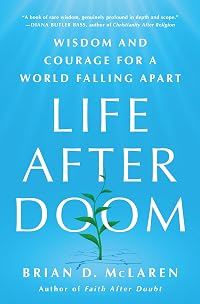
Life After Doom: Wisdom and Courage for a World Falling Apart
by Brian D. McLaren
On This Page
Description
""A book of rare wisdom, genuinely profound in depth and scope." -Diana Butler Bass, author of Christianity After Religion "As rich and thoughtful as all of Brian McLaren's work, but with a particular urgency!" -Bill McKibben A deeply insightful exploration of how to live with wisdom, resilience and love in our turbulent times For the last quarter-century, author and activist Brian D. McLaren has been writing at the intersection of religious faith and contemporary culture. In Life After show more Doom, he engages with the catastrophic failure of both our religious and political leaders to address the dominant realities of our time: ecological overshoot, economic injustice, and the increasing likelihood of civilizational collapse. McLaren defines doom as the "un-peaceful, uneasy, unwanted feeling" that "we humans have made a mess of our civilization and our planet, and not enough of us seem to care enough to change deeply enough or quickly enough to save ourselves." Blending insights from philosophers, poets, scientists, and theologians, Life After Doom explores the complexity of hope, the necessity of grief, and the need for new ways of thinking, becoming, and belonging in turbulent times. If you want to help yourself, your family, and the communities to which you belong to find courage and resilience for the deeply challenging times that are upon us - this is the book you need right now"-- show lessTags
Recommendations



Member Reviews
It’s the end of the world as we know it. And we’re not fine.
So what can we do?
In Life After Doom: Wisdom and Courage for a World Falling Apart, (galley received as part of early review program), Brian McLaren considers our present predicament and how we might deal with it.
He began by describing the possible ways climate change and civilization plays out. Some of the models involve a lot of suffering but most of us would find them not entirely intolerable. Some of the models involve the complete collapse of everything we hold dear, and ourselves.
For many this is all overhyped and excessive. It won’t be that bad, they think. It can’t be that bad. This kind of bargaining is common, as the author well knows, and has experienced show more himself. None of us want to think it could be that bad. No one can really imagine the end of everything he or she knows.
But that hasn’t ever been able to stop it when things do get that bad, and everything a person knows is gone. Ask the Israelites of the Exile. Ask the western world of the fifth and sixth centuries.
But the book is about life after doom. How to live in light of all these matters? The author addresses the way things are and how they have come about. He points out how we got here because of our colonialist/dominionist heritage of exploitation. He wants us to call in the poets. He wants us to heed indigenous wisdom - although his definition of “indigenous,” which probably does not originate with him, is pretty expansive. He would like to appeal beyond the religious, but the author’s heritage in Christianity and that perspective informs everything. He wants to prepare you for the end of everything; how well one might feel prepared by the end is another story.
But he does not want it to be all about doom and despair. He wants to encourage hope in doing what can be done. The author does well to remind us how this will not be the end of the world: it would seem the earth has been as hot as it is now before, and much more. The earth will persevere until the Lord comes; it might just not be as amenable or comfortable for us. So whatever we can do can at least marginally improve our conditions and perhaps also for the future. We live at arguably one of the greatest times to be alive; our goal should not be to enjoy everything to the hurt and harm of all who come afterward, but to find ways to conserve and preserve our environment.
It is harder today to deny the changes to our climate than it was a decade ago; no doubt it will continually prove harder to deny them, despite all the work of those who profit by the status quo to try to do so. We do well to consider how we can live within our means as human beings on a finite planet without depleting all the finite resources. We cannot know exactly what will be; but, as in all things, we do best when we are prepared for the worst while doing what we can to make it for the best. show less
So what can we do?
In Life After Doom: Wisdom and Courage for a World Falling Apart, (galley received as part of early review program), Brian McLaren considers our present predicament and how we might deal with it.
He began by describing the possible ways climate change and civilization plays out. Some of the models involve a lot of suffering but most of us would find them not entirely intolerable. Some of the models involve the complete collapse of everything we hold dear, and ourselves.
For many this is all overhyped and excessive. It won’t be that bad, they think. It can’t be that bad. This kind of bargaining is common, as the author well knows, and has experienced show more himself. None of us want to think it could be that bad. No one can really imagine the end of everything he or she knows.
But that hasn’t ever been able to stop it when things do get that bad, and everything a person knows is gone. Ask the Israelites of the Exile. Ask the western world of the fifth and sixth centuries.
But the book is about life after doom. How to live in light of all these matters? The author addresses the way things are and how they have come about. He points out how we got here because of our colonialist/dominionist heritage of exploitation. He wants us to call in the poets. He wants us to heed indigenous wisdom - although his definition of “indigenous,” which probably does not originate with him, is pretty expansive. He would like to appeal beyond the religious, but the author’s heritage in Christianity and that perspective informs everything. He wants to prepare you for the end of everything; how well one might feel prepared by the end is another story.
But he does not want it to be all about doom and despair. He wants to encourage hope in doing what can be done. The author does well to remind us how this will not be the end of the world: it would seem the earth has been as hot as it is now before, and much more. The earth will persevere until the Lord comes; it might just not be as amenable or comfortable for us. So whatever we can do can at least marginally improve our conditions and perhaps also for the future. We live at arguably one of the greatest times to be alive; our goal should not be to enjoy everything to the hurt and harm of all who come afterward, but to find ways to conserve and preserve our environment.
It is harder today to deny the changes to our climate than it was a decade ago; no doubt it will continually prove harder to deny them, despite all the work of those who profit by the status quo to try to do so. We do well to consider how we can live within our means as human beings on a finite planet without depleting all the finite resources. We cannot know exactly what will be; but, as in all things, we do best when we are prepared for the worst while doing what we can to make it for the best. show less
Ratings
Members
- Recently Added By
Lists

Psychology: Abuse, Grief, Self-Help
189 works; 1 member
Author Information

58+ Works 12,612 Members
Brian D. McLaren is a prominent, controversial evangelical pastor. He was recognized as one of Time magazine's "25 Most Influential Evangelicals in America" in 2005, and is the founding pastor of Cedar Ridge Community Church in Spencerville, Maryland. Born in 1956, Brian McLaren graduated from the University of Maryland, College Park, with BA and show more MA degrees in English. After several years of teaching English and consulting in higher education, he left academia in 1986 to become the founding pastor of Cedar Ridge Community Church, a nondenominational church in the Baltimore-Washington region. Many of the books that McLaren has authored, including the "A New Kind of Christian" trilogy, deal with Christianity in the context of the cultural shift towards a new emerging church movement. (Bowker Author Biography) show less
Classifications
- Genres
- Religion & Spirituality, Nonfiction
- DDC/MDS
- 200.1 — Religion The Bible & Christianity Religion Systems, scientific principles, psychology of religion, philosophy and religion
- LCC
- BL627.55 .M345 — Philosophy, Psychology and Religion Religions. Mythology. Rationalism Religions. Mythology. Rationalism
- BISAC
Statistics
- Members
- 97
- Popularity
- 332,890
- Reviews
- 1
- Rating
- (3.75)
- Languages
- English
- Media
- Paper, Audiobook, Ebook
- ISBNs
- 5
- ASINs
- 2