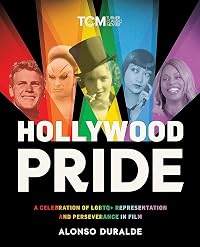
Hollywood Pride: A Celebration of LGBTQ+ Representation and Perseverance in Film
by Alonso Duralde 
On This Page
Description
"Just in time for Pride Month, this book is a first-of-its-kind in-depth exploration of LGBTQ+ representation from the dawn of cinema through today, from noted film critic Alonso Duralde and Turner Classic Movies"--Tags
Recommendations








Member Reviews
The subtitle calls this "a celebration of LGBTQ+ representation and preseverance in film." It's a survey of the major films and personalities who make up LGBT history in (mostly) American cinema.
The book is organized chronologically, with chapters divided roughly by decade. Each chapter is divided into two main sections, "The Films" and "Icons," giving capsule summaries of the movies or biographies of the people. Those sections are followed by "other films of note" and "other icons of note" listings, which run rapid-fire through supplemental choices, summarizing movies in a sentence and careers in a couple of key credits. There are occasional sidebars, mini-essays of a page or two on major themes of a particular decade.
The individual show more entries are brief, with most lasting only four or five paragraphs. Duralde does a superb job of cramming a lot of information into limited space, but the prose never feels rushed or overly info-dump-y. He doesn't limit herself to positive depictions of the community (the first half of the book would pretty much vanish if he did), and is careful to place each entry in its historical context. The "icons" section of the 1930s chapter, for instance, ends with a section on "the sissies," a group of character actors famous for playing effeminate gay-coded men -- Edward Everett Horton, Franklin Pangborn, Eric Blore -- and Duralde notes that even today, those portrayals remain controversial within the community.
As the title suggests, the focus is mostly on American film, though there are a few entries on particularly important movies and people from international cinema.
Turner Classic Movies, working with Running Press, has been publishing a series of glossy coffee-table/reference books for some years now; this is the third in a series of books on historic representation of minority communities, following Donald Bogle's Hollywood Black and Luis I. Reyes's Viva Hollywood. Duralde's book is an excellent overview, and it leaves me eager to read the Bogle and Reyes books. show less
The book is organized chronologically, with chapters divided roughly by decade. Each chapter is divided into two main sections, "The Films" and "Icons," giving capsule summaries of the movies or biographies of the people. Those sections are followed by "other films of note" and "other icons of note" listings, which run rapid-fire through supplemental choices, summarizing movies in a sentence and careers in a couple of key credits. There are occasional sidebars, mini-essays of a page or two on major themes of a particular decade.
The individual show more entries are brief, with most lasting only four or five paragraphs. Duralde does a superb job of cramming a lot of information into limited space, but the prose never feels rushed or overly info-dump-y. He doesn't limit herself to positive depictions of the community (the first half of the book would pretty much vanish if he did), and is careful to place each entry in its historical context. The "icons" section of the 1930s chapter, for instance, ends with a section on "the sissies," a group of character actors famous for playing effeminate gay-coded men -- Edward Everett Horton, Franklin Pangborn, Eric Blore -- and Duralde notes that even today, those portrayals remain controversial within the community.
As the title suggests, the focus is mostly on American film, though there are a few entries on particularly important movies and people from international cinema.
Turner Classic Movies, working with Running Press, has been publishing a series of glossy coffee-table/reference books for some years now; this is the third in a series of books on historic representation of minority communities, following Donald Bogle's Hollywood Black and Luis I. Reyes's Viva Hollywood. Duralde's book is an excellent overview, and it leaves me eager to read the Bogle and Reyes books. show less
Ratings
Members
- Recently Added By
Author Information

3 Works 154 Members
Alonso Duralde is a LibraryThing Author, an author who lists their personal library on LibraryThing.
Series
Belongs to Publisher Series
Common Knowledge
- Canonical title
- Hollywood Pride: A Celebration of LGBTQ+ Representation and Perseverance in Film
- Dedication
- For Pilar Ampuero Duralde and Dave White, whom I culd almost always talk into watching a movie
- First words
- One of the first innovations in cinematic narrative was crosscutting, which linked two simultaneous actions taking place in different locations (for example: The cowboy rides across the plain, meanwhile bandits are blo... (show all)wing up the dam.) -Introduction
The Edison employee behind the Dickson Experimental Sound Film, was a busy man in the 1890s; in addition to directing and playing violin for this breakthrough piece of film (and of LGBTQ+ cinema), W.K.L Dickson also cr... (show all)eated the first motion-picture study in 1893, a small room measuring twenty-five by thirty-feet. It would soon come into regular use: the first kinetoscope parlor in the United States opened in 1894 on Broadway in New York City. -Chapter One, First Flickers
Classifications
- Genres
- Nonfiction, History, Sexuality and Gender Studies, General Nonfiction, Art & Design
- DDC/MDS
- 791.43 — Arts & recreation Recreation, sports, and performing arts Public performances Motion pictures, radio, television, podcasting Motion pictures
- LCC
- PN1995.9 .H55 .D8725 — Language and Literature Literature (General) Literature (General) Drama Motion pictures
- BISAC
Statistics
- Members
- 29
- Popularity
- 954,361
- Reviews
- 1
- Rating
- (4.00)
- Languages
- English
- Media
- Paper, Ebook
- ISBNs
- 3
- ASINs
- 1