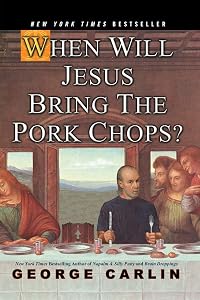
When Will Jesus Bring the Pork Chops?
by George Carlin
On This Page
Description
In a collection of irreverent humor, the author presents his observations and opinions on the foibles and follies of modern life, taking on such topics as the media, the battle of the sexes, hygiene, evasive language, and politics.Tags
Recommendations

















Member Reviews
Shortly after Carlin's death in 2008, I saw this book on the bargain shelf in the bookstore and picked it up out of pure sentiment to the memory of a once-great comedian who still entertained me in his twilight years, even though the edge seemed to have gone. Reading this book, I get more of the same: a warm feeling for a guy who made me laugh for decades, but nothing to lead me to believe he had new ground to cover. Some of this material I recognize from bits he'd done on late night talk shows and his stand-up routines. Other bits reminded me of things I'd read from him in the past. (Hasn't he done "euphemisms" to death already? Pardon the pun.) So it's with a heavy heart that I bid him farewell, and that same heart gives me the smile show more I have on my face as I flip back through this book now. It's an adequate book-end to a life spent dissecting the English language, but the real joy came a ways back in the stack (if you follow my metaphor). show less
If cultural criticism and picking apart language with an eye for the absurd and brandishing a double-edged tongue is your thing, then you'll love this book. It's Carlin, what else can one say? His stage is now the page, and boy, does he deliver. Here's a an excerpt about business I particularly found entertaining:
"The Wall Street Journal reminds you that your job as a businessman is to fuck the other guy before he fucks you. Sometimes you have to do such a complete job of fucking the other guy that he stays fucked for a long time, even to the point of going out of business and losing everything he owns. Quite often, the difference between getting fucked and being the one who does the fucking can be one small piece of business show more information, such as they’re not making steam locomotives anymore, or the zeppelin travel market has begun to decline. Those two important business facts appeared recently in the Wall Street Journal. If you’re a reptilian lowlife on your way up, stop getting fucked and start doing the fucking. Read the Wall Street Journal."
And here's one about euphemisms:
"There are several reasons why we seem to employ so much euphemistic language: the need to avoid unpleasant realities; the need to make things sound more important than they really are; marketing demands; pretentiousness; boosting employee self-esteem; and, in some cases, just plain, old political correctness.
But no matter their purpose, the one thing euphemisms all have in common is that they soften the language. They portray reality as less vivid. And I’ve noticed Americans have a problem with reality; they prefer to avoid the truth and not look it in the eye. I think it’s one of the consequences of being fat and prosperous and too comfortable. So, naturally, as time has passed, and we’ve grown fatter and more prosperous, the problem has gotten worse. Here’s a good example:
There’s a condition in combat—most people know it by now. It occurs when a soldier’s nervous system has reached the breaking point. In World War I, it was called shell shock. Simple, honest, direct language. Two syllables. Shell shock. Almost sounds like the guns themselves. Shell shock!
That was 1917. A generation passed. Then, during the Second World War, the very same combat condition was called battle fatigue. Four syllables now. It takes longer to say, stretches it out. The words don’t seem to hurt as much. And fatigue is a softer word than shock. Shell shock. Battle fatigue. The condition was being euphemized.
More time passed and we got to Korea, 1950. By that time, Madison Avenue had learned well how to manipulate the language, and the same condition became operational exhaustion. It had been stretched out to eight syllables. it took longer to say, so the impact was reduced, and the humanity was completely squeezed out of the term. It was now absolutely sterile: operational exhaustion. It sounded like something that might happen to your car.
And then, finally, we got to Vietnam. Given the dishonesty surrounding that war, I guess it’s not surprising that, at the time, the very same condition was renamed post-traumatic stress disorder. It was still eight syllables, but a hyphen had been added, and, at last, the pain had been completely buried under psycho-jargon. Post-traumatic stress disorder.
I’d be willing to bet anything that if we’d still been calling shell shock, some of those Vietnam veterans might have received the attention they needed, at the time they needed it. But it didn’t happen, and I’m convinced one of the reasons was that softer language we now prefer: The New Language. The language that takes the life out of life." show less
"The Wall Street Journal reminds you that your job as a businessman is to fuck the other guy before he fucks you. Sometimes you have to do such a complete job of fucking the other guy that he stays fucked for a long time, even to the point of going out of business and losing everything he owns. Quite often, the difference between getting fucked and being the one who does the fucking can be one small piece of business show more information, such as they’re not making steam locomotives anymore, or the zeppelin travel market has begun to decline. Those two important business facts appeared recently in the Wall Street Journal. If you’re a reptilian lowlife on your way up, stop getting fucked and start doing the fucking. Read the Wall Street Journal."
And here's one about euphemisms:
"There are several reasons why we seem to employ so much euphemistic language: the need to avoid unpleasant realities; the need to make things sound more important than they really are; marketing demands; pretentiousness; boosting employee self-esteem; and, in some cases, just plain, old political correctness.
But no matter their purpose, the one thing euphemisms all have in common is that they soften the language. They portray reality as less vivid. And I’ve noticed Americans have a problem with reality; they prefer to avoid the truth and not look it in the eye. I think it’s one of the consequences of being fat and prosperous and too comfortable. So, naturally, as time has passed, and we’ve grown fatter and more prosperous, the problem has gotten worse. Here’s a good example:
There’s a condition in combat—most people know it by now. It occurs when a soldier’s nervous system has reached the breaking point. In World War I, it was called shell shock. Simple, honest, direct language. Two syllables. Shell shock. Almost sounds like the guns themselves. Shell shock!
That was 1917. A generation passed. Then, during the Second World War, the very same combat condition was called battle fatigue. Four syllables now. It takes longer to say, stretches it out. The words don’t seem to hurt as much. And fatigue is a softer word than shock. Shell shock. Battle fatigue. The condition was being euphemized.
More time passed and we got to Korea, 1950. By that time, Madison Avenue had learned well how to manipulate the language, and the same condition became operational exhaustion. It had been stretched out to eight syllables. it took longer to say, so the impact was reduced, and the humanity was completely squeezed out of the term. It was now absolutely sterile: operational exhaustion. It sounded like something that might happen to your car.
And then, finally, we got to Vietnam. Given the dishonesty surrounding that war, I guess it’s not surprising that, at the time, the very same condition was renamed post-traumatic stress disorder. It was still eight syllables, but a hyphen had been added, and, at last, the pain had been completely buried under psycho-jargon. Post-traumatic stress disorder.
I’d be willing to bet anything that if we’d still been calling shell shock, some of those Vietnam veterans might have received the attention they needed, at the time they needed it. But it didn’t happen, and I’m convinced one of the reasons was that softer language we now prefer: The New Language. The language that takes the life out of life." show less
Hysterical in places, vile in others. Definitely not politically correct. Not even socially correct. But nobody captures the cynical zeitgeist of our error quite like George Carlin. Recommended, but certainly not for the faint of heart.
For the full book review:
---
----
Excerpt:
----
...
However, “When Will Jesus Bring the Pork Chops?” may not be for everyone. Carlin’s humor is often dark and involves a heavy dose of cynicism. Those sensitive to criticism of societal norms and values, particularly around religion and politics, might find his jokes too harsh or offensive. Nonetheless, for fans of Carlin’s brand of humor and new readers with an appetite for critical thought and a tolerance for edgy comedy, this book is a treasure trove of laughs and unexpected wisdom.
From a literary standpoint, Carlin’s work in this book is a seamless continuation of his performances on stage. It’s as if one is reading his stand-up routine, with the added benefit of being able to show more pause, reflect, and dive back in for more. His mastery of language is evident; he plays with words in a way that is both artful and accessible, ensuring that his messages are not lost in the comedy.
...
---
For the full book review: show less
---
----
Excerpt:
----
...
However, “When Will Jesus Bring the Pork Chops?” may not be for everyone. Carlin’s humor is often dark and involves a heavy dose of cynicism. Those sensitive to criticism of societal norms and values, particularly around religion and politics, might find his jokes too harsh or offensive. Nonetheless, for fans of Carlin’s brand of humor and new readers with an appetite for critical thought and a tolerance for edgy comedy, this book is a treasure trove of laughs and unexpected wisdom.
From a literary standpoint, Carlin’s work in this book is a seamless continuation of his performances on stage. It’s as if one is reading his stand-up routine, with the added benefit of being able to show more pause, reflect, and dive back in for more. His mastery of language is evident; he plays with words in a way that is both artful and accessible, ensuring that his messages are not lost in the comedy.
...
---
For the full book review: show less
I've read or heard so many pithy, one-sentence George Carlin lines---not what I would call jokes, because they always seemed too substantive to be classified that simply---that I thought now that I'm older I'd have a good chance at really appreciating his humor. And it's very possible that I would still enjoy his stand-up. But I did not enjoy this book.
It started off a little hit or miss, so I thought it just needed to build up its momentum, but by the third disc (of six) it was just dull, repetitive, and neither funny nor interesting, without even a redeeming hint of substance. None of the recurring themes/subjects reached a satisfying conclusion, and some of the material felt so tired that I was continually surprised when he referred show more to something relatively contemporary.
This may have been more palatable as a bedtime read consumed in small portions over a long time, instead of listened to in several-hour chunks on a long road trip. I haven't given up on liking Carlin's work, but I may not bother with the (audio)books in the future. show less
It started off a little hit or miss, so I thought it just needed to build up its momentum, but by the third disc (of six) it was just dull, repetitive, and neither funny nor interesting, without even a redeeming hint of substance. None of the recurring themes/subjects reached a satisfying conclusion, and some of the material felt so tired that I was continually surprised when he referred show more to something relatively contemporary.
This may have been more palatable as a bedtime read consumed in small portions over a long time, instead of listened to in several-hour chunks on a long road trip. I haven't given up on liking Carlin's work, but I may not bother with the (audio)books in the future. show less
I own both the hardcover and the audiobook. My reaction is different depending on the format. There are two things to consider here, the: humor and writing. As to the humor, this is a subjective experience for every reader. With the exception of a one liner regarding a musical Christmas vibrator (p. 17), I did not laugh out loud. Instead, my reactions were a mix of mild grins and slight chuckles. For me, the humor was mild when read. My introduction to When Will Jesus Bring The Pork Chops? was with the printed book. I was fortunate to have seen Carlin in person. And, I saw most of his cable TV specials. As I read the printed page, I tried to imagine his voice in my head and possible delivery of the material – voice inflections, show more pregnant pauses, dead-pan expressions, raised eyebrows, and other facial movements.
It wasn’t until I recently acquired the audiobook that the material impressed me for its humor quality. Material such as Ninety-Nine Things You Need To Know (p. 37) was more enjoyable as heard from the audiobook. It had more punch coming through Carlin’s voice.
This is not a joke book, where you have a setup and punch line. Carlin’s type of humor is not for everyone. It is irreverent, anti-establishment, absurdist; and at times, even twisted – Tips For Serial Killers (pp. 66-68). Containing profanity and sexually explicit material, the book is not for children and possible some immature adolescents. This is for adults who aren’t offended easily.
The topics are wide ranging and include: the belief in God vs. UFOs – They Came From Out Of The Sky (p. 12); unrestrained barbs against the handicap, the young and the elderly, Liberals, Conservatives, religion, etc. In going after political correctness, he summarizes the problem succinctly: . . . Political correctness cripples discourse; creates ugly language and is generally stupid (p. 72). His irreverent take on religion is thought provoking, but may put off some readers. And yet, you can’t deny the inventiveness in reducing the Judeo-Christian Ten Commandments to two – The Two Commandments (p. 14). One of his longest treatments is on the misuse of language by politicians – Politician Talk (pp. 77-84).
In what mirrors his unconventional humor, the book is presented without a Table of Contents, Chapters or an Index. Additionally, there are no numbers next to each entry, as I have seen in joke books. There are only two recurring sections scattered throughout the book: essays on Euphemisms (11 sections); and Bit and Pieces (5 sections) – the latter consisting of short one or two line observations. The book is a basket full of material, in no particular order. Thus, the book is disjointed by its nature. There is no narrative coherence, nor would there be for a collection such as this. The upside is that you can read the book in small chunks and not be lost, if there are long intervals between your reading. There is a wealth of ideas present; so much so that, it demands repeat readings.
And yet, despite the disjointed nature of the book, I felt repeated admiration for Carlin as a creative writer – a fountain of inspiration; very erudite; and with a talent for constructing phrases into irreverent observations. He is not only a wordsmith, but a linguistic historian – e.g., see the piece Shell Shock To PTSD (pp. 39-40). His understanding of “language” would rival that of any college professor, who specializes in linguistics. In part, his understanding is through an exploration of the evolution of language through a look at Euphemisms. Moreover, his cataloguing of Euphemisms is extensive and, at times overwhelming. As stated above, eleven sections are devoted to Euphemisms. There are different kinds of humor: physical (pratfalls); voice impressions (of other people); observational (on common, everyday things). With Carlin, the humor stems from an examination of the development of language, and the use or misuse of “words.”
In conveying his humor and absurdist observations, he employs an exhaustive variety of writing forms or literary compositions. The book contains a collection of: poems; advertisements for silly products; observations on euphemisms; essays; letters; dialogues; short conversations; public service announcements; boxing ring announcements; commercials; telephone conversations; TV promos, etc. His news report on The Death of Humpty Dumpty (pp.199-204) is a brilliant piece of writing.
Although the purpose of this book is to entertain by making the reader laugh, its chief value is as a sampler of creative writing. With its wealth of writing formats/forms, this could serve as the textbook for a college course on creative writing.
This is the 3rd of Carlin’s published books. It reveals that he wasn’t just a comic who could deliver words in a comedic manner, but that he was an inventive writer and deep thinker. I will be revisiting this book repeatedly. show less
It wasn’t until I recently acquired the audiobook that the material impressed me for its humor quality. Material such as Ninety-Nine Things You Need To Know (p. 37) was more enjoyable as heard from the audiobook. It had more punch coming through Carlin’s voice.
This is not a joke book, where you have a setup and punch line. Carlin’s type of humor is not for everyone. It is irreverent, anti-establishment, absurdist; and at times, even twisted – Tips For Serial Killers (pp. 66-68). Containing profanity and sexually explicit material, the book is not for children and possible some immature adolescents. This is for adults who aren’t offended easily.
The topics are wide ranging and include: the belief in God vs. UFOs – They Came From Out Of The Sky (p. 12); unrestrained barbs against the handicap, the young and the elderly, Liberals, Conservatives, religion, etc. In going after political correctness, he summarizes the problem succinctly: . . . Political correctness cripples discourse; creates ugly language and is generally stupid (p. 72). His irreverent take on religion is thought provoking, but may put off some readers. And yet, you can’t deny the inventiveness in reducing the Judeo-Christian Ten Commandments to two – The Two Commandments (p. 14). One of his longest treatments is on the misuse of language by politicians – Politician Talk (pp. 77-84).
In what mirrors his unconventional humor, the book is presented without a Table of Contents, Chapters or an Index. Additionally, there are no numbers next to each entry, as I have seen in joke books. There are only two recurring sections scattered throughout the book: essays on Euphemisms (11 sections); and Bit and Pieces (5 sections) – the latter consisting of short one or two line observations. The book is a basket full of material, in no particular order. Thus, the book is disjointed by its nature. There is no narrative coherence, nor would there be for a collection such as this. The upside is that you can read the book in small chunks and not be lost, if there are long intervals between your reading. There is a wealth of ideas present; so much so that, it demands repeat readings.
And yet, despite the disjointed nature of the book, I felt repeated admiration for Carlin as a creative writer – a fountain of inspiration; very erudite; and with a talent for constructing phrases into irreverent observations. He is not only a wordsmith, but a linguistic historian – e.g., see the piece Shell Shock To PTSD (pp. 39-40). His understanding of “language” would rival that of any college professor, who specializes in linguistics. In part, his understanding is through an exploration of the evolution of language through a look at Euphemisms. Moreover, his cataloguing of Euphemisms is extensive and, at times overwhelming. As stated above, eleven sections are devoted to Euphemisms. There are different kinds of humor: physical (pratfalls); voice impressions (of other people); observational (on common, everyday things). With Carlin, the humor stems from an examination of the development of language, and the use or misuse of “words.”
In conveying his humor and absurdist observations, he employs an exhaustive variety of writing forms or literary compositions. The book contains a collection of: poems; advertisements for silly products; observations on euphemisms; essays; letters; dialogues; short conversations; public service announcements; boxing ring announcements; commercials; telephone conversations; TV promos, etc. His news report on The Death of Humpty Dumpty (pp.199-204) is a brilliant piece of writing.
Although the purpose of this book is to entertain by making the reader laugh, its chief value is as a sampler of creative writing. With its wealth of writing formats/forms, this could serve as the textbook for a college course on creative writing.
This is the 3rd of Carlin’s published books. It reveals that he wasn’t just a comic who could deliver words in a comedic manner, but that he was an inventive writer and deep thinker. I will be revisiting this book repeatedly. show less
At his best, George Carlin was a comic genius, a politically incorrect slayer of sacred cows, a man who made us laugh at ourselves and sometimes even offered us new insights. At his worst, he was a foul-mouthed misogynistic pervert. You get equal helpings of the best and the worst in this collection, plus a bunch of stuff that, dare I say it, is pretty boring. It is, after all, a collection of short observations similar to his standup performance. I got the distinct feeling that material was thin at this point in his life.
Anyone who’s seen Carlin perform or has read his past volumes know that he was a keen observer of language use, exploring our euphemisms to show how we’ve become increasingly politically correct (or tactful, show more depending on your point of view). Carlin saw most of this as mealy-mouthed, and he may have had a point. But there is simply too much in this volume that just goes on and on about how our language has changed, and I yelled “Enough!” more than once. Just because it’s true doesn’t make it interesting, or funny.
There are high points, too, at least for those of us that love comedy of the absurd. I laughed out loud to some of his surrealistic descriptions of his uncles. And “A Modern Man” and “The Two Commandments” are classics from his standup routine.
It’s a mixed bag, fun to dip into when you need a laugh. show less
Anyone who’s seen Carlin perform or has read his past volumes know that he was a keen observer of language use, exploring our euphemisms to show how we’ve become increasingly politically correct (or tactful, show more depending on your point of view). Carlin saw most of this as mealy-mouthed, and he may have had a point. But there is simply too much in this volume that just goes on and on about how our language has changed, and I yelled “Enough!” more than once. Just because it’s true doesn’t make it interesting, or funny.
There are high points, too, at least for those of us that love comedy of the absurd. I laughed out loud to some of his surrealistic descriptions of his uncles. And “A Modern Man” and “The Two Commandments” are classics from his standup routine.
It’s a mixed bag, fun to dip into when you need a laugh. show less
Members
- Recently Added By
Lists

Amusing Book Titles
146 works; 39 members

Books With Interesting Titles
173 works; 14 members

Books With Complete Sentence Titles
502 works; 17 members
Author Information

75+ Works 7,585 Members
Comedian George Carlin was born on May 12, 1937 in Bronx, New York. He began his career at age 19 at the KJOE radio station in Louisiana. After making numerous appearances on TV, Carlin moved to radio and produced two albums, Take-Offs and Put-Ons, and FM & AM, which won a Grammy Award and was the first of four albums in a row to go gold. One of show more his best known routines was Seven Words You Can Never Say on Television. After performing this routine in Milwaukee in 1972, he was arrested for disturbing the peace and it also led to an indecency case after WBAI-FM radio aired it in 1973. Carlin also wrote three books and appeared on television and in movies. Besides his four Grammy Awards for best spoken comedy album, he was nominated for five Emmys. In 2002, Carlin was awarded the Freedom of Speech Award by the First Amendment Center in cooperation with the U.S. Comedy Arts Festival in Aspen, Colorado, and he was the named 11th recipient of The Kennedy Center Mark Twain Prize for American Humor in June of 2008. George Carlin passed away at age 71 on June 22, 2008 in Santa Monica, California. (Bowker Author Biography) show less
Awards and Honors
Awards
Distinctions
Work Relationships
Is contained in
Common Knowledge
- Canonical title
- When Will Jesus Bring the Pork Chops?
- Original publication date
- 2004; 2005-10-19
- People/Characters
- George Carlin
- Epigraph
- "Of course the people don't want war. But after all, it's the leaders of the country who determine the policy, and it's always a simple matter to drag the people along whether it's a democracy, a fascist dictatorship, or a pa... (show all)rliament, or a communist dictatorship. Voice or no voice, the people can always be brought to the bidding of the leaders. That is easy. All you have to do is tell them they are being attacked, and denounce the pacifists for lack of patriotism, and exposing the country to greater danger."
—HERMANN GÖRING AT THE NUREMBERG TRIALS
"All tears are the same."
—IRISH WOMAN
"So little time. So little to do."
—OSCAR LEVANT
"The main obligation is to amuse yourself."
—S. J. PERELMAN
"Today's another day. Time to play."
—SALLY WADE - Dedication
- This book is dedicated to my amazing daughter, Kelly: keeper of the sacred DNA, citizen of the universe, and one of America's few really good Buddhist poker players.
- First words
- Preface
I'm an outsider by choice, but not truly.
Since this book comes out in the fall, I'd like to take advantage of this early opportunity to wish all of you an enjoyable Christmas season and a happy New Year filled with good fortune. (George's Holiday Message)
I'm a modern man,
digital and smoke-free;
a man for the millennium. - Last words
- (Click to show. Warning: May contain spoilers.)Shhhhh.
- Original language
- English
Classifications
Statistics
- Members
- 2,137
- Popularity
- 9,583
- Reviews
- 43
- Rating
- (3.57)
- Languages
- English, Portuguese
- Media
- Paper, Audiobook, Ebook
- ISBNs
- 15
- UPCs
- 1
- ASINs
- 15