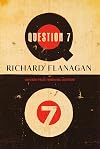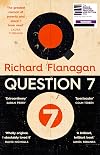
Question 7
by Richard Flanagan
On This Page
Description
"By way of H. G. Wells and Rebecca West's affair through 1930s nuclear physics to Flanagan's father working as a slave labourer near Hiroshima when the atom bomb is dropped, this daisy chain of events reaches fission when Flanagan as a young man finds himself trapped in a rapid on a wild river not knowing if he is to live or to die. At once a love song to his island home and to his parents, this hypnotic melding of dream, history, place and memory is about how our lives so often arise out of show more the stories of others and the stories we invent about ourselves"-- show lessTags
Recommendations










Member Recommendations
Member Reviews
It is with temerity that I have tagged this post about Question 7 as a 'book review'. The truth is that it's impossible to contribute anything coherent about the experience of reading Richard Flanagan's latest book...
It's such an emotional experience, and like The Narrow Road to the Deep North (2013, see my inadequate thoughts here) it is magnificent but it becomes overwhelming. The reading needs to be punctuated by long walks and meditative strolls in the garden, by strong coffee and the occasional generous single-malt. The prose is exquisite in its evocation of an image, a memory, or a feeling. Flanagan's words absorb all attention; they are insistent.
It was only many years after it happened that I began to understand. That what show more occurred is still occurring. I wrote about the story in one way a long time ago for another novel, my first. Though I tried to be honest, it was still happening and so it was dishonest. That's what I couldn't see then that I see now, that though it happened then it's still happening now and it won't ever stop happening, and that writing about it, that writing about anything, can't be an opinion about what happened as if it had already happened when it is still happening, still unintelligible, still mysterious, and all writing is trapped in tenses when life isn't. Life is always happening and has happened and will happen, and the only writing that can have any worth confounds time and stands outside of it, swims with it and flies with it and dives deep within it, seeking the answer to one question: who loves longer? (p.99)
This enigmatic question derives from the title. It comes from one of Chekhov's short stories 'Questions Posed by a Mad Mathematician', a parody of those problem-solving questions that we used to get at school:
Wednesday, June 17, 1881, a train had to leave station A at 3am in order to reach station B at 11pm; just as the train was about to depart, however, an order came that the train had to reach station B by 7pm. Who loves longer, a man or a woman?
Who?
You, me, a Hiroshima resident or a slave labourer? And why do we do what we do to each other?
That's question 7. (p.24)
The image that haunts this passage is Flanagan himself, trapped for hours in a kayak in a rising Tasmanian river, when he was twenty-one. Though writing about it is 'trapped in tenses', for him, this near-drowning is not in the past. The miracle of his survival is always with him. He retells this experience towards the end of the book with such compelling force that the awestruck reader feels like a helpless witness to his terror and despair.
In a blend of history, autofiction and memoir, Flanagan in Question 7 unravels another miraculous survival — his father's. Flanagan fictionalised his father's experience when a POW on the Death Railway in The Narrow Road to the Deep North. Those of us who read it will never forget the mud, the rain, the hunger and the savage brutality that killed so many men. Now in Question 7 he tells us that his father survived because the bombing of Hiroshima and Nagasaki ended the war. If the war had not ended then, his father would almost certainly have perished, as did so many thousands of those slave-labourers. In a trail of events segmented by other aspects of the narrative, Flanagan traces the circuitous history of the development of those atomic bombs, starting in the early 20th century with an novelist's imaginative conception of what such a bomb could be and do, progressing through the WW2 race to develop one before the Germans did, and heroising the role of those who foresaw its horrors, and tried to prevent them.
Flanagan likely owes his existence to that first atomic bomb, and perhaps I do too. Late in his life my father told me that his life was likely saved by the US use of atomic bombs to force a Japanese surrender. With the war in Europe over, his regiment was about to embark for war in the Pacific where the casualty rate was expected to be catastrophic. It was a chastening discovery. I had always thought that the use of atomic bombs was an atrocity and a war crime: Hiroshima was morally wrong, and Nagasaki even more so, but they quite probably saved my father's life. It is hard to come to terms with this.
To read the rest of my review please visit https://anzlitlovers.com/2024/01/10/question-7-2023-by-richard-flanagan/ show less
It's such an emotional experience, and like The Narrow Road to the Deep North (2013, see my inadequate thoughts here) it is magnificent but it becomes overwhelming. The reading needs to be punctuated by long walks and meditative strolls in the garden, by strong coffee and the occasional generous single-malt. The prose is exquisite in its evocation of an image, a memory, or a feeling. Flanagan's words absorb all attention; they are insistent.
It was only many years after it happened that I began to understand. That what show more occurred is still occurring. I wrote about the story in one way a long time ago for another novel, my first. Though I tried to be honest, it was still happening and so it was dishonest. That's what I couldn't see then that I see now, that though it happened then it's still happening now and it won't ever stop happening, and that writing about it, that writing about anything, can't be an opinion about what happened as if it had already happened when it is still happening, still unintelligible, still mysterious, and all writing is trapped in tenses when life isn't. Life is always happening and has happened and will happen, and the only writing that can have any worth confounds time and stands outside of it, swims with it and flies with it and dives deep within it, seeking the answer to one question: who loves longer? (p.99)
This enigmatic question derives from the title. It comes from one of Chekhov's short stories 'Questions Posed by a Mad Mathematician', a parody of those problem-solving questions that we used to get at school:
Wednesday, June 17, 1881, a train had to leave station A at 3am in order to reach station B at 11pm; just as the train was about to depart, however, an order came that the train had to reach station B by 7pm. Who loves longer, a man or a woman?
Who?
You, me, a Hiroshima resident or a slave labourer? And why do we do what we do to each other?
That's question 7. (p.24)
The image that haunts this passage is Flanagan himself, trapped for hours in a kayak in a rising Tasmanian river, when he was twenty-one. Though writing about it is 'trapped in tenses', for him, this near-drowning is not in the past. The miracle of his survival is always with him. He retells this experience towards the end of the book with such compelling force that the awestruck reader feels like a helpless witness to his terror and despair.
In a blend of history, autofiction and memoir, Flanagan in Question 7 unravels another miraculous survival — his father's. Flanagan fictionalised his father's experience when a POW on the Death Railway in The Narrow Road to the Deep North. Those of us who read it will never forget the mud, the rain, the hunger and the savage brutality that killed so many men. Now in Question 7 he tells us that his father survived because the bombing of Hiroshima and Nagasaki ended the war. If the war had not ended then, his father would almost certainly have perished, as did so many thousands of those slave-labourers. In a trail of events segmented by other aspects of the narrative, Flanagan traces the circuitous history of the development of those atomic bombs, starting in the early 20th century with an novelist's imaginative conception of what such a bomb could be and do, progressing through the WW2 race to develop one before the Germans did, and heroising the role of those who foresaw its horrors, and tried to prevent them.
Flanagan likely owes his existence to that first atomic bomb, and perhaps I do too. Late in his life my father told me that his life was likely saved by the US use of atomic bombs to force a Japanese surrender. With the war in Europe over, his regiment was about to embark for war in the Pacific where the casualty rate was expected to be catastrophic. It was a chastening discovery. I had always thought that the use of atomic bombs was an atrocity and a war crime: Hiroshima was morally wrong, and Nagasaki even more so, but they quite probably saved my father's life. It is hard to come to terms with this.
To read the rest of my review please visit https://anzlitlovers.com/2024/01/10/question-7-2023-by-richard-flanagan/ show less
Wednesday, June 17,1881, a train had to leave station A at 3 A.M. in order to reach station B at 11 P.M.; just as the train was about to depart, however, an order came that the train had to reach station B by 7 P.M. Who is capable of loving longer, a man or a woman?
That is “Question 7,” excerpted from a little-known early short story by Anton Chekhov entitled “Questions Posed by a Mad Mathematician.” Of course, there can be no answer to such an absurd question.
At 8:15 AM on August 6, 1945, the Enola Gay’s bombardier Major Thomas Ferebee released a lever 31,000 feet over Hiroshima and forty-three seconds later some “60,000 or 80,000 or 140,000” people (no one really knows) died. At that same moment, eighty miles to the show more south of Ground Zero, Arch Flanagan—who had miraculously survived a stretch as slave laborer on the infamous Burma Death Railway—was “pushing carriages of rock up long dark tunnels” in a coal mine under the Inland Sea. Now in his fourth year as a Japanese POW, physically and psychologically broken, the skeletal creature that still endured fully expected death to take him soon. He could hardly know then that the atomic bomb that killed 60,000 or 80,000 or 140,000 people that morning would mean that he would be spared. Nor could he have imagined that about sixteen years later a son would be born to him who would go on to become an internationally acclaimed author and who would win the Man Booker Prize for his novel The Narrow Road to the Deep North, inspired by Arch’s brutal experience on the Burma railway. There is much that is unknowable in life, but it is almost certain that if not for the bomb nicknamed "Little Boy” that would mean death for 60,000 or 80,000 or 140,000 Japanese souls, Tasmanian novelist Richard Flanagan would never have been born. Were the lives of Arch Flanagan (or Richard Flanagan, for that matter) or the hundreds of thousands of other Japanese and European and American and Australian survivors of the war worth the sacrifice of the 60,000 or 80,000 or 140,000 human beings who perished at Hiroshima on that day? Of course, there can be no answer to such an absurd question.
But that paradox clearly haunted the author, and it informs every single page of his own Question 7 [2023], a mesmerizing literary tour de force that is styled as a memoir but is in every way so very much more than that. One reviewer branded it “genre-bending,” and while I am ever reluctant to borrow from others when composing my own reviews, I surely cannot improve upon that. But then, as someone who has read every novel penned by Richard Flanagan can attest, genre-bending is what defines his art, from my first encounter with him in Gould’s Book of Fish [2001]—which I described elsewhere as “a stunningly original and brilliant blend of satire, heartache, love, cruelty, comedy, and existential tragedy, tossed with a superb use of magical realism … think William Faulkner, Gabriel Garcia Marquez and John Irving, all stirring the same pot with different shaped spoons”—to the more mainstream literary fiction of The Narrow Road to the Deep North [2013], a historical novel focused on extremes of brutality and endurance that turns out after all to be a love story that likewise manages to qualify as a magnificent achievement.
At this point, it’s only fair to issue a kind of spoiler alert, because it seems to me that it would be nearly impossible to do justice to Flanagan’s work here without giving much of the story away, which yet sounds a bit weird because this is mostly nonfiction that hardly suggests a cliffhanger at the end. I say “mostly nonfiction” because while this is essentially an autobiography, the author admits to a certain literary license here and there. And if I state that it is “essentially an autobiography” I must immediately contradict myself because in fact it steps far beyond memoir to history, literature, and nuclear physics, as well as speculative challenges to notions of both teleology and existentialism that somehow manages not to reinforce nihilism. And there we are back to genre-bending! By the way, Flanagan never once cites schools of philosophy, though his musings repeatedly compel the mind of the reader to go there. He also never refers to quantum mechanics, but as I turned the pages I could not help but think of quantum probabilities and the “many-worlds” theory that insists that anything that can occur actually does occur elsewhere in the multiverse but is hidden from us because by observing an event we manifest only our own reality and obscure all the others. In a different take on the familiar “butterfly effect,” I suppose, in at least one of those worlds there is and never has been a Richard Flanagan.
It would hardly be giving too much away to point out that Flanagan plucked the title for his book from that brain-bender in the Chekhov short story. That he would turn to a corner of literature so utterly obscure for this purpose only underscores the eclectic range of the author’s intellect. Nearly as unfamiliar to most is The World Set Free, a 1914 novel by polymath H. G. Wells that predicted the development of the atomic bomb as a weapon of war. As Flanagan tells it, this sci-fi flight of fancy was written in part during a period that saw Wells distracted by his infatuation with the decades-younger journalist Rebecca West. Hardly as successful as his prior bestsellers, The Time Machine and The War of the Worlds (if indeed more prescient!), The World Set Free was largely forgotten—except by atomic scientist Leó Szilárd, who, upon reading it in the early 1930s, became obsessed by the implications, which later sparked an epiphany that had him conceive the concept of a chain reaction that could lead to nuclear detonation! As it turned out, Szilárd became part of the group that was to persuade FDR to launch a race to develop the bomb before Hitler could do so, as well as a key figure in the Manhattan Project that was to result in the creation of "Little Boy” and the deaths of 60,000 or 80,000 or 140,000 men, women, and children in Hiroshima in August, 1945—but also spare the life of Arch Flanagan, and thus make possible the birth of Richard Flanagan some years later.
Talk about the butterfly effect!
Despite the spoilers, there is a good deal more to Question 7, and it will definitely make you think. Like Gould’s Book of Fish—which I reread immediately after I turned the final page—I will likely read this one again at some point. There really is so much to ponder in what is after all a rather short book, given its dramatic scope. I especially enjoyed his treatment of the steamy relationship that arose between Wells and West, literary license and all, which reminded me a bit of his tortured portrait of Charles Dickens in Flanagan’s Wanting [2008], another outstanding effort. He also revisits the genocide that led to the almost complete extermination of aborigines by white settlers in what was then the convict colony of Van Diemen’s Land, a topic that runs through many of his books, the climate change driven fires that have forever disfigured the Tasmania that he knew in his youth, and his own near-death experience in a drowning incident that would later beget the substance of his superlative first novel, Death of a River Guide [1994].
Much as in Cormac McCarthy’s fiction, the universal themes that characterize Flanagan’s work frequently identify the prevalence of cruelty and evil in the world while ever holding out the hope—no matter how tiny—that love and compassion could ultimately prevail. In Question 7, there’s the compelling account of the all too real life encounters between the author and certain elderly Japanese men who had, many years before, once been the very sadistic camp guards who had cruelly victimized Arch Flanagan. They now seemed like such nice, older gentlemen. At the site of the mine where Arch once wasted away, local guides denied that slave labor ever existed, a potent reminder that history can not only be forgotten but intentionally scrubbed—a process sadly in progress across the United States today.
Arch Flanagan never fully recovered from his trauma as a prisoner of war, but he managed to live on to the ripe old age of ninety-eight, to hear his son relate back to him the stories of visits with other old men who had once viciously abused him. He passed away on the same day his now famous son confided that the final draft of The Narrow Road to the Deep North was complete. What does any of this actually mean? Of course, there can be no answer to such absurd questions—but we must nevertheless keep asking. At least, that’s my takeaway after closing the cover of Question 7.
I struggled to locate the text of “Questions Posed by a Mad Mathematician” [1882] on the web, and finally resorted to buying the collection, The Undiscovered Chekhov: Forty-Three New Stories [1998], in order to read it. At less than two pages long, the story proved anticlimactic. But I did get to read all the other questions. The final one, “Question 8,” is my favorite: “My mother-in-law is 75, and my wife 42. What time is it?”
I reviewed other Richard Flanagan novels here:
Review of: The Narrow Road to the Deep North, by Richard Flanagan
Review of: Wanting, by Richard Flanagan
Review of: Death of a River Guide, by Richard Flanagan
Review of: First Person: A Novel, by Richard Flanagan
Review of: The Sound of One Hand Clapping, by Richard Flanagan
Latest book review & podcast ... Review of: Question 7, by Richard Flanagan https://regarp.com/2025/10/25/review-of-question-7-by-richard-flanagan/ show less
That is “Question 7,” excerpted from a little-known early short story by Anton Chekhov entitled “Questions Posed by a Mad Mathematician.” Of course, there can be no answer to such an absurd question.
At 8:15 AM on August 6, 1945, the Enola Gay’s bombardier Major Thomas Ferebee released a lever 31,000 feet over Hiroshima and forty-three seconds later some “60,000 or 80,000 or 140,000” people (no one really knows) died. At that same moment, eighty miles to the show more south of Ground Zero, Arch Flanagan—who had miraculously survived a stretch as slave laborer on the infamous Burma Death Railway—was “pushing carriages of rock up long dark tunnels” in a coal mine under the Inland Sea. Now in his fourth year as a Japanese POW, physically and psychologically broken, the skeletal creature that still endured fully expected death to take him soon. He could hardly know then that the atomic bomb that killed 60,000 or 80,000 or 140,000 people that morning would mean that he would be spared. Nor could he have imagined that about sixteen years later a son would be born to him who would go on to become an internationally acclaimed author and who would win the Man Booker Prize for his novel The Narrow Road to the Deep North, inspired by Arch’s brutal experience on the Burma railway. There is much that is unknowable in life, but it is almost certain that if not for the bomb nicknamed "Little Boy” that would mean death for 60,000 or 80,000 or 140,000 Japanese souls, Tasmanian novelist Richard Flanagan would never have been born. Were the lives of Arch Flanagan (or Richard Flanagan, for that matter) or the hundreds of thousands of other Japanese and European and American and Australian survivors of the war worth the sacrifice of the 60,000 or 80,000 or 140,000 human beings who perished at Hiroshima on that day? Of course, there can be no answer to such an absurd question.
But that paradox clearly haunted the author, and it informs every single page of his own Question 7 [2023], a mesmerizing literary tour de force that is styled as a memoir but is in every way so very much more than that. One reviewer branded it “genre-bending,” and while I am ever reluctant to borrow from others when composing my own reviews, I surely cannot improve upon that. But then, as someone who has read every novel penned by Richard Flanagan can attest, genre-bending is what defines his art, from my first encounter with him in Gould’s Book of Fish [2001]—which I described elsewhere as “a stunningly original and brilliant blend of satire, heartache, love, cruelty, comedy, and existential tragedy, tossed with a superb use of magical realism … think William Faulkner, Gabriel Garcia Marquez and John Irving, all stirring the same pot with different shaped spoons”—to the more mainstream literary fiction of The Narrow Road to the Deep North [2013], a historical novel focused on extremes of brutality and endurance that turns out after all to be a love story that likewise manages to qualify as a magnificent achievement.
At this point, it’s only fair to issue a kind of spoiler alert, because it seems to me that it would be nearly impossible to do justice to Flanagan’s work here without giving much of the story away, which yet sounds a bit weird because this is mostly nonfiction that hardly suggests a cliffhanger at the end. I say “mostly nonfiction” because while this is essentially an autobiography, the author admits to a certain literary license here and there. And if I state that it is “essentially an autobiography” I must immediately contradict myself because in fact it steps far beyond memoir to history, literature, and nuclear physics, as well as speculative challenges to notions of both teleology and existentialism that somehow manages not to reinforce nihilism. And there we are back to genre-bending! By the way, Flanagan never once cites schools of philosophy, though his musings repeatedly compel the mind of the reader to go there. He also never refers to quantum mechanics, but as I turned the pages I could not help but think of quantum probabilities and the “many-worlds” theory that insists that anything that can occur actually does occur elsewhere in the multiverse but is hidden from us because by observing an event we manifest only our own reality and obscure all the others. In a different take on the familiar “butterfly effect,” I suppose, in at least one of those worlds there is and never has been a Richard Flanagan.
It would hardly be giving too much away to point out that Flanagan plucked the title for his book from that brain-bender in the Chekhov short story. That he would turn to a corner of literature so utterly obscure for this purpose only underscores the eclectic range of the author’s intellect. Nearly as unfamiliar to most is The World Set Free, a 1914 novel by polymath H. G. Wells that predicted the development of the atomic bomb as a weapon of war. As Flanagan tells it, this sci-fi flight of fancy was written in part during a period that saw Wells distracted by his infatuation with the decades-younger journalist Rebecca West. Hardly as successful as his prior bestsellers, The Time Machine and The War of the Worlds (if indeed more prescient!), The World Set Free was largely forgotten—except by atomic scientist Leó Szilárd, who, upon reading it in the early 1930s, became obsessed by the implications, which later sparked an epiphany that had him conceive the concept of a chain reaction that could lead to nuclear detonation! As it turned out, Szilárd became part of the group that was to persuade FDR to launch a race to develop the bomb before Hitler could do so, as well as a key figure in the Manhattan Project that was to result in the creation of "Little Boy” and the deaths of 60,000 or 80,000 or 140,000 men, women, and children in Hiroshima in August, 1945—but also spare the life of Arch Flanagan, and thus make possible the birth of Richard Flanagan some years later.
Talk about the butterfly effect!
Despite the spoilers, there is a good deal more to Question 7, and it will definitely make you think. Like Gould’s Book of Fish—which I reread immediately after I turned the final page—I will likely read this one again at some point. There really is so much to ponder in what is after all a rather short book, given its dramatic scope. I especially enjoyed his treatment of the steamy relationship that arose between Wells and West, literary license and all, which reminded me a bit of his tortured portrait of Charles Dickens in Flanagan’s Wanting [2008], another outstanding effort. He also revisits the genocide that led to the almost complete extermination of aborigines by white settlers in what was then the convict colony of Van Diemen’s Land, a topic that runs through many of his books, the climate change driven fires that have forever disfigured the Tasmania that he knew in his youth, and his own near-death experience in a drowning incident that would later beget the substance of his superlative first novel, Death of a River Guide [1994].
Much as in Cormac McCarthy’s fiction, the universal themes that characterize Flanagan’s work frequently identify the prevalence of cruelty and evil in the world while ever holding out the hope—no matter how tiny—that love and compassion could ultimately prevail. In Question 7, there’s the compelling account of the all too real life encounters between the author and certain elderly Japanese men who had, many years before, once been the very sadistic camp guards who had cruelly victimized Arch Flanagan. They now seemed like such nice, older gentlemen. At the site of the mine where Arch once wasted away, local guides denied that slave labor ever existed, a potent reminder that history can not only be forgotten but intentionally scrubbed—a process sadly in progress across the United States today.
Arch Flanagan never fully recovered from his trauma as a prisoner of war, but he managed to live on to the ripe old age of ninety-eight, to hear his son relate back to him the stories of visits with other old men who had once viciously abused him. He passed away on the same day his now famous son confided that the final draft of The Narrow Road to the Deep North was complete. What does any of this actually mean? Of course, there can be no answer to such absurd questions—but we must nevertheless keep asking. At least, that’s my takeaway after closing the cover of Question 7.
I struggled to locate the text of “Questions Posed by a Mad Mathematician” [1882] on the web, and finally resorted to buying the collection, The Undiscovered Chekhov: Forty-Three New Stories [1998], in order to read it. At less than two pages long, the story proved anticlimactic. But I did get to read all the other questions. The final one, “Question 8,” is my favorite: “My mother-in-law is 75, and my wife 42. What time is it?”
I reviewed other Richard Flanagan novels here:
Review of: The Narrow Road to the Deep North, by Richard Flanagan
Review of: Wanting, by Richard Flanagan
Review of: Death of a River Guide, by Richard Flanagan
Review of: First Person: A Novel, by Richard Flanagan
Review of: The Sound of One Hand Clapping, by Richard Flanagan
Latest book review & podcast ... Review of: Question 7, by Richard Flanagan https://regarp.com/2025/10/25/review-of-question-7-by-richard-flanagan/ show less
0ne of the very few books which deserves five stars by my reckoning. Biography, autobiography, history, literature, ecology. From page 277 is a brilliant analysis of English (Martian) attitudes to Australian convicts and Aborigines. It is as if, he says, 100 years after the holocaust the perpetrators blamed and scorned the victims. I have often thought something similar, but this book puts it so well, so much better than any of my writing.
Winner of the Baillie Gifford prize for non-fiction last year, Question 7 is an interesting mix of philosophy and history peppered with memoir. It's a book that's hard to pin down or restrain - it skips all over the place, quietly suggesting some of life's big questions about why certain things happen, or people behave in a certain way.
The name of the book comes from question 7 in one of Chekhov's early stories which was a parody of children's maths questions:
Wednesday, June 17th 1881, a train had to leave station A at 3am in order to reach station B at 11pm; just as the train was about to depart, however, an order came that the train had to reach station B by 7pm. Who loves longer, a man or a woman?
Chekhov believed the role of show more literature was not to provide the right answers but to ask the right questions, and clearly this is what Flanagan tries to do in this book (and mostly succeeds).
The thread of the book is based around his father's internment in a Japanese POW camp, and his liberation that came ultimately from the dropping of the atom bomb on Hiroshima. He plots the connection between H.G. Wells' unlikely affair with Rebecca West to his writing a novel that sowed the seed of the idea for nuclear bombs in the mind of scientist Leo Szilard. Along the way Flanagan also examines the colonisation of his native Tasmania and the impact that this had on his own family's history, and tells the story of his near death experience in a Tasmanian river.
It's not quite a perfect chain of events, which is why I'm dropping a star as my attention wandered somewhere in the middle when he jumped from chapters on the atom bomb development to family memoir snippets from his childhood in Tasmania. However, on the whole I enjoyed this book; I learnt a lot, Googled a lot, and thought deeply between reads.
It's a book I probably read less of in one sitting than normal. I had to be in the right mood for it, and as it was thought-provoking it didn't work well as a tired bedtime read. Given that it jumps around in content quite a lot, on occasion I lost the thread of the writing if I didn't keep reading it on consecutive days and had to retrace my steps, so I would certainly recommend committing to it if you choose to read it.
4 stars - this dipped a little closer to 3.5 stars somewhere in the middle, but a strong ending won me back. I don't think I did the book justice in how I read it, with too much dipping in and out. show less
The name of the book comes from question 7 in one of Chekhov's early stories which was a parody of children's maths questions:
Wednesday, June 17th 1881, a train had to leave station A at 3am in order to reach station B at 11pm; just as the train was about to depart, however, an order came that the train had to reach station B by 7pm. Who loves longer, a man or a woman?
Chekhov believed the role of show more literature was not to provide the right answers but to ask the right questions, and clearly this is what Flanagan tries to do in this book (and mostly succeeds).
The thread of the book is based around his father's internment in a Japanese POW camp, and his liberation that came ultimately from the dropping of the atom bomb on Hiroshima. He plots the connection between H.G. Wells' unlikely affair with Rebecca West to his writing a novel that sowed the seed of the idea for nuclear bombs in the mind of scientist Leo Szilard. Along the way Flanagan also examines the colonisation of his native Tasmania and the impact that this had on his own family's history, and tells the story of his near death experience in a Tasmanian river.
It's not quite a perfect chain of events, which is why I'm dropping a star as my attention wandered somewhere in the middle when he jumped from chapters on the atom bomb development to family memoir snippets from his childhood in Tasmania. However, on the whole I enjoyed this book; I learnt a lot, Googled a lot, and thought deeply between reads.
It's a book I probably read less of in one sitting than normal. I had to be in the right mood for it, and as it was thought-provoking it didn't work well as a tired bedtime read. Given that it jumps around in content quite a lot, on occasion I lost the thread of the writing if I didn't keep reading it on consecutive days and had to retrace my steps, so I would certainly recommend committing to it if you choose to read it.
4 stars - this dipped a little closer to 3.5 stars somewhere in the middle, but a strong ending won me back. I don't think I did the book justice in how I read it, with too much dipping in and out. show less
This book is a freewheeling meditation on life and family and all over the place in the best possible way. A memoir like few others I've read. One of my favorite books of the year.
I listened to this as an audiobook, performed by Richard Flanagan himself. While his delivery was clear, it sometimes felt a little monotone, which may not have been ideal for this type of book. Not having read any of his other works didn’t seem to matter much until possibly the very end.
At its heart, I loved many of the stories in this book. The flow from H.G. Wells’ novels to inspired scientists, invention, achievement, and then the horror of the atom bomb was compelling. Threading this together with his father’s experience as a Japanese prisoner of war, and Flanagan retracing his father’s steps, gave the narrative a personal resonance. These sections, in particular, felt exciting and useful to me as a writer, offering ideas show more that I could apply in my own work.
Where it was more challenging for me was in the extended focus on Flanagan’s near-death experience and the attempt to link it back to broader themes, including spirituality. While the material is undoubtedly significant, I found it slowed the pace and made it harder to stay connected to the narrative. It felt very personal, and at times a bit distant from me as a reader.
Overall, I enjoyed the book and found it packed with ideas presented in an accessible, engaging way. While it doesn’t read like a conventional memoir and some sections were harder to connect with, the compelling storytelling and insights make it worth reading. show less
At its heart, I loved many of the stories in this book. The flow from H.G. Wells’ novels to inspired scientists, invention, achievement, and then the horror of the atom bomb was compelling. Threading this together with his father’s experience as a Japanese prisoner of war, and Flanagan retracing his father’s steps, gave the narrative a personal resonance. These sections, in particular, felt exciting and useful to me as a writer, offering ideas show more that I could apply in my own work.
Where it was more challenging for me was in the extended focus on Flanagan’s near-death experience and the attempt to link it back to broader themes, including spirituality. While the material is undoubtedly significant, I found it slowed the pace and made it harder to stay connected to the narrative. It felt very personal, and at times a bit distant from me as a reader.
Overall, I enjoyed the book and found it packed with ideas presented in an accessible, engaging way. While it doesn’t read like a conventional memoir and some sections were harder to connect with, the compelling storytelling and insights make it worth reading. show less
HG Wells meets a young woman and begins a torrid affair that influences his later writing. A talented scientist realises that the power of the atom could be uses to create a devastating weapon. The crew of a bomber plane release a bomb which kills thousands and changes the direction of world history. An Australian prisoner of war struggles to survive in a Japanese camp. A young boy starts life in poverty but grows to be a writer. An island is conquered and destroyed.
This is an amazing read! Partly a series of short stories and musings, partly a treatise about the effect that humans have on society, the whole is just wonderful. Flanagan is a great writer and here his passion for his homeland shines through. The themes are disparate and show more shouldn't work but they do and the whole is powerful and profound. show less
This is an amazing read! Partly a series of short stories and musings, partly a treatise about the effect that humans have on society, the whole is just wonderful. Flanagan is a great writer and here his passion for his homeland shines through. The themes are disparate and show more shouldn't work but they do and the whole is powerful and profound. show less
Members
- Recently Added By
Lists

Non-fiction
55 works; 1 member

Books Read in 2024
4,623 works; 126 members
Author Information

21+ Works 9,947 Members
Richard Flanagan was born in Longford, Tasmania, in 1961. He received a Master of Letters degree from Oxford University. His first novel, Death of a River Guide, won Australia's National Fiction Award. His works include The Sound of One Hand Clapping, The Unknown Terrorist, and four history books. He has received numerous awards including the show more Commonwealth Writers Prize for Gould's Book of Fish, the 2011 Tasmania Book Prize for Wanting, and the 2014 Man Booker Prize for The Narrow Road to the Deep North. He directed a feature film version of The Sound of One Hand Clapping. He was also shortlisted for the UK Indie Booksellers Award with The Narrow Road to the Deep North. This same title was won the Margaret Scott Prize for best book by a Tasmanian writer 2015. In 2018, The Narrow Road to the Deep North will be made into an international television series. The University of Melbourne has appointed him as the Boisbouvier Founding Chair in Australian Literature at the University of Melbourne, a new professorship to 'advance the teaching, understanding and public appreciation of Australian literature'. (Bowker Author Biography) show less
Some Editions
Awards and Honors
Awards
Distinctions
Series
Belongs to Publisher Series
Astrolabi (20)
Common Knowledge
- Original publication date
- 2023
- Dedication
- For Phil Cullen
- First words
- In the winter of 2012, against my better judgement and for reasons that were not entirely to do with writing - much as I said they were - and which even now are not clear to me, I visited the site of Ohama Camp, Japan, where ... (show all)my father had once been interned. It was very cold, a bitter day, and an iron sky threw a foreboding case on the Island Sea beneath which my father had once worked in a coal mine as a slave laborer. -Chapter 1
- Last words
- (Click to show. Warning: May contain spoilers.)The rainforest steamed in the midday heat, we stood in the sun a few moments longer, looking at the faraway river, resting, perhaps we ate something or drank something, and I said little, too embarrassed or unable to express everything that swirled in my soul at that moment, and then gathering up what little we had brought with us, we began making our way to the water.
- Blurbers
- Cumming, Laura; Perry, Sarah; Toibin, Colm; Nicholls, David; Rebanks, James; Winton, Tim (show all 7); Funder, Anna
- Canonical DDC/MDS
- 823
- Canonical LCC
- PR9619.F525
Classifications
Statistics
- Members
- 452
- Popularity
- 67,663
- Reviews
- 15
- Rating
- (4.19)
- Languages
- 6 — Catalan, Dutch, English, French, Spanish, Swedish
- Media
- Paper, Audiobook, Ebook
- ISBNs
- 19
- ASINs
- 8