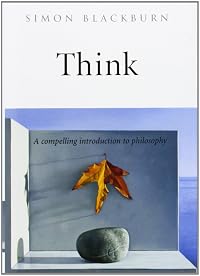
Think: A Compelling Introduction to Philosophy
by Simon Blackburn
On This Page
Description
"Simon Blackburn begins by putting forward a convincing case for the study of philosophy and goes on to give the reader a sense of how the great historical figures such as Descartes, Hume, Kant, and Wittgenstein have approached its central themes."Tags
Recommendations







Member Reviews
I was an absolutely awful philosophy student for a couple of years in college, so I've always wanted to see if I could get back on that horse and understand some of those big, abstract thoughts that excited, scared, and mystified me in equal measure as an undergraduate. Simon Blackburn's "Think" was a pretty decent place to pick up the thread again. It's certainly written for the curious layperson, and Blackburn writes in a personable and straightforward tone on all the Big Questions. Not that I'm clear on everything: even after going over the relevant section various times, the mind/body problem is still frustrates me, but I suppose I might be in good company there. The author, to his credit, admits the problems he's addressing are show more likely intractable -- though it should probably be noted that he did this in the book's closing pages, not in its introduction. Some qualms: though he's usually careful to label them as such, he inserts his own opinions in the text more than many philosophy professors would, and his take on God -- he considers a theistic God to be something of a non-starter -- might alienate a few Christian readers. Others might complain that the excerpts from the philosophical texts that he includes here could probably have been more extensive. It's not a substitute for four years spent in philosophy lectures or ten years spent in a monastery, but this book's a useful item for readers in search of some new mental framing devices with which to, yah know, think about things. show less
I bought this book for $1 at a garage sale. While reading the section on Descartes, I had the following thought about Cogito and zen-like state of suburban yard maintenance:
-----------
It is such a lonely place there in the yard when one is left alone with thoughts and little else. Each suburban yard is its own Cogito, the rock upon which all doubt of existence is tested. The man who works there, whether at his own pace or with forced determination to meet a standard set by some unknown force, must eventually deal with the thoughts that occur in his mind. He may try to drown them out with the humming of 2-cycle engines, but he cannot deny that they exist. They will creep up on him as he falls into the pattern around the maples or the show more flowerbeds, the same pattern he walked the week before and the week before that. And when his automatic turning and cutting is conducted almost without perception, he will find himself face to face with those thoughts he sought to hide from. It is the same with the Zen masters of archery or sword. This pseudo-agricultural art, this metaphysical horticulture cannot be denied.
-----------
A great introduction to philosophy, but perhaps a bit too thick for beginners. If you're looking for a lighter read, try Consolations of Philosophy by Alain de Botton. show less
-----------
It is such a lonely place there in the yard when one is left alone with thoughts and little else. Each suburban yard is its own Cogito, the rock upon which all doubt of existence is tested. The man who works there, whether at his own pace or with forced determination to meet a standard set by some unknown force, must eventually deal with the thoughts that occur in his mind. He may try to drown them out with the humming of 2-cycle engines, but he cannot deny that they exist. They will creep up on him as he falls into the pattern around the maples or the show more flowerbeds, the same pattern he walked the week before and the week before that. And when his automatic turning and cutting is conducted almost without perception, he will find himself face to face with those thoughts he sought to hide from. It is the same with the Zen masters of archery or sword. This pseudo-agricultural art, this metaphysical horticulture cannot be denied.
-----------
A great introduction to philosophy, but perhaps a bit too thick for beginners. If you're looking for a lighter read, try Consolations of Philosophy by Alain de Botton. show less
My wife’s aunt gave me this one for Christmas…. (ahem) Christmas 2008. Thought it was about time I got round to it. I was definitely intersested to read it as I’ve always wanted to know more about philosophy. If you do, Simon Blackburn, Prof of Philosophy at Cambridge University is your man. Thing is, having read the book, I’m not sure I do still want to know more…
The book starts out aiming to appeal to the pleb in the street. That’s me, I thought. But a chapter or two in and I was lost among lengthy quotes from Hume and Descartes and generally feeling a bit fed up with it all. I tried really really hard to follow the arguments. Like when you open up a new manual or a language textbook and say, I’m going to really make show more sure I understand each bit before moving on to the next bit. Ah, good intentions…
I got so bogged down in it eventually that I started thinking well what’s the point. Who cares. I’ve got more important things to think about like what I cook for dinner or whether to accept the mother in law’s invitation to go round tomorrow night. And, frankly, there’s very little in this book that can really help me make those decisions unless I devote myself to learning the systems of thought he explains.
Blackburn tries really really hard. The book is well produced and well organised. It’s the kind of book you see on the shelf and just want to pick up and read. But I found it pretty hard going. It was only when he got the chapter about God that I perked up a bit. Trouble is, Blackburn, like so very many others really has no notion of what being a Christian is really about in essence. It’s our fault really, us Christians are a bit too much fluff and no substance sometimes, all ritual and no reality too often.
For example, he questions the reality of miracles on the basis that they do not demonstrate that God is in charge of the world. If they did, he argues, why are they not more useful? Why water into wine and not the destruction of HIV? Why raising Lazarus instead of killing Hitler? Valid questions, but the premise is wrong (see! I did learn something). The premise is that water into wine is worth less than destroying HIV. Unless you understand the significance of the miracle at Cana, then it’s understandable you’ll think it a waste of time.
I think, actually, that Prof Blackburn has a bit of a chip on his shoulder re Christians. Letting his gown slip a bit he says “[God] sends to hell those who don’t believe in him, and of course encourages his believers down here to give them a hard time, as well.” Of course? Eh? So, the poor prof seems to have suffered from some overzealous brethren. Shame he can’t be a bit more philosophical about that!
And that’s what disturbed me most about the book really, despite how well it was written and the fundamental importance, apparently, of the subject matter, where does it leave people like my beautiful wife. She’s a feeling-based person, all intuition and gut feelings, very deep and moved easily by all sorts of things. She has no time for thought, just as I, often, have no time for feelings. The problem for this book is that her way of living is equally valid.
And speaking of validity, right at the end, there’s a quite startling contradiction. On p296 he mentions how societies create different solutions to the problem of living and says that they are simply different: “we do not have to rank them.” Yet on facing page he then says, “we do not have to see them as equally good.” But surely, if we do not see them as equal, if we have decided they are not equal, we’ve already ranked them, no?
So, this is a good book, but not for me. It may be for you. show less
The book starts out aiming to appeal to the pleb in the street. That’s me, I thought. But a chapter or two in and I was lost among lengthy quotes from Hume and Descartes and generally feeling a bit fed up with it all. I tried really really hard to follow the arguments. Like when you open up a new manual or a language textbook and say, I’m going to really make show more sure I understand each bit before moving on to the next bit. Ah, good intentions…
I got so bogged down in it eventually that I started thinking well what’s the point. Who cares. I’ve got more important things to think about like what I cook for dinner or whether to accept the mother in law’s invitation to go round tomorrow night. And, frankly, there’s very little in this book that can really help me make those decisions unless I devote myself to learning the systems of thought he explains.
Blackburn tries really really hard. The book is well produced and well organised. It’s the kind of book you see on the shelf and just want to pick up and read. But I found it pretty hard going. It was only when he got the chapter about God that I perked up a bit. Trouble is, Blackburn, like so very many others really has no notion of what being a Christian is really about in essence. It’s our fault really, us Christians are a bit too much fluff and no substance sometimes, all ritual and no reality too often.
For example, he questions the reality of miracles on the basis that they do not demonstrate that God is in charge of the world. If they did, he argues, why are they not more useful? Why water into wine and not the destruction of HIV? Why raising Lazarus instead of killing Hitler? Valid questions, but the premise is wrong (see! I did learn something). The premise is that water into wine is worth less than destroying HIV. Unless you understand the significance of the miracle at Cana, then it’s understandable you’ll think it a waste of time.
I think, actually, that Prof Blackburn has a bit of a chip on his shoulder re Christians. Letting his gown slip a bit he says “[God] sends to hell those who don’t believe in him, and of course encourages his believers down here to give them a hard time, as well.” Of course? Eh? So, the poor prof seems to have suffered from some overzealous brethren. Shame he can’t be a bit more philosophical about that!
And that’s what disturbed me most about the book really, despite how well it was written and the fundamental importance, apparently, of the subject matter, where does it leave people like my beautiful wife. She’s a feeling-based person, all intuition and gut feelings, very deep and moved easily by all sorts of things. She has no time for thought, just as I, often, have no time for feelings. The problem for this book is that her way of living is equally valid.
And speaking of validity, right at the end, there’s a quite startling contradiction. On p296 he mentions how societies create different solutions to the problem of living and says that they are simply different: “we do not have to rank them.” Yet on facing page he then says, “we do not have to see them as equally good.” But surely, if we do not see them as equal, if we have decided they are not equal, we’ve already ranked them, no?
So, this is a good book, but not for me. It may be for you. show less
I wish I had read this as a teen, when I first got interested in philosophy. A really nice whirlwind tour that leaves me with the sense that I have a good basic overview of the realm of philosophy, despite the countless philosophers, opinions, terms and -isms out there. Upon his suggestion in the introduction, I read Hume, Descartes and Berkeley alongside, and found the simultaneous reading to balance well. He would select out key passages from these (and other works), rephrase if need be, and based on them weave together a review of a few of the better-known stances on the core concepts. I foound his style comfortable and easy, though it could have been a bit shorter, and unfortunately the whole last chapter felt quite weak and out of show more place really. A good effort to popularise philosophy. show less
The subtitle to Think is a Compelling Introduction—a but of a misnomer. This is far from an introduction. The reader needs a thorough grounding in philosophy to comprehend this work. I thought I had such a grounding but apparently my not. I did find it surprising the philosophers are so argumentative and that so many of them were annoyed with Descartes.
An excellent and very interesting read. I can't quite justify five stars, however, as it does not seem to be as geared-up for absolute beginners to the topic as it claims to be. I did appreciate the way that all the philosophical fields that were discussed were arranged with neat - secular titles - and I have to give Simon Blackburn great credit for his obvious passion and enthusiasm.
It was nice to see an introductory volume that had no other axe to grind than an earnest desire to make an incredibly complex field somewhat more accessible to the lay-person. My only quibble is whether or not it actually succeeded.
Not quite - but an excellent effort.
It was nice to see an introductory volume that had no other axe to grind than an earnest desire to make an incredibly complex field somewhat more accessible to the lay-person. My only quibble is whether or not it actually succeeded.
Not quite - but an excellent effort.
An engaging and entertaining book on the basics of philosophy. The author approaches philosophy by posing basic problems in epistemology, the existence of God, and ethics. He discusses the historical approaches to these problems, discussing Hume and Descartes with excellent clarity. As Joe pointed out later, however, he does call Copernicus a Dutchman
Members
- Recently Added By
Lists

Will Durant's 100 Books: An Update
46 works; 4 members

Philosophy, Politics and Economics
61 works; 1 member
Author Information

55+ Works 5,775 Members
Simon Blackburn is Professor of Philosophy at the University of Cambridge.
Some Editions
Work Relationships
Common Knowledge
- Original title
- Think: A Compelling Introduction to Philosophy
- Original publication date
- 1999
Classifications
- Genres
- Philosophy, Nonfiction, General Nonfiction, Religion & Spirituality
- DDC/MDS
- 100 — Philosophy & psychology Philosophy Philosophy, parapsychology and occultism, psychology
- LCC
- BD21 .B47 — Philosophy, Psychology and Religion Speculative philosophy Speculative philosophy General philosophical works
- BISAC
Statistics
- Members
- 1,622
- Popularity
- 13,930
- Reviews
- 11
- Rating
- (3.65)
- Languages
- 10 — Dutch, English, French, German, Italian, Latvian, Portuguese, Romanian, Croatian, Spanish
- Media
- Paper, Audiobook, Ebook
- ISBNs
- 21
- UPCs
- 1
- ASINs
- 9