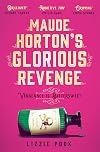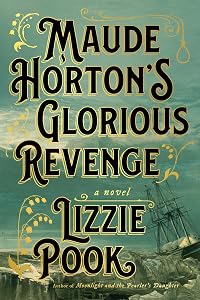
Maude Horton's Glorious Revenge
by Lizzie Pook
On This Page
Description
Twenty-year-old Constance Horton has run away from her life in Victorian London, disguising herself as a boy to board the Makepeace, an expedition vessel bound for the icy and unexplored Northwest Passage of the Arctic. She struggles to keep her real identity a secret on the ship, a feat that only grows more difficult when facing off with the constant dangers of the icy North. Even more dangerous than the cold, the storms, and the hunger, are some of the men aboard, including the ship's show more scientist Edison Stowe. He seems to be watching Constance, and she knows that his attention could be fatal. In London two years later: Maude Horton is searching for the truth. After being told by the British Admiralty that her sister's death onboard the Makepeace was nothing more than a tragic accident, she receives a diary revealing that Edison Stowe had more of a hand in Constance's death than the returning crew acknowledged. In order to get the answers she needs, Maude decides to shadow Edison. She joins him on a new venture he's started to capitalize on the murder mania that has all of London in a frenzy, a travel company that takes guests around the country via train to witness public hangings, to extract the truth from him in any way possible. As tensions and dangers mount, it ultimately falls to Maude to enact the ultimate revenge to get justice for her sister. show lessTags
Recommendations



























Member Reviews
I set 'Maude Horton's Glorious Revenge' (2024) aside at 33%.
The book was well written. I liked that there was no attempt to present it as if it were a novel that could have been published in 1850. The writing felt contemporary and so did most of the dialogue. I thought that made the book more entertaining and avoided it becoming a pastiche. The use of Constance's first-person journal entries for the past and third-person reporting for the present helped stoke my curiosity and gave the story some variety.
The book was well researched. The historical details were fascinating without being burdensome. It brought 1850s London to life with enough detail to make me very glad not to have been born in that era and it describes life on a small show more naval ship in as an ordinary seaman, that makes it feel like something that could only be survived with the help of a lot of rum.
Despite all of that, after I'd read the first third of the book, I found myself reluctant to pick it up again. Why? The worlds described, London and the Makepeace voyaging through the Arctic ice, were unpleasant and oppressive. Edison Stowe, the bad guy in the story, has no redeeming attributes. He was the embodiment of Victorian venal entitlement. Constance, the dead sister was reckless and selfish. Maude, the live sister is about to turn to the dark side to get her revenge. It's clear that there is nothing she won't do to make Stowe pay. I can feel the bad things coming and I know they will be vivid, credible and vicious.
I don't want all that nastieness in my head, especially if all I get is a story of self-destructive revenge, so I've set the book aside.
I would like to read more of Lizzie Pook's work, so I'll be giving her debut novel, 'Moonlight and the Pearler's Daughter' (2022) a try. show less
The book was well written. I liked that there was no attempt to present it as if it were a novel that could have been published in 1850. The writing felt contemporary and so did most of the dialogue. I thought that made the book more entertaining and avoided it becoming a pastiche. The use of Constance's first-person journal entries for the past and third-person reporting for the present helped stoke my curiosity and gave the story some variety.
The book was well researched. The historical details were fascinating without being burdensome. It brought 1850s London to life with enough detail to make me very glad not to have been born in that era and it describes life on a small show more naval ship in as an ordinary seaman, that makes it feel like something that could only be survived with the help of a lot of rum.
Despite all of that, after I'd read the first third of the book, I found myself reluctant to pick it up again. Why? The worlds described, London and the Makepeace voyaging through the Arctic ice, were unpleasant and oppressive. Edison Stowe, the bad guy in the story, has no redeeming attributes. He was the embodiment of Victorian venal entitlement. Constance, the dead sister was reckless and selfish. Maude, the live sister is about to turn to the dark side to get her revenge. It's clear that there is nothing she won't do to make Stowe pay. I can feel the bad things coming and I know they will be vivid, credible and vicious.
I don't want all that nastieness in my head, especially if all I get is a story of self-destructive revenge, so I've set the book aside.
I would like to read more of Lizzie Pook's work, so I'll be giving her debut novel, 'Moonlight and the Pearler's Daughter' (2022) a try. show less
If I hadn’t already read Lizzie Pook’s delightful first novel Moonlight and the Pearler’s Daughter I would have still jumped at the chance to read Maude Horton’s Glorious Revenge. All I had to see were the words “Victorian London” and “Northwest Passage”!
In 1845, the war hero and explorer John Franklin set off on a second expedition to search for a passage to the East through the Arctic. After they didn’t return, search parties were sent to look for them.
The Arctic explorers were the astronauts of the 1840s, sailing into the unknown frozen North with its terrors and monstrous creatures, polar bears and narwhales and walrus. They seized the public’s imagination.
The Victorians lusted for news about murders and show more hangings, freaks, and abnormal behavior.
Pook imagines two sisters. Constance is obsessed with the Arctic. She longs for adventure, and learning that another ship is going to search for the lost Franklin expedition, she disguises herself and signs up as a cabin boy. When the ship returns, she is reported as having died. Her sister Maude is determined to learn how her sister passed.
Constance’s story is told by the journal she kept, which Maude is given. It mentions a man who posed a threat to Constance, Edison Stowe, whose sick obsessions she had discovered. Maude tracks Stowe down and formulates a plan to get close to him and learn her sister’s fate.
This page-turner takes us into the Arctic and the bowels and masts of a sailing ship, and to the spectacles of public hangings, and even into Madame Tussaud’s Chamber of Horrors. It’s a dark story, full of suspense and violence, with poetic justice meted out at the end.
Thanks to the publisher for a free book. show less
In 1845, the war hero and explorer John Franklin set off on a second expedition to search for a passage to the East through the Arctic. After they didn’t return, search parties were sent to look for them.
The Arctic explorers were the astronauts of the 1840s, sailing into the unknown frozen North with its terrors and monstrous creatures, polar bears and narwhales and walrus. They seized the public’s imagination.
The Victorians lusted for news about murders and show more hangings, freaks, and abnormal behavior.
Pook imagines two sisters. Constance is obsessed with the Arctic. She longs for adventure, and learning that another ship is going to search for the lost Franklin expedition, she disguises herself and signs up as a cabin boy. When the ship returns, she is reported as having died. Her sister Maude is determined to learn how her sister passed.
Constance’s story is told by the journal she kept, which Maude is given. It mentions a man who posed a threat to Constance, Edison Stowe, whose sick obsessions she had discovered. Maude tracks Stowe down and formulates a plan to get close to him and learn her sister’s fate.
This page-turner takes us into the Arctic and the bowels and masts of a sailing ship, and to the spectacles of public hangings, and even into Madame Tussaud’s Chamber of Horrors. It’s a dark story, full of suspense and violence, with poetic justice meted out at the end.
Thanks to the publisher for a free book. show less
During Victorian England, a young woman, Constance Horton, disguised herself as a boy and took to the sea on a vessel heading for the Artic looking for the lost ship of an English explorer. Her sister, Maude Horton, has received the message that Constance has died, and she searches for the reason why. A young man brings her a diary that her sister had written while on the ship pointing to a vicious man that searches for bones, etc.
The story is somewhat of a stretch as to how this young woman could remain hidden on such a ship. A this time, public hangings are extremely popular even bringing about "tours" to such events. Maude finds herself on one such tour searching for the man that killed her sister.
Story is almost all plot with very show more little characterization and the diary entries really do not particularly sound believable. show less
The story is somewhat of a stretch as to how this young woman could remain hidden on such a ship. A this time, public hangings are extremely popular even bringing about "tours" to such events. Maude finds herself on one such tour searching for the man that killed her sister.
Story is almost all plot with very show more little characterization and the diary entries really do not particularly sound believable. show less
I finished this book yesterday, and I thought "What did I just read?" I'm not sure what I was expecting, but what I got was not really for me. The book begins with an Arctic expedition set in the 19th century. It begins with 20-year-old- Constance Horton who signs on as a ship's boy on the Makepiece, which is a vessel that was being sent to the Arctic to find out what happened to the Franklin Expedition, which had disappeared while on a voyage to find the Northwest Passage. Constance does not come back to England when the Makepiece returns, and Maude Horton, her sister, is trying to find out what happened to her. Maude has Constance's diary, and she knows from there that one particular man who was also on the Makepiece was responsible show more for the disappearance of her sister. Edison Stowe is that man, but Maude knows that he is also very dangerous. The book is a cat-and-mouse chase across England as Maude Horton joins Edison Stowe's popular hanging excursions which is a touring company which follows the public hangings in and around England. I found the book convoluted and hard to follow. I was listening to it on audiobook, and that might explain my lack of comprehension, and understanding of what the author was trying to portray. I did finish the book, but I did not enjoy it. Wrong genre for me, I guess. show less
Ratings
Members
- Recently Added By
Lists

Books Read in 2025
4,091 works; 97 members
Author Information
3 Works 261 Members
Some Editions
Awards and Honors
Common Knowledge
- Canonical title
- Maude Horton's Glorious Revenge
- People/Characters
- Maude Horton; Constance Horton; Henry Horton; Francis Heart; Edison Stowe; George Inchbold (show all 13); Abel Mance; Adelaide Swan; Hattie; William Calcraft; Silas Blackthorn; Giles Sedgewick; Charles Arnott
- Important places
- Greenland; Beechey Island, Nunavut, Canada; King William Island, Nunavut, Canada
- Important events
- Franklin's Lost Expedition (1845 | 1848)
- Epigraph
- Murder is, doubtless, a very shocking offence; nevertheless, as what is done is not to be undone, let us make our money of it. - "Blood," Punch, 1842
Ah Franklin! To follow you, one does not need geography. At least not totally, but more of that. Instrumental knowledge that bones have, Their limits, their measurings, The eye create the horizon, The ear invents the wind, Th... (show all)e hand reaching out from the parka sleeve. By touch demands that the touched thing be. - Gwendolyn MacEwen, Terror and Erebus - Dedication
- For Bobby
- First words
- Let us begin at the end, shall? In a cold London square.
- Last words
- (Click to show. Warning: May contain spoilers.)The sun gives a flash of its warmth through the London sky, and Maude Horton, her sister beside her, pulls tight the shawl around her shoulders and disappears into the trees.
- Blurbers
- Lloyd, Ellery; Hart, Emilia; Stonex, Emma; McCulloch, Amy; Trigiani, Adriana
Classifications
Statistics
- Members
- 110
- Popularity
- 294,433
- Reviews
- 5
- Rating
- (3.41)
- Languages
- English, French, German
- Media
- Paper, Audiobook, Ebook
- ISBNs
- 18
- ASINs
- 3