On This Page
Description
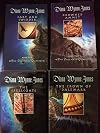
When their father, a traveling minstrel, is killed, three children involved in rebellion and intrigue inherit a lute-like cwidder with more than musical powers.Tags
Recommendations











Member Reviews
Just reread Cart & Cwidder 13 Feb 2023 - might keep going though.
Comfort reread. Why do I ship Kialan and Dagnar this time, lol.
I kept thinking about the way Moril is seen from the outside as sulky and teenagery in the 4th book. As usual, the way magic works is poetic and ineffable and not exactly spelled out even though Moril introspecting about it is a big part of the last half of the book. Moril seeing Hestefan and realizing that that's what he'll look like as an adult is a whole mood.
RE: CROWN OF DALEMARK, 2017-05-21
I saw this in the used bookstore near my work, and thought "yes, I *do* want to reread that for a dollar." It's been a long time since I last read the Dalemark books so things came back to me slowly and piecemeal in that show more pleasurable way.
I have Thoughts about the Adon's gifts as they relate to the tarot and the plot events surrounding:
Ring/pentacles/earth, money and career:Mitt's conversation with Alk about giving up theft
Cup/cups/water, relationships and emotions:Mitt working through his feelings about Hildy
Sword/swords/air, intellect, logic, and thought:Mitt and Moril solving the sword puzzle, and then realizing they shouldn't solve it and figuring out how to bungle it
Crown/wands/fire, action, inspiration, and energy:the conversation with Hern
4.5 rounded up to 5 for nostalgia. Now I really want to reread the other three! So I guess it'll cost me more than a dollar. show less
Comfort reread. Why do I ship Kialan and Dagnar this time, lol.
I kept thinking about the way Moril is seen from the outside as sulky and teenagery in the 4th book. As usual, the way magic works is poetic and ineffable and not exactly spelled out even though Moril introspecting about it is a big part of the last half of the book. Moril seeing Hestefan and realizing that that's what he'll look like as an adult is a whole mood.
RE: CROWN OF DALEMARK, 2017-05-21
I saw this in the used bookstore near my work, and thought "yes, I *do* want to reread that for a dollar." It's been a long time since I last read the Dalemark books so things came back to me slowly and piecemeal in that show more pleasurable way.
I have Thoughts about the Adon's gifts as they relate to the tarot and the plot events surrounding:
Ring/pentacles/earth, money and career:
Cup/cups/water, relationships and emotions:
Sword/swords/air, intellect, logic, and thought:
Crown/wands/fire, action, inspiration, and energy:
4.5 rounded up to 5 for nostalgia. Now I really want to reread the other three! So I guess it'll cost me more than a dollar. show less
Cart & Cwidder
Originally published in 1975. I really wish I had read this short novel as a kid. I still enjoyed reading it now, but I think it would have been one of my favorite books if I had read it at a younger age.
Although a YA novel, with a fun and fast-moving, adventurous tone, this book doesn't shy away from ‘heavier' emotional issues and political situations.
The feudal land of Dalemark is divided, and the South is extremely politically repressive. But people depend on traveling minstrels for not only entertainment but news and mail delivery – so entertainers have a more free rein than most. Moril has spent his whole life traveling and performing with his family from a horse-drawn cart, singing and playing the cwidder across show more the land.
But when his father is murdered by a group of richly-dressed men, his mother immediately chooses to return to the stable, well-to-do suitor that she left for a musician years before. Moril and his brother and sister, driven both by suspicions that their mother's new beau had something to do with the murder, and a lack of enthusiasm for a bourgeois lifestyle, take the cart and strike out on their own, agreeing to take the young man who had been their family's passenger to his destination in the North.
More trouble awaits than they had bargained on however, as secrets regarding an underground political movement are revealed, and the children realize that their life was not all the happy-go-lucky glamour that it seemed. Soon they're well in over their heads – which makes it convenient that Moril's inherited cwidder, reputed to have belonged to the legendary bard Osfameron, may have more-than-simply-musical powers.
Drowned Ammet
Takes place at the same time as the previous novel, but with different characters.
In South Dalemark, after their landlord conspires to throw his family off their farm, a boy named Mitt must struggle to fit into town life, as his mother works hard (but uses her money spendthrift-ly) and his father gets involved in an illegal revolutionary movement.
When the political group is betrayed, Mitt, with the encouragement of his mother, devotes himself to becoming a double agent – involved with his father's group, but secretly bent on betraying those inside the group that he believes sold out his father. His allegiances are difficult, as one of those men treats him like a son, and in addition, his stepfather seems to offer him a respectable, straight-and-narrow path. But Mitt is obsessed with his plan to blow up the Earl during the festival of Ammet and to blame his radical compatriots for the crime.
But nothing turns out quite the way he planned, and Mitt finds himself on a sea voyage with two rich kids, and with the involvement of two pagan/folk-type supernatural figures, Ammett himself and the fertility goddess(?) Libby Beer, Mitt will have to grow, face some truths, and make some hard decisions about his path.
The Spellcoats
At first, this story seems to have little relationship to the two before it. It's not till the very end that it's revealed that it takes place in Dalemark – but during near-prehistoric times. The society portrayed is very primitive, perhaps analogous to Bronze Age tribes in Britain. When most of the men of a village go off to fight a war against some blond invaders, the pale, fair looks passed down to one family's children by their mysterious, foreign(?) mother make them a target of fear and superstition.
They escape their threatening neighbors, bringing only their household gods with them in a boat down the river – but these gods turn out to be more than the reader might have assumed, as they embark on a journey of danger and magic, which will lead them not only to the center of the conflict between two tribes, but to the greater threat posed to all by an evil, soul-catching sorcerer.
The narrator is a young woman who tells the story through her complicated weaving, setting her tale down in a textile coat. To her people, these ‘spellcoats' have both traditional and magical powers, and the record of her story will become essential to her story...
The Crown of Dalemark
In this last book, many of the elements of ‘The Spellcoats' become more clear, as it is shown that many of the characters and gods mentioned in that story have become part of Dalemark's mythology and legends – it explains why it was decided to print it there, out of chronological order!
Here, Maewen, a young girl from ‘modern' Dalemark is convinced/tricked to go 200 years back in time and impersonate a young woman who has disappeared – but who was convinced that gods spoke to her and that she was destined to be Queen of all Dalemark, reuniting the conflict-riven North and South. Maewen has doubts about this, as she meets characters that she was familiar with from paintings that she saw displayed of famous people from Dalemark's history – but she has never heard anything about this supposedly-important young ‘Queen.'
Still, she feels she has very little choice but to go along with it, and as time goes on, she finds herself becoming emotionally involved in the situation she finds herself in – one that, for the reader, is yet more entertaining, because it involves characters we've met before in the other novels collected here.
All four of these books are good, and although they're not precisely part of a ‘series,' they go well together.
I think the appeal of Wynne Jones' books is that she believes strongly in ‘good' – and this comes through in all of her stories. But, at the same time, she has neither a simplistic view of the world or the naïve expectation that everything will go as it should or that authority can be trusted. show less
Originally published in 1975. I really wish I had read this short novel as a kid. I still enjoyed reading it now, but I think it would have been one of my favorite books if I had read it at a younger age.
Although a YA novel, with a fun and fast-moving, adventurous tone, this book doesn't shy away from ‘heavier' emotional issues and political situations.
The feudal land of Dalemark is divided, and the South is extremely politically repressive. But people depend on traveling minstrels for not only entertainment but news and mail delivery – so entertainers have a more free rein than most. Moril has spent his whole life traveling and performing with his family from a horse-drawn cart, singing and playing the cwidder across show more the land.
But when his father is murdered by a group of richly-dressed men, his mother immediately chooses to return to the stable, well-to-do suitor that she left for a musician years before. Moril and his brother and sister, driven both by suspicions that their mother's new beau had something to do with the murder, and a lack of enthusiasm for a bourgeois lifestyle, take the cart and strike out on their own, agreeing to take the young man who had been their family's passenger to his destination in the North.
More trouble awaits than they had bargained on however, as secrets regarding an underground political movement are revealed, and the children realize that their life was not all the happy-go-lucky glamour that it seemed. Soon they're well in over their heads – which makes it convenient that Moril's inherited cwidder, reputed to have belonged to the legendary bard Osfameron, may have more-than-simply-musical powers.
Drowned Ammet
Takes place at the same time as the previous novel, but with different characters.
In South Dalemark, after their landlord conspires to throw his family off their farm, a boy named Mitt must struggle to fit into town life, as his mother works hard (but uses her money spendthrift-ly) and his father gets involved in an illegal revolutionary movement.
When the political group is betrayed, Mitt, with the encouragement of his mother, devotes himself to becoming a double agent – involved with his father's group, but secretly bent on betraying those inside the group that he believes sold out his father. His allegiances are difficult, as one of those men treats him like a son, and in addition, his stepfather seems to offer him a respectable, straight-and-narrow path. But Mitt is obsessed with his plan to blow up the Earl during the festival of Ammet and to blame his radical compatriots for the crime.
But nothing turns out quite the way he planned, and Mitt finds himself on a sea voyage with two rich kids, and with the involvement of two pagan/folk-type supernatural figures, Ammett himself and the fertility goddess(?) Libby Beer, Mitt will have to grow, face some truths, and make some hard decisions about his path.
The Spellcoats
At first, this story seems to have little relationship to the two before it. It's not till the very end that it's revealed that it takes place in Dalemark – but during near-prehistoric times. The society portrayed is very primitive, perhaps analogous to Bronze Age tribes in Britain. When most of the men of a village go off to fight a war against some blond invaders, the pale, fair looks passed down to one family's children by their mysterious, foreign(?) mother make them a target of fear and superstition.
They escape their threatening neighbors, bringing only their household gods with them in a boat down the river – but these gods turn out to be more than the reader might have assumed, as they embark on a journey of danger and magic, which will lead them not only to the center of the conflict between two tribes, but to the greater threat posed to all by an evil, soul-catching sorcerer.
The narrator is a young woman who tells the story through her complicated weaving, setting her tale down in a textile coat. To her people, these ‘spellcoats' have both traditional and magical powers, and the record of her story will become essential to her story...
The Crown of Dalemark
In this last book, many of the elements of ‘The Spellcoats' become more clear, as it is shown that many of the characters and gods mentioned in that story have become part of Dalemark's mythology and legends – it explains why it was decided to print it there, out of chronological order!
Here, Maewen, a young girl from ‘modern' Dalemark is convinced/tricked to go 200 years back in time and impersonate a young woman who has disappeared – but who was convinced that gods spoke to her and that she was destined to be Queen of all Dalemark, reuniting the conflict-riven North and South. Maewen has doubts about this, as she meets characters that she was familiar with from paintings that she saw displayed of famous people from Dalemark's history – but she has never heard anything about this supposedly-important young ‘Queen.'
Still, she feels she has very little choice but to go along with it, and as time goes on, she finds herself becoming emotionally involved in the situation she finds herself in – one that, for the reader, is yet more entertaining, because it involves characters we've met before in the other novels collected here.
All four of these books are good, and although they're not precisely part of a ‘series,' they go well together.
I think the appeal of Wynne Jones' books is that she believes strongly in ‘good' – and this comes through in all of her stories. But, at the same time, she has neither a simplistic view of the world or the naïve expectation that everything will go as it should or that authority can be trusted. show less
Ratings
Members
- Recently Added By
Lists

Favourite High Fantasy Books
113 works; 23 members

Epic fantasy by female authors
47 works; 7 members

Books I Wish I’d Read as a Kid
32 works; 4 members
Author Information

112+ Works 80,448 Members
Diana Wynne Jones was born in London on August 16, 1934. In 1953, she began school at St. Anne's College Oxford and attended lectures by J. R. R. Tolkien and C. S. Lewis. After graduation, she created plays for children that were performed at the London Arts Theatre. Her first book was published in 1973. She wrote over 40 books during her lifetime show more including Dark Lord of Derkholm, Earwig and the Witch, and the Chrestomanci series. She won numerous awards including the Guardian Award for Children's Books in 1977 for Charmed Life, the Boston Globe-Horn Book Award in 1984 for Archer's Goon, the Mythopeic Award in 1999, the Karl Edward Wagner Award in 1999, and the Life Achievement Award from the World Fantasy Organization in 2007. Her book Howl's Moving Castle was adapted into an animated film by director Hayao Miyazaki, and the film was nominated for an Academy Award for Best Animated Feature. She died from lung cancer on March 26, 2011 at the age of 76. (Bowker Author Biography) show less
Some Editions
Series

Work Relationships
Common Knowledge
- Canonical title
- The Dalemark Quartet
- Original publication date
- 2003
Classifications
Statistics
- Members
- 241
- Popularity
- 134,977
- Reviews
- 2
- Rating
- (3.68)
- Languages
- English
- Media
- Paper, Ebook
- ISBNs
- 3
- ASINs
- 4