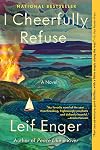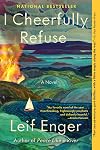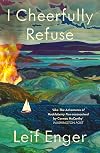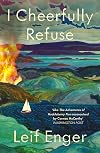
I Cheerfully Refuse
by Leif Enger
On This Page
Description
"Set in a not-too-distant America, I Cheerfully Refuse is the tale of a bereaved and pursued musician embarking under sail on a sentient Lake Superior in search of his departed, deeply beloved, bookselling wife. Rainy, an endearing bear of an Orphean narrator, seeks refuge in the harbors, fogs, and remote islands of the inland sea. Encountering lunatic storms and rising corpses from the warming depths, Rainy finds on land an increasingly desperate and illiterate people, a malignant show more billionaire ruling class, crumbled infrastructure, and a lawless society. Amid the Gulliver-like challenges of life at sea and no safe landings, Rainy is lifted by physical beauty, surprising humor, generous strangers, and an unexpected companion in a young girl who comes aboard. And as his innate guileless nature begins to make an inadvertent rebel of him, Rainy's private quest for the love of his life grows into something wider and wilder, sweeping up friends and foes alike in his strengthening wake. I Cheerfully Refuse epitomizes the "musical, sometimes magical and deeply satisfying kind of storytelling" (Los Angeles Times) for which Leif Enger is cherished. A rollicking narrative in the most evocative of settings, this latest novel is a symphony against despair and a rallying cry for the future"-- show lessTags
Recommendations












































Member Reviews
Summary: In a dystopian America, Rainy and Lark carve out a joyful life until tragedy sends Rainy on a Lake Superior odyssey.
I don’t typically select books this way. Looking at a table of new works at my local store, the cover art of this book caught my eye. The description sounded like a modern day odyssey. And the author was from Minnesota. Having had a good experience with another Minnesota author, William Kent Krueger, I thought I’d give Leif Enger a try. I’m so glad I did, though amid the goodness, truth and beauty of the story was heartbreak and terrible darkness.
The setting is Lake Superior in a not-too-distant future America. Societal order, the economy, and the climate have collapsed. The country is controlled by sixteen show more multi-billionaire “astronauts.” Some semblance of societal order is maintained by pharmaceuticals developed aboard “ships of horror.” Children are rated on a “feral scale” and medicated. And if it all becomes intolerable, a little slip of paper with a drug called “Willow” will help you end it all. And some are having “Willow” parties. Libraries have closed and books are becoming an increasingly scarce commodity.
Rainy and Lark have somehow carved out a joyful life together. He’s a big bear of a man who paints houses, plays bass guitar, often with a local band, but sometimes just to comfort his friends. Lark is a former librarian with a big heart and a passion for books. She runs a second-hand bookstore in a bakery, scouring estate sales for book collections. Lark taught Rainy to sail, going to a place called “The Slates,” where they had a somewhat mystical encounter they believed was with Molly Thorn, thought to be dead. Consequently, they buy and re-hab an old sailboat.
Lark, in her open-heartedness brings home a fugitive, Kellen. He has run away from one of the pharmaceutical ships. Perhaps the fact that he had in his possession an unpublished work of Molly Thorn’s, I Cheerfully Refuse, sufficiently seals the deal and he stays with the couple. But tragedy strikes the night of Lark’s birthday. Kellen has disappeared. After a futile hunt, he returns home to find his home destroyed, and Lark brutally murdered. A stranger, an older gentleman, who he later learns is Werryck, ran the ship Kellen had fled, and has been around the town, and through the book, has traced Kellen to their house. That’s why Kellen has gone.
Not only that, Werryck is after Rainy. Whatever they tore up the house looking for is still missing. So, Rainy takes to his boat. The only destination he can think of is “The Slates,” hoping perhaps he will find Lark there. Along the way, he is joined by Sol, a young girl he rescues from an abuser, buying her with his bass. Together they endure Superior’s terrible storms, scrape together an existence, outsmart a corrupt bridge operator, and search for an old relative who once cared for her.
The novel asks the question what kind of people will we become and what kind of communities will we form when the societal order fails? Along the way, amid the corruption, Rainy and Sol will find outposts of goodness. But what kind of person will Rainy, who has lived by goodness, supporting his friends, become? He faces his greatest test when he becomes Werryck’s captive.
Rainy’s sailing journey on Lake Superior strikes me as a modern-day Odyssey. Will he, in the end, find home? And how will the journey have changed him? Also, not unlike Octavia Butler’s Parable of the Sower, Enger confronts us with a very possible dystopia, asking us what kind of people we would be in such times. He does all this in a compellingly beautiful story. show less
I don’t typically select books this way. Looking at a table of new works at my local store, the cover art of this book caught my eye. The description sounded like a modern day odyssey. And the author was from Minnesota. Having had a good experience with another Minnesota author, William Kent Krueger, I thought I’d give Leif Enger a try. I’m so glad I did, though amid the goodness, truth and beauty of the story was heartbreak and terrible darkness.
The setting is Lake Superior in a not-too-distant future America. Societal order, the economy, and the climate have collapsed. The country is controlled by sixteen show more multi-billionaire “astronauts.” Some semblance of societal order is maintained by pharmaceuticals developed aboard “ships of horror.” Children are rated on a “feral scale” and medicated. And if it all becomes intolerable, a little slip of paper with a drug called “Willow” will help you end it all. And some are having “Willow” parties. Libraries have closed and books are becoming an increasingly scarce commodity.
Rainy and Lark have somehow carved out a joyful life together. He’s a big bear of a man who paints houses, plays bass guitar, often with a local band, but sometimes just to comfort his friends. Lark is a former librarian with a big heart and a passion for books. She runs a second-hand bookstore in a bakery, scouring estate sales for book collections. Lark taught Rainy to sail, going to a place called “The Slates,” where they had a somewhat mystical encounter they believed was with Molly Thorn, thought to be dead. Consequently, they buy and re-hab an old sailboat.
Lark, in her open-heartedness brings home a fugitive, Kellen. He has run away from one of the pharmaceutical ships. Perhaps the fact that he had in his possession an unpublished work of Molly Thorn’s, I Cheerfully Refuse, sufficiently seals the deal and he stays with the couple. But tragedy strikes the night of Lark’s birthday. Kellen has disappeared. After a futile hunt, he returns home to find his home destroyed, and Lark brutally murdered. A stranger, an older gentleman, who he later learns is Werryck, ran the ship Kellen had fled, and has been around the town, and through the book, has traced Kellen to their house. That’s why Kellen has gone.
Not only that, Werryck is after Rainy. Whatever they tore up the house looking for is still missing. So, Rainy takes to his boat. The only destination he can think of is “The Slates,” hoping perhaps he will find Lark there. Along the way, he is joined by Sol, a young girl he rescues from an abuser, buying her with his bass. Together they endure Superior’s terrible storms, scrape together an existence, outsmart a corrupt bridge operator, and search for an old relative who once cared for her.
The novel asks the question what kind of people will we become and what kind of communities will we form when the societal order fails? Along the way, amid the corruption, Rainy and Sol will find outposts of goodness. But what kind of person will Rainy, who has lived by goodness, supporting his friends, become? He faces his greatest test when he becomes Werryck’s captive.
Rainy’s sailing journey on Lake Superior strikes me as a modern-day Odyssey. Will he, in the end, find home? And how will the journey have changed him? Also, not unlike Octavia Butler’s Parable of the Sower, Enger confronts us with a very possible dystopia, asking us what kind of people we would be in such times. He does all this in a compellingly beautiful story. show less
When I met Lark there were two things I had to do, two ideas to embrace or lose my chance. Reading was the first. I could read but rarely did. My parents, ahead of their time, had little use for books, so I grew up a knockabout. It's fair to say in my case size preceded sense. I wasn't a bully--well, probably sometimes. I'm not without regrets.
Rainy's a big guy with a kind heart and he and Lark have made a meaningful life for themselves in this dystopian version of the United States (dystopian, yet far too close to our present situation for comfortable reading). Lark, who was a librarian back when libraries existed, runs an illegal bookstore out of a bakery and Rainy plays bass guitar in a bar band on the weekends and picks up jobs here show more and there and fixes up a run down sailboat in between. They also rent out their attic room and it's a lodger who eventually brings ruin down on them, sending Rainy fleeing onto Lake Superior in that sailboat. What follows is Rainy as a Richard Kimble-Odysseus like character, landing in different places along the coast as he works his way toward the Slate Islands, where he and Lark once traveled.
Look out the window, will you? At the clouds, ripped at the edges and moving fast. The sea like a shroud. The eaves bare of ravens, every bird flown.
Leif Enger's writing style is engaging and he imbues every character and situation with humanity and heart. Rainy is an impossible guy not to love, he's so pure of heart and works so hard to do the right thing. He is eventually joined with by Pippi Longstocking-like sidekick, who gives him someone to protect, and she's a lovely addition to the story, which often feels episodic in nature. While Enger's writing is solid, he sometimes goes a little far with Rainy's ability to read deep emotions into quick glances at people he's never met.
I waved a greeting she did not return. Her eyes were clear and farcical and I fell short in her assessment. The tip of her cigarette brightened.
But that's a quibble in a story so engaging and well-paced as this one. show less
Rainy's a big guy with a kind heart and he and Lark have made a meaningful life for themselves in this dystopian version of the United States (dystopian, yet far too close to our present situation for comfortable reading). Lark, who was a librarian back when libraries existed, runs an illegal bookstore out of a bakery and Rainy plays bass guitar in a bar band on the weekends and picks up jobs here show more and there and fixes up a run down sailboat in between. They also rent out their attic room and it's a lodger who eventually brings ruin down on them, sending Rainy fleeing onto Lake Superior in that sailboat. What follows is Rainy as a Richard Kimble-Odysseus like character, landing in different places along the coast as he works his way toward the Slate Islands, where he and Lark once traveled.
Look out the window, will you? At the clouds, ripped at the edges and moving fast. The sea like a shroud. The eaves bare of ravens, every bird flown.
Leif Enger's writing style is engaging and he imbues every character and situation with humanity and heart. Rainy is an impossible guy not to love, he's so pure of heart and works so hard to do the right thing. He is eventually joined with by Pippi Longstocking-like sidekick, who gives him someone to protect, and she's a lovely addition to the story, which often feels episodic in nature. While Enger's writing is solid, he sometimes goes a little far with Rainy's ability to read deep emotions into quick glances at people he's never met.
I waved a greeting she did not return. Her eyes were clear and farcical and I fell short in her assessment. The tip of her cigarette brightened.
But that's a quibble in a story so engaging and well-paced as this one. show less
Although dystopian novels arent usually something I seek out, author Leif Enger writes so beautifully that I was eager to see how he handled such a topic. His newest novel, I Cheerfully Refuse, is not just a dystopian novel but an odyssey for our time.
In a world ruled by the wealthiest, subject to devastating weather events, and populated by small outposts of people living hard scrabble lives, Rainy (short for Ranier), a musician and odd jobber, and his beloved wife Lark, a bookseller, live mostly contented lives. They are good, resourceful people, liked by their community, and still capable of occasional dreams. When Lark brings home a refugee named Kellan who is being pursued by dark forces, Rainy looks the other way, especially since show more Kellan gives Lark a copy of I Cheerfully Refuse, the sole and rare novel she has yet to read by an author named Molly Thorn, who has played a large part in Rainy and Lark's life. But Kellan's presence and then absence brings Rainy into the crosshairs of those in charge of this terrible, not too future world, forcing him to flee on a small sailboat named Flower, into the uncertain, warming waters of Lake Superior searching for Lark.
As Rainy sails around, he encounters the remnants of civilization with people who are desperate, evil, rebellious, con artists, beaten down, and occasionally good and kind. He also rescues a young girl named Sol along his way and the two of them form an awkward sort of partnership as time goes on. They are battered by catastrophic weather events, faced with direct evidence of the great inequality of their society, and presented with true evil on their long and meandering odyssey.
Enger does a masterful job protraying the menace of a society that is crumbling, one that is governed by the amoral and the uncaring, that sees its people as dispensable and disposable. His characters are complete and worthy guides to his story. The setting of the novel, on the shores and waters of Lake Superior, is absolutely integral to the novel. And Enger has found an effective and disturbing way to highlight the impact of climate change on the world of the novel (and our own if we don't change course quickly!): Lake Superior, which famously does not give up her dead, is in fact, giving them up in this novel as the drowned of past decades and centuries bob to the surface in a regular, macabre display. It's not a comfortable story but it's not as bleak as it can sometimes seem either. Enger's writing is beautiful, easing the reader through the story, towards an earned and yet unknowable end. The novel is both grim and hopeful, centering oppression and the destruction of our planet and our society, but also celebrating love and chosen family. The novel can be a tad confusing at times but then the possible end of times would be, wouldn't it? show less
In a world ruled by the wealthiest, subject to devastating weather events, and populated by small outposts of people living hard scrabble lives, Rainy (short for Ranier), a musician and odd jobber, and his beloved wife Lark, a bookseller, live mostly contented lives. They are good, resourceful people, liked by their community, and still capable of occasional dreams. When Lark brings home a refugee named Kellan who is being pursued by dark forces, Rainy looks the other way, especially since show more Kellan gives Lark a copy of I Cheerfully Refuse, the sole and rare novel she has yet to read by an author named Molly Thorn, who has played a large part in Rainy and Lark's life. But Kellan's presence and then absence brings Rainy into the crosshairs of those in charge of this terrible, not too future world, forcing him to flee on a small sailboat named Flower, into the uncertain, warming waters of Lake Superior searching for Lark.
As Rainy sails around, he encounters the remnants of civilization with people who are desperate, evil, rebellious, con artists, beaten down, and occasionally good and kind. He also rescues a young girl named Sol along his way and the two of them form an awkward sort of partnership as time goes on. They are battered by catastrophic weather events, faced with direct evidence of the great inequality of their society, and presented with true evil on their long and meandering odyssey.
Enger does a masterful job protraying the menace of a society that is crumbling, one that is governed by the amoral and the uncaring, that sees its people as dispensable and disposable. His characters are complete and worthy guides to his story. The setting of the novel, on the shores and waters of Lake Superior, is absolutely integral to the novel. And Enger has found an effective and disturbing way to highlight the impact of climate change on the world of the novel (and our own if we don't change course quickly!): Lake Superior, which famously does not give up her dead, is in fact, giving them up in this novel as the drowned of past decades and centuries bob to the surface in a regular, macabre display. It's not a comfortable story but it's not as bleak as it can sometimes seem either. Enger's writing is beautiful, easing the reader through the story, towards an earned and yet unknowable end. The novel is both grim and hopeful, centering oppression and the destruction of our planet and our society, but also celebrating love and chosen family. The novel can be a tad confusing at times but then the possible end of times would be, wouldn't it? show less
Lost in the quiet, understated telling of this story, one could almost forget that things have gone terribly wrong. Somehow Enger pulls a rabbit out of a hat, hope and renewal out of loss and tragedy. It’s a marvelous thing to marinate in the languid beauty of the language. And yet almost everything has been lost. It’s hard to put a finger on what that means. The world has changed. Our civilization is … what? In decline? Over? It’s hard to pinpoint because this is the story of a man, not a world.
The protagonist, Rainy, known intimately by his first person narration, possesses an equipoise both admirable and probably dubious. Could we navigate this as well? But it’s his lyrical telling that carries this immersive tale from show more peaceful accommodation through terror and ultimately beyond.
It's also about sailing. show less
The protagonist, Rainy, known intimately by his first person narration, possesses an equipoise both admirable and probably dubious. Could we navigate this as well? But it’s his lyrical telling that carries this immersive tale from show more peaceful accommodation through terror and ultimately beyond.
It's also about sailing. show less
Series Info/Source: This is a stand alone book. I borrowed this on ebook from the library.
Thoughts: This was an intriguing read that moves at a deliberate pace. I enjoyed the near future subtly dystopian setting and the Lake Superior location (we recently bought a home next to Lake Superior and I love it up there!). The story is mainly driven by two things: (1) will Rainy make it to the mysterious island and find his wife and (2) will Rainy escape the evil men that are after him.
Rainy and his wife are scraping by in northern Minnesota in a small town on Lake Superior. The world isn't what it used to be under the current political system. Young people are being forced to sign prolonged contracts with corporations that work them like show more slaves with very little rights, society is divided into the Astronauts (those with huge amounts of money) and everyone else, women are no longer safe to travel on their own as kidnappings and trafficking run rampant. However, Rainy and his wife have a good thing going on. Rainy plays in a band, his wife owns a book shop, and life is pretty much decent. Then, a young man asks to rent the spare room in their house and this leads to a catastrophic chain of events that has Rainy fleeing his home on an old sailboat into the deadly waters of Lake Superior.
I loved the subtly of the dystopian elements of the future here. There was a no major apocalypse that happened; there was just a slow slide of basic human rights and education that landed the United States in such a rough place. Well, it's a good place for the ultra-rich and a horrible place for everyone else.
The story has aspects of survival to it but also spends time discussing and contrasting the beauty and horror of life in general. Lake Superior can be an amazingly beautiful place but also a deadly one. The same can be said for the people Rainy runs in to on his travels. Some are generous and kind and uplifting, and some want to kill him and thrive on human misery. You can't help but contrast a lot of things here with what the United States is facing moving forward. There is mention of a buffoon president and laws put in place that benefit the rich and victimize the poor. There is a background of an increasingly illiterate population and people being coerced into making political decisions based on flash and not substance. This is all in the background and not the main purpose of the story, but it points to a grim possible future.
I also really enjoyed Rainy's relationship with the young girl he rescues from a bad situation. Together, they make each other's lives better and together they work to find peace in a world gone wrong. It's a beautifully written story.
My only issues with this book are fairly small. At times, it moves very slow. Also, it has that unfinished feeling to it that a lot of dystopian/post-apocalyptic books suffer from. I also personally chose a poor time to read this because I was reading it during the US 2024 presidential election and finished it the day after the election results came out. I think that amplified the political background in this book and made me hope that this isn't an eerily accurate representation of the nation's path forward.
My Summary (4/5): Overall I enjoyed this. It is beautiful and thought-provoking. I always enjoy books that find beauty and kindness in bleak circumstances. This book does an excellent job of contrasting beauty and kindness with ugliness and hate. It gives an eerily plausible look at the path the United States could be slowly sliding down but also gives hope that in that new era there will still be enlightment and kindness. I do plan on picking up more of Enger's books in the future, but for now am leaning towards less heavy books while I try to work my way through my feelings of disappointment with the decisions our nation is making. show less
Thoughts: This was an intriguing read that moves at a deliberate pace. I enjoyed the near future subtly dystopian setting and the Lake Superior location (we recently bought a home next to Lake Superior and I love it up there!). The story is mainly driven by two things: (1) will Rainy make it to the mysterious island and find his wife and (2) will Rainy escape the evil men that are after him.
Rainy and his wife are scraping by in northern Minnesota in a small town on Lake Superior. The world isn't what it used to be under the current political system. Young people are being forced to sign prolonged contracts with corporations that work them like show more slaves with very little rights, society is divided into the Astronauts (those with huge amounts of money) and everyone else, women are no longer safe to travel on their own as kidnappings and trafficking run rampant. However, Rainy and his wife have a good thing going on. Rainy plays in a band, his wife owns a book shop, and life is pretty much decent. Then, a young man asks to rent the spare room in their house and this leads to a catastrophic chain of events that has Rainy fleeing his home on an old sailboat into the deadly waters of Lake Superior.
I loved the subtly of the dystopian elements of the future here. There was a no major apocalypse that happened; there was just a slow slide of basic human rights and education that landed the United States in such a rough place. Well, it's a good place for the ultra-rich and a horrible place for everyone else.
The story has aspects of survival to it but also spends time discussing and contrasting the beauty and horror of life in general. Lake Superior can be an amazingly beautiful place but also a deadly one. The same can be said for the people Rainy runs in to on his travels. Some are generous and kind and uplifting, and some want to kill him and thrive on human misery. You can't help but contrast a lot of things here with what the United States is facing moving forward. There is mention of a buffoon president and laws put in place that benefit the rich and victimize the poor. There is a background of an increasingly illiterate population and people being coerced into making political decisions based on flash and not substance. This is all in the background and not the main purpose of the story, but it points to a grim possible future.
I also really enjoyed Rainy's relationship with the young girl he rescues from a bad situation. Together, they make each other's lives better and together they work to find peace in a world gone wrong. It's a beautifully written story.
My only issues with this book are fairly small. At times, it moves very slow. Also, it has that unfinished feeling to it that a lot of dystopian/post-apocalyptic books suffer from. I also personally chose a poor time to read this because I was reading it during the US 2024 presidential election and finished it the day after the election results came out. I think that amplified the political background in this book and made me hope that this isn't an eerily accurate representation of the nation's path forward.
My Summary (4/5): Overall I enjoyed this. It is beautiful and thought-provoking. I always enjoy books that find beauty and kindness in bleak circumstances. This book does an excellent job of contrasting beauty and kindness with ugliness and hate. It gives an eerily plausible look at the path the United States could be slowly sliding down but also gives hope that in that new era there will still be enlightment and kindness. I do plan on picking up more of Enger's books in the future, but for now am leaning towards less heavy books while I try to work my way through my feelings of disappointment with the decisions our nation is making. show less
There have been many near future dystopian novels about climate change and the breakdown of social and governmental order but Leif Enger’s contribution reaches the rare level of combining the genre with lyrical writing, thrilling suspense, appealing characters, and a timeless romance. Additionally, Enger’s portrayal of Lake Superior conveys the profound beauty and threat of this vast inland sea. Enger’s characters encounter its fearful power and mesmerizing beauty.
Rainy and Lark live in an isolated and overlooked pocket community while the wider world around them is enmeshed in turmoil. The wealthy few are in control, the working class a kind of indentured servants. Medical research to keep the population compliant occurs on the show more ‘hospital ships.’ People are choosing death, hopeful for something better. One escapee from this system lands in Rainy’s hometown, on the run, and Lark offers him shelter. The man’s pursuers follow his trail with devastating results.
To save his life, Rainy takes sail on Lake Superior, encountering deadly storms. Stopping at small towns along the coast, he discovers helpful people while others are out for themselves; he visits places of mutual support and those that are raked with division and violence. He picks up a spunky and stowaway girl who seeks her grandfather. But they are stalked by the people who had destroyed Rainy’s life.
Yes, the story sounds horrifying, and there is horror with suicides and murders and corpses floating up from the lake. “What scares me is the notion that we are all one rotten moment, one crushed hope or hollow stomach from stuffing someone blameless in a cage,” Rainy considers.
But Rainy’s deep humanity and love, and the people who work for freedom and offer mutual aid lift the story so that, in the end, you are left with hope. There is still the beauty and wonder of the world, music and art, warmth and safety to be found.
Those familiar with Lake Superior will recognize the landmarks on Rainy’s journey.
Thanks to the publisher for a free book show less
Rainy and Lark live in an isolated and overlooked pocket community while the wider world around them is enmeshed in turmoil. The wealthy few are in control, the working class a kind of indentured servants. Medical research to keep the population compliant occurs on the show more ‘hospital ships.’ People are choosing death, hopeful for something better. One escapee from this system lands in Rainy’s hometown, on the run, and Lark offers him shelter. The man’s pursuers follow his trail with devastating results.
To save his life, Rainy takes sail on Lake Superior, encountering deadly storms. Stopping at small towns along the coast, he discovers helpful people while others are out for themselves; he visits places of mutual support and those that are raked with division and violence. He picks up a spunky and stowaway girl who seeks her grandfather. But they are stalked by the people who had destroyed Rainy’s life.
Yes, the story sounds horrifying, and there is horror with suicides and murders and corpses floating up from the lake. “What scares me is the notion that we are all one rotten moment, one crushed hope or hollow stomach from stuffing someone blameless in a cage,” Rainy considers.
But Rainy’s deep humanity and love, and the people who work for freedom and offer mutual aid lift the story so that, in the end, you are left with hope. There is still the beauty and wonder of the world, music and art, warmth and safety to be found.
Those familiar with Lake Superior will recognize the landmarks on Rainy’s journey.
Thanks to the publisher for a free book show less
Set in a not-too-distant future marked by climate change, lawlessness, and corruption and governed by a dictatorial ruling class known as the astronauts, Rainy, a musician, and his beloved wife, Lark, a bookstore owner, live on the shore of Lake Superior until she is murdered. Rainy, in his grief, sets sail in an old sailboat partly to escape the perpetrators but also in the hope of finding Lark’s spirit. In his journey, he confronts severe storms, extreme evil and violence but he also finds friendship and hope along the way.
I Cheerfully Refuse by Lief Enger is a beautifully written dystopian tale full of contrasts between the beauty of the landscape and the horrors he encounters on shore, between the kindness of some of the show more characters he meets and the shocking cruelty of others and all written in lyrical prose. At times, the tale feels like a wild adventure and, at other times, like a fairy tale wonderfully told. This is not always an easy story - there are suicides, references to paedophilia, lynchings - but, in the end, there is hope. I listened to the audiobook narrated by David Aaron Baker who does an absolutely wonderful job of conveying the beauty and lyricism of Enger’s prose.
Thanks to Netgalley and RB Media for an audiobook of this novel in exchange for an honest review show less
I Cheerfully Refuse by Lief Enger is a beautifully written dystopian tale full of contrasts between the beauty of the landscape and the horrors he encounters on shore, between the kindness of some of the show more characters he meets and the shocking cruelty of others and all written in lyrical prose. At times, the tale feels like a wild adventure and, at other times, like a fairy tale wonderfully told. This is not always an easy story - there are suicides, references to paedophilia, lynchings - but, in the end, there is hope. I listened to the audiobook narrated by David Aaron Baker who does an absolutely wonderful job of conveying the beauty and lyricism of Enger’s prose.
Thanks to Netgalley and RB Media for an audiobook of this novel in exchange for an honest review show less
Members
- Recently Added By
Lists

Book Review Roundup
254 works; 2 members

Books Read 2025
70 works; 2 members
Author Information

13+ Works 9,081 Members
Awards and Honors
Awards
Distinctions
Notable Lists
Common Knowledge
- Original publication date
- 2024
Classifications
Statistics
- Members
- 687
- Popularity
- 41,792
- Reviews
- 37
- Rating
- (3.98)
- Languages
- English
- Media
- Paper, Audiobook, Ebook
- ISBNs
- 10
- ASINs
- 4