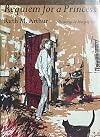
Requiem for a Princess
by Ruth M. Arthur
On This Page
Tags
Recommendations






























Member Reviews
The daughter of a sheep-farmer and his wife, Willow Forrester’s biggest problem was trying to convince her prosaic parents that her beloved music and piano playing would provide an adequate career - until, that is, she accidentally discovers that she was adopted. Unwilling to question her parents, but unable to forget her new-found knowledge, Willow worries away at the notion of her own identity, making herself ill in the process. When the family doctor suggests a holiday, Willow and her mother go to stay at Penliss, a lovely old house in Cornwall, where Willow immediately forms a bond of friendship with the owner, Rosamund Tresilian.
Although Willow feels a strange connection to the portrait of Isabel de Calverados, an orphaned show more Spanish girl adopted by the Tresilian family in Elizabethan times, it is not until her mother leaves her at Penliss for an extended visit and she discovers Isabel’s strange medallion buried in the garden, that she begins to dream of this other adopted daughter. The story of Isabel gradually unfolds, as Willow learns that the young Spanish girl was orphaned when her family were killed by pirates, that she herself was rescued by a British sailor named Anthony Tresilian, who brought her to his home in Cornwall to be cared for, and that she was raised and well-loved by Anthony’s father, Cornelius. Hated by the local people because of her Spanish blood, Isabel nevertheless found friendship, in the form of her Breton nurse, Celestine, and the playful dolphin that liked to visit the local bay; as well as the love of a young man named Richard. But after the death of Cornelius Tresilian, the local people’s enmity grew, and when she was accused of witchcraft, Isabel was forced to flee Cornwall with Richard. Believed lost at sea during a terrible storm, Isabel’s tombstone in the local chapel reads: “In memory of Issable de Calverados aged 17 years, dear adopted daughter of Cornelius Tresilian Esquire, supposed drowned 1602."
Arthur’s narrative is absorbing, her prose deeply evocative but never melodramatic, and the elements of the supernatural are handled with her own inimitable style. Willow’s dreams are clearly some sort of connection to the past, but it is left up to the reader to decide upon the exact nature of that connection. Are they some sort of haunting, or a psychic remnant? Could Willow’s “sleep-walking” episode, in which she wakes up with sand on her feet after having dreamed of being at the bay, be evidence of real time travel? Any or all of these could be the answer, but the notion of dreams as connection to the past also appears in Philippa Pearce’s Tom’s Midnight Garden. show less
Although Willow feels a strange connection to the portrait of Isabel de Calverados, an orphaned show more Spanish girl adopted by the Tresilian family in Elizabethan times, it is not until her mother leaves her at Penliss for an extended visit and she discovers Isabel’s strange medallion buried in the garden, that she begins to dream of this other adopted daughter. The story of Isabel gradually unfolds, as Willow learns that the young Spanish girl was orphaned when her family were killed by pirates, that she herself was rescued by a British sailor named Anthony Tresilian, who brought her to his home in Cornwall to be cared for, and that she was raised and well-loved by Anthony’s father, Cornelius. Hated by the local people because of her Spanish blood, Isabel nevertheless found friendship, in the form of her Breton nurse, Celestine, and the playful dolphin that liked to visit the local bay; as well as the love of a young man named Richard. But after the death of Cornelius Tresilian, the local people’s enmity grew, and when she was accused of witchcraft, Isabel was forced to flee Cornwall with Richard. Believed lost at sea during a terrible storm, Isabel’s tombstone in the local chapel reads: “In memory of Issable de Calverados aged 17 years, dear adopted daughter of Cornelius Tresilian Esquire, supposed drowned 1602."
Arthur’s narrative is absorbing, her prose deeply evocative but never melodramatic, and the elements of the supernatural are handled with her own inimitable style. Willow’s dreams are clearly some sort of connection to the past, but it is left up to the reader to decide upon the exact nature of that connection. Are they some sort of haunting, or a psychic remnant? Could Willow’s “sleep-walking” episode, in which she wakes up with sand on her feet after having dreamed of being at the bay, be evidence of real time travel? Any or all of these could be the answer, but the notion of dreams as connection to the past also appears in Philippa Pearce’s Tom’s Midnight Garden. show less
Re-reading an old favorite. This has almost all of the elements of a perfect Ruth M. Arthur book; a mystery, a troubled adolescent protagonist in search of her own authentic life, a scary old witch, a hidden treasure (not to mention a hidden garden), a love interest, and secrets piled upon secrets. The plot is deeply satisfying and the resolution on all fronts delicious.
It's interesting how many plot elements Arthur recycled time after time- and how fresh they seemed to be in her hands.
It's interesting how many plot elements Arthur recycled time after time- and how fresh they seemed to be in her hands.
While staying in Cornwall, Willow Forrester, dismayed to have discovered that she is adopted, finds herself enthralled by, then in thrall to, the portrait of Isabel de Calverados, a sixteenth century Spanish girl who was also an adopted daughter.
Willow thought she would never recover from the shock of her unexpected discovery. Yet, when, through a series of strong dreams, she came to know a proud, lonely, sixteenth century girl, also adopted, she found answers to questions she had hardly dared ask.
Willow thought she would never recover from the shock of her unexpected discovery. Yet, when, through a series of strong dreams, she came to know a proud, lonely, sixteenth century girl, also adopted, she found answers to questions she had hardly dared ask.
The description fits. It's a bit of a mystery, a bit of a ghost story, and very much a coming-of-age story. Even though the girl is a teen, I think the story would be most enjoyed by 'tweens. I must say that it was not much more complex than a nice bit of escapism, but fine for a curl up with a cuppa. I really didn't understand the motivations of Rosamund and Amalie, though.
Ratings
Members
- Recently Added By
Lists

Best Time Travel Novels
165 works; 125 members

School Made Us Read It
380 works; 197 members
Author Information

27 Works 495 Members
Some Editions
Awards and Honors
Common Knowledge
- Canonical title
- Requiem for a Princess
- Original publication date
- 1967
Classifications
- Genres
- Fiction and Literature, Children's Books, Teen, Young Adult, Tween, Fantasy
- DDC/MDS
- 823.91 — Literature & rhetoric English & Old English literatures English fiction 1900- 1901-1999
- LCC
- PZ7 .A745 .R — Language and Literature Fiction and juvenile belles lettres Fiction and juvenile belles lettres Juvenile belles lettres
Statistics
- Members
- 76
- Popularity
- 417,320
- Reviews
- 4
- Rating
- (3.97)
- Languages
- English
- Media
- Paper
- ISBNs
- 4
- ASINs
- 2