On This Page
Description
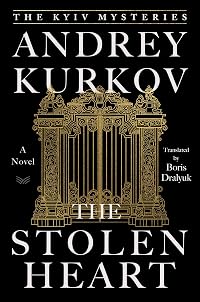
"Samson Kolechko and his colleague have been dispatched to investigate the illegal sale of meat. How selling cuts of one's own livestock qualifies as a crime eludes the young investigator, but an order is an order, and, at the insistence of the secret police officer assigned to "reinforce" the Lybid police station, Samson vows to do his very best. But just as Samson is beginning to dig into the very meat of this case, his live-in fiancaee Nadezhda is abducted by striking railway workers who show more object to the census she's carrying out. Complicating matters, the police station has been infiltrated by a mysterious thief, a deadly tram accident--which may have been premeditated--disrupts the city, and, to top it all, the culprit from Samson's "silver bone" investigation may have resurfaced. Against this backdrop, it's no wonder the "meat case" takes a backseat. Yet, despite the rising danger, the detective cannot let himself be distracted from his dogged pursuit of the seemingly mundane matter of the meat sellers, for ultimately his fate, and Nadezhda's too, rests on it."--Provided by publisher. show lessTags
Recommendations















Member Reviews
Samson Kolechko has fallen into a job as an investigator in Bolshevik Kyiv during the unsettled time after World War I. A Chekist (a member of a brutal secret police organization) has enlisted him and his colleague Kholodny, a former priest, to investigate an apparent homicide. Someone has reported blood seeping under the door of a shed. It turns out to be pig’s blood – but though it isn’t a homicide, Samson and Kholodny must investigate the illegal slaughter and sale of meat in violation of a new law that says all meat must go to the newly established ExProFooCom, the Extraordinary Provincial Food Committee, which Samson had never heard of. They arrest Citizen Briskin, who sold the pig that was slaughtered, and must find and show more interview everyone who bought meat from him.
This not-a-homicide investigation is the central mystery of the story, though it’s something of a MacGuffin. Samson repeatedly interviews Briskin, coaxing names of buyers out of him while reluctantly taking up smoking, having been told it’s important to blow smoke in suspects’ faces when interrogating them. He and Kholodny try to negotiate the new rules and decrees while skirting around the inherent violence used to enforce them. Meanwhile he and his colleague debate whether Judas was the first revolutionary, and whether he deserves the monument Trotsky wants erect in his name.
There are other episodic events. A crash between a cart and a tram leads to multiple deaths. Samson’s feelings for the woman with whom he shares his apartment are growing warmer, and when she disappears while trying to carry out her orders to gather railway statistics, he’s frantic and sets out to rescue her. She’s being held by militantly independent rail workers who violently reject the authority of the Soviets – or anyone else – devoted only to keeping the rail lines open as warring factions crisscross Ukraine, vying for power. Then there are the petty thefts occurring in the office that he must solve.
Kurkov’s true subject is what it was like to live through a destabilized period in Ukraine’s history when the national identity was up for grabs and the Soviet state was finding its feet, with conflicting forces, absurd new regulations, and fleeting moments of sweetness mingled together. This is the second in a planned trilogy (after 2024’s The Silver Bone) written by an author who is considered a major literary figure in Ukraine, who finished this novel and stopped writing fiction during the Russian invasion in favor of journalism. The literal translation of the original is The Heart is Not Meat – an assertion made by a character who bought the slaughtered pig’s heart but denies it was illegal, because it’s not actually meat.
It’s a claim that resonates with the overall tone of the story in which small pleasures and kindnesses persist in a time of chaos. Samson tries to follow orders obediently without losing his basic morality in a system that is brutal, illogical, and capricious. Mixed into the violence of the era, Kurkov maintains a tone of humorous absurdity; faced with extraordinary challenges, most people we encounter are just trying to live their lives. Given the current state of play, as a tyrant tries to reestablish the Soviet empire with brutality, it’s a gentle testament to the resilience of the Ukrainian people by an author with a lot of heart.
https://crimefictionreview.com/the-stolen-heart-by-andrey-kurkov/ show less
This not-a-homicide investigation is the central mystery of the story, though it’s something of a MacGuffin. Samson repeatedly interviews Briskin, coaxing names of buyers out of him while reluctantly taking up smoking, having been told it’s important to blow smoke in suspects’ faces when interrogating them. He and Kholodny try to negotiate the new rules and decrees while skirting around the inherent violence used to enforce them. Meanwhile he and his colleague debate whether Judas was the first revolutionary, and whether he deserves the monument Trotsky wants erect in his name.
There are other episodic events. A crash between a cart and a tram leads to multiple deaths. Samson’s feelings for the woman with whom he shares his apartment are growing warmer, and when she disappears while trying to carry out her orders to gather railway statistics, he’s frantic and sets out to rescue her. She’s being held by militantly independent rail workers who violently reject the authority of the Soviets – or anyone else – devoted only to keeping the rail lines open as warring factions crisscross Ukraine, vying for power. Then there are the petty thefts occurring in the office that he must solve.
Kurkov’s true subject is what it was like to live through a destabilized period in Ukraine’s history when the national identity was up for grabs and the Soviet state was finding its feet, with conflicting forces, absurd new regulations, and fleeting moments of sweetness mingled together. This is the second in a planned trilogy (after 2024’s The Silver Bone) written by an author who is considered a major literary figure in Ukraine, who finished this novel and stopped writing fiction during the Russian invasion in favor of journalism. The literal translation of the original is The Heart is Not Meat – an assertion made by a character who bought the slaughtered pig’s heart but denies it was illegal, because it’s not actually meat.
It’s a claim that resonates with the overall tone of the story in which small pleasures and kindnesses persist in a time of chaos. Samson tries to follow orders obediently without losing his basic morality in a system that is brutal, illogical, and capricious. Mixed into the violence of the era, Kurkov maintains a tone of humorous absurdity; faced with extraordinary challenges, most people we encounter are just trying to live their lives. Given the current state of play, as a tyrant tries to reestablish the Soviet empire with brutality, it’s a gentle testament to the resilience of the Ukrainian people by an author with a lot of heart.
https://crimefictionreview.com/the-stolen-heart-by-andrey-kurkov/ show less
I began reading Andrey Kurkov's mystery novels with Death and the Penguin, and absolutely brilliant melange of both mystery and absurdism. Since then, I've been keeping my eyes open for more of his work. The Stolen Heart is the second of Kurkov's Kyiv mysteries, set in post-WWI Ukraine, when the country was being roiled by a number of factions—from aristocratic to socialist and everything in between. I enjoyed the first Kyiv mystery, but also thought that Kurkov seemed to be feeling his way into this new time period (most of his works are set relatively close to our current time), and I very much was looking forward to seeing how the series would develop in the next volume.
The Stolen Heart did not disappoint. Samson Kolechko, the show more central character, is a former engineer turned police detective, still relatively new in this second profession. At this point, the Soviets are the most powerful of the factions roiling Ukraine—and, as a result, life in the capital city is quickly changing in multiple ways. New laws intended to "equalize" the city's populace are quickly cropping up; the most recent of these prohibits the private sale of meat. Kolchenko is assigned to investigate a "murder" that turns out to be the slaughter of a pig. Thus, it becomes a complicated case of illegal selling of meat that involves not just the seller, but a wide collection of individuals to whom the meat has been sold.
There's a great deal beyond the meat-sale case, but I don't want to summarize any more: part of what makes Khurkov's writing so delightful is the way the absurd and the magical come into play. What starts as a single plot line spins out in multiple directions.
These mysteries are most definitely not "cozy," but they also don't deal in gratuitous violence. The central mystery is puzzling, both in its own right and in the context of a rapidly society. There's also a strong cast of supporting characters Kolchenko's fiance, a statistician; an eye doctor who is regularly called on to treat non-optometrical conditions; a former priest who has has also joined the police and works alongside Kolchenko. The city of kyiv is also a character in its own right.
If you enjoy mysteries, particularly those both taking place in interesting historical/cultural periods and exploding some of the conventions of the genre, you will find The Stolen Heart deeply enjoyable.
I received a free electronic review copy of this title from the publisher via Edelweiss; the opinions are my own. show less
The Stolen Heart did not disappoint. Samson Kolechko, the show more central character, is a former engineer turned police detective, still relatively new in this second profession. At this point, the Soviets are the most powerful of the factions roiling Ukraine—and, as a result, life in the capital city is quickly changing in multiple ways. New laws intended to "equalize" the city's populace are quickly cropping up; the most recent of these prohibits the private sale of meat. Kolchenko is assigned to investigate a "murder" that turns out to be the slaughter of a pig. Thus, it becomes a complicated case of illegal selling of meat that involves not just the seller, but a wide collection of individuals to whom the meat has been sold.
There's a great deal beyond the meat-sale case, but I don't want to summarize any more: part of what makes Khurkov's writing so delightful is the way the absurd and the magical come into play. What starts as a single plot line spins out in multiple directions.
These mysteries are most definitely not "cozy," but they also don't deal in gratuitous violence. The central mystery is puzzling, both in its own right and in the context of a rapidly society. There's also a strong cast of supporting characters Kolchenko's fiance, a statistician; an eye doctor who is regularly called on to treat non-optometrical conditions; a former priest who has has also joined the police and works alongside Kolchenko. The city of kyiv is also a character in its own right.
If you enjoy mysteries, particularly those both taking place in interesting historical/cultural periods and exploding some of the conventions of the genre, you will find The Stolen Heart deeply enjoyable.
I received a free electronic review copy of this title from the publisher via Edelweiss; the opinions are my own. show less
Ratings
Members
- Recently Added By
Lists

Kindle Books
15 works; 1 member

Books Read in 2023
5,617 works; 146 members
Author Information

70+ Works 5,274 Members
Andrey Kurkov was born in St. Petersburg and now lives in Kiev. He spent time in the military as a prison warden and has also worked as a journalist and film cameraman. He is now a screenwriter and author of four novels and four childrens books.
Series

Common Knowledge
- Canonical title
- The Stolen Heart
Classifications
- Genres
- Fiction and Literature, Mystery, General Fiction, Historical Fiction
- DDC/MDS
- 891.7344 — Literature & rhetoric Literatures of other languages East Indo-European and Celtic literatures Russian and East Slavic languages Russian fiction USSR 1917–1991 Late 20th century 1917–1991
- LCC
- PG3950.21 .U75 — Language and Literature Slavic languages and literatures. Baltic languages. Albanian language Slavic. Baltic. Albanian Slavic Ukrainian
- BISAC
Statistics
- Members
- 67
- Popularity
- 466,346
- Reviews
- 2
- Rating
- (3.67)
- Languages
- English, German, Spanish
- Media
- Paper, Ebook
- ISBNs
- 10
- ASINs
- 7