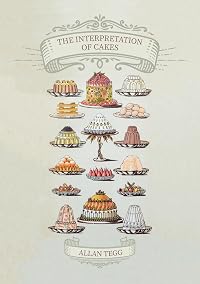
The Interpretation of Cakes
by Allan Tegg
On This Page
Description
The Interpretation of Cakes is like no other novel you have ever read and is one novel that you will never forget. It's 1916 and Isaak Brodsky has inherited his family's patisserie in the Jewish quarter of Budapest. Here, in the midst of shelves overcrowded with marvellous, mouth-watering cakes, Isaak discovers that offering his customers the right cake leads to their spiritual growth and his own. And so, the twentieth century science of Cake-analysis is born. This novel brings Budapest's show more cafes, streets and people to life in a charming, joyous and irresistible romp through the beginnings of psychotherapy and the mysteries of the conscious and unconscious mind. Thinking, and indeed, eating cake, will never be the same again. show lessMember Reviews
Allan Tegg is a psychotherapist who's written a whimsical but illuminating novella about the mysteries of the unconscious — as revealed by Hungarian cakes!
The story is layered like a cake, with slices of narrative interleaved with the narrator's insights fizzing in the brain like a contrasting ingredient that adds texture and flavour. The story features a bunch of characters whose subconscious is trying to solve a problem for them and for whom a particular Hungarian cake represents or challenges some aspect of their psyche. Now and then the narrator pops up to clarify what's going on in the subconscious and to advocate for his craft.
Bizarre, eh? But lots of fun...
Yaakov Brodsky, for example, has a breakdown in his cake shop because show more he's not suited to the needs of a community traumatised by pogroms in Poland and Ukraine. His son Isaak takes over (long before everybody was psychologising everything) but struggles because his rational mind won't listen to the deepest reaches of his brain. Fortunately his customers provide the opportunity for him to grow and learn...
Hershko Kubrinsky escaped from a tough industrial childhood but brought its shame with him and expressed it in anger. He turns up to buy a Dobos Torte, but Isaak, perceiving that Hershko is 'in a mood', says he should buy the Punch Cake because it is more fun. It was created to rebel against the brutal conformity of traditional cakes, and as you can see in the slideshow below, it's very pink. Hershko smashes it in fury because his subconscious knew why he wanted the Dobos Torte.
Hershko wanted to have this particular cake to consolidate his emerging awareness that weakness did not have to evoke crippling shame. That a bad beginning could become a success. But Isaak (who needs to work on his psyche too) misreads the situation because he hasn't recognised that weakness can spur creativity.
To read the rest of my review (with images of the gorgeous cakes, please visit https://anzlitlovers.com/2023/12/11/the-interpretation-of-cakes-2023-by-allan-te... show less
The story is layered like a cake, with slices of narrative interleaved with the narrator's insights fizzing in the brain like a contrasting ingredient that adds texture and flavour. The story features a bunch of characters whose subconscious is trying to solve a problem for them and for whom a particular Hungarian cake represents or challenges some aspect of their psyche. Now and then the narrator pops up to clarify what's going on in the subconscious and to advocate for his craft.
Bizarre, eh? But lots of fun...
Yaakov Brodsky, for example, has a breakdown in his cake shop because show more he's not suited to the needs of a community traumatised by pogroms in Poland and Ukraine. His son Isaak takes over (long before everybody was psychologising everything) but struggles because his rational mind won't listen to the deepest reaches of his brain. Fortunately his customers provide the opportunity for him to grow and learn...
Hershko Kubrinsky escaped from a tough industrial childhood but brought its shame with him and expressed it in anger. He turns up to buy a Dobos Torte, but Isaak, perceiving that Hershko is 'in a mood', says he should buy the Punch Cake because it is more fun. It was created to rebel against the brutal conformity of traditional cakes, and as you can see in the slideshow below, it's very pink. Hershko smashes it in fury because his subconscious knew why he wanted the Dobos Torte.
József Dobos opened his patisserie on the upmarket Kecskeméti utca in the 1880s. These were the times before refrigeration and butter was preserved by adding salt. One day, an apprentice accidentally used sugar. Most chefs would have fired him immediately. József believed things happened for a reason and every crisis was an opportunity. He thrust his finger into the butter and raised it to his lips. 'Magnificent', he exclaimed. 'This little delight has been under our noses for centuries. But it took a clumsy boy to bring it to our attention. I'll christen it buttercream.' (p.32)
Hershko wanted to have this particular cake to consolidate his emerging awareness that weakness did not have to evoke crippling shame. That a bad beginning could become a success. But Isaak (who needs to work on his psyche too) misreads the situation because he hasn't recognised that weakness can spur creativity.
To read the rest of my review (with images of the gorgeous cakes, please visit https://anzlitlovers.com/2023/12/11/the-interpretation-of-cakes-2023-by-allan-te... show less
Members
- Recently Added By
Author Information
1 Work 1 Member
Some Editions
Common Knowledge
- Original publication date
- 2023
Classifications
Statistics
- Members
- 1
- Popularity
- 8,812,029
- Reviews
- 1
- Rating
- (4.00)
- Languages
- English
- Media
- Paper
- ISBNs
- 1