The 15-Minute City: A Solution to Saving Our Time and Our Planet
by Carlos Moreno
On This Page
Description
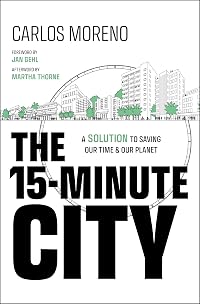
A fresh and innovative perspective on urban issues and creating sustainable cities. In The 15-Minute City: A Solution for Saving Our Time and Our Planet, human city pioneer and international scientific advisor Carlos Moreno delivers an exciting and insightful discussion of the deceptively simple and revolutionary idea that everyday destinations like schools, stores, and offices should only be a short walk or bike ride away from home. This book tells the story of an idea that spread from city show more to city, describing a new way of looking at living that addresses many of the most intractable challenges of our time. Hundreds of mayors worldwide have already embraced the concept as a way to help recover from the pandemic, and the idea continues to gain speed. You'll learn why more and more cities are planning to make cars far less necessary for contemporary city-dwellers and how they're planning to achieve that goal. You'll also find: Strategies for cities to recover and adapt to benefit residents, saving them precious time; Techniques to change the habits of automobile-dependent city residents and maximize social benefits of living in a human-centric city; Scientifically developed, research-backed solutions for enduring urban issues and problems. Deeply committed to science, progress, and creativity, Moreno presents an essential and timely resource in The 15-Minute City, which will prove invaluable to anyone with an interest in modern and innovative approaches to consistently challenging urban issues that have bedeviled policy makers and city residents since the invention of the car. show lessTags
Recommendations





Member Reviews
This is probably an unnecessary book. The idea of the “15-minute city” is such a simple and catchy one that you probably understand it already from the handful of newspaper articles you’ve read about it. Moreno’s book adds a bit of historical background and some case studies, but it’s written in such an annoying way, and with so few concrete details, that it is more likely to put you off than to inspire you with practical ways to implement his ideas in your own city.
Part of the problem is obviously that Moreno is a mathematician and computer scientist by background and is not a native speaker of English, so the book is written in a heavily French-accented version of International Academic English, something that might be show more tolerable in an academic paper but starts to grate quite seriously in a 250-page text. But that’s relatively minor compared to the sensation the book gives you of being mired in an endless PowerPoint presentation, full of bullet points and buzzwords and illustrated by a selection of repurposed slides from other talks. You keep thinking that he’s going to get onto some actual details of how to implement changes in cities, but no, it’s yet another vibrant, dynamic, networked, sustainable, revitalised paragraph of good intentions…
Read Jane Jacobs and project a few 21st century notions about teleworking and the like onto her text and you’ll be much happier and probably better-informed about the background to Moreno’s ideas for urban planning. show less
Part of the problem is obviously that Moreno is a mathematician and computer scientist by background and is not a native speaker of English, so the book is written in a heavily French-accented version of International Academic English, something that might be show more tolerable in an academic paper but starts to grate quite seriously in a 250-page text. But that’s relatively minor compared to the sensation the book gives you of being mired in an endless PowerPoint presentation, full of bullet points and buzzwords and illustrated by a selection of repurposed slides from other talks. You keep thinking that he’s going to get onto some actual details of how to implement changes in cities, but no, it’s yet another vibrant, dynamic, networked, sustainable, revitalised paragraph of good intentions…
Read Jane Jacobs and project a few 21st century notions about teleworking and the like onto her text and you’ll be much happier and probably better-informed about the background to Moreno’s ideas for urban planning. show less
Ratings
Members
- Recently Added By
Lists

The War on Cars podcast
108 works; 1 member
Author Information
23 Works 72 Members
Classifications
- Genres
- Nonfiction, Economics, Science & Nature, Politics and Government, Art & Design
- DDC/MDS
- 338.927 — Society, government, & culture Economics Production Economic Development And Growth Particular Policy Tendencies Greening
- LCC
- HD75.6 .M674 — Social sciences Industries. Land use. Labor Industries. Land use. Labor Economic growth, development, planning
- BISAC
Statistics
- Members
- 28
- Popularity
- 983,271
- Reviews
- 2
- Rating
- (3.75)
- Languages
- English
- Media
- Paper, Ebook
- ISBNs
- 3
- ASINs
- 1