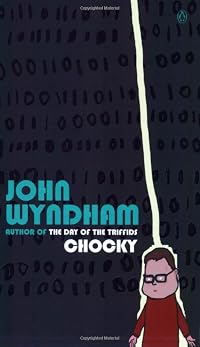
Chocky
by John Wyndham
On This Page
Description
Matthew is a normal eleven year old boy living with his parents and little sister in Surrey. He's too old and sensible to have an imaginary friend really. Yet when Matthew's parents keep finding him talking and arguing with a strange presence whom Matthew calls Chocky, that's what they believe it must be . . . . at first. But Chocky is oddly sinister, and keeps asking Matthew all sorts of complicated questions about the world and making him behave in unusual and erratic ways. Then Matthew show more suddenly does something heroic, well beyond his capabilities; the media become interested and the interest in Matthew widens. His parents refer him to a psychologist. Who is Chocky? And what could he or she want with their son? show lessTags
Recommendations




















Member Recommendations

Member Reviews
Deeply enjoyable short novel, as long as becoming immersed for a short time in 50's patriarchy is not off-putting for you. I find it refreshing to dive back into the anthropology of past decades to a time when all female characters were, naturally, full of feeling and emotions, and all male characters were rational and intellectual and responsible for protecting the women and children in their lives. Part of what I love about scifi is to recognize how time-bound this genre is even though authors are trying to be forward thinking, and trying to break through the constraints of their era. On top of my voyeuristic interest into the gendered roles of the past, though, the book offered me a lovely tangential look at the fears and concerns show more that come with parenting a child you love when he is not quite all right--the book explores whether a parent's role is to encourage difference or to make children conform; it plays with the idea of whether unusual differences in a child should be considered an illness to be eradicated or a gift to be embraced. And I enjoyed my time spent, as always, with John Wyndham and his imagination. show less
A quiet, subtle book. Yes, it shows its age with the gigantic, unwieldy info dump at the end, but before that, it's a great story. For some reason, I kept flashing to the end of Stephen King's [b:Under the Dome|6320534|Under the Dome|Stephen King|https://d.gr-assets.com/books/1268982908s/6320534.jpg|6760952]. I won't say why, but for those that read the ending of that book, maybe you'll see where I'm going.
Anyway, I liked how Wyndham slowly brought Chocky to the fore, the ways he revealed this element. Again, a touch heavy-handed at the end, but really, what SF book written in the 60s didn't suffer a little from that? It was the style of the times.
However, there's an understated easiness with the writing, a casual conversation with a show more polite, upper middle-class Brit that belies the horror happening just under the surface. Well done, Mr. Wyndham. show less
Anyway, I liked how Wyndham slowly brought Chocky to the fore, the ways he revealed this element. Again, a touch heavy-handed at the end, but really, what SF book written in the 60s didn't suffer a little from that? It was the style of the times.
However, there's an understated easiness with the writing, a casual conversation with a show more polite, upper middle-class Brit that belies the horror happening just under the surface. Well done, Mr. Wyndham. show less
"When people live their lives by their beliefs reality is almost irrelevant."
When David Gore, the narrator, overhears his adopted son, Matthew, having a conversation with what he assumes is an imaginary friend he becomes concerned. Apart from the fact that Matthew is almost twelve years old and so surely past the age when he should have an imaginary friend, it also seems to be a very strange conversation, with questions no twelve-year-old would normally ask.
David and his wife, Mary, have had some experience with this sort of thing, their daughter Polly had her own invisible friend, Piff, when she was five but Chocky appears to be different. Whilst Polly had been very much in control of Piff, Chocky needs to have things that Matthew is show more looking at explained to her as if she's never seen them before. Matthew is unable to tell his parents Chocky’s age, where Chocky comes from or even whether Chocky is male or female (he eventually decides on female).
Things get worse when Chocky shows that she can take over Matthew's body as well as his mind and finally that she can talk through Matthew's mouth. Who or what is Chocky? Is she a positive or a harmful one influence on Matthew? David and Mary become increasingly worried, they don’t know how to help their son or even if he really needs help. However, when she saves Matthew and Polly from drowning she comes to the attention of the press as a 'guardian angel' Chocky realises that she has to leave.
By using Matthew's adoptive father as the narrator Wyndham is able to employ him as the voice of reason contrasting him with the emotional response of his adoptive mother. The only thing they agree on is that, although Matthew doesn't seem at all frightened or unhappy, his behaviour is certainly not normal.
But Chocky isn't a malevolent entity in fact she wants to help humanity. Chocky believes that humanity is worth helping. As Margaret Atwood says in her afterword "We are intelligent and intelligence is 'a holy thing, to be fostered and treasured'. Our technology, however, sucks." Chocky tells us that we are using up irreplaceable natural resources but larger more powerful forces will try and stifle more eco-friendly innovation which seems quite remarkable given that this book was first published in 1968.
This is a fairly short novel so I don't want to say much more about the plot but will say is that it’s not difficult to work out what is going on. The science fiction elements are subtle and the book is as much about the relationship between parents and children until the final chapter however this is also a book with a real message, it's brevity means that not a word is wasted making it a quick and compelling read which I would certainly recommend. show less
When David Gore, the narrator, overhears his adopted son, Matthew, having a conversation with what he assumes is an imaginary friend he becomes concerned. Apart from the fact that Matthew is almost twelve years old and so surely past the age when he should have an imaginary friend, it also seems to be a very strange conversation, with questions no twelve-year-old would normally ask.
David and his wife, Mary, have had some experience with this sort of thing, their daughter Polly had her own invisible friend, Piff, when she was five but Chocky appears to be different. Whilst Polly had been very much in control of Piff, Chocky needs to have things that Matthew is show more looking at explained to her as if she's never seen them before. Matthew is unable to tell his parents Chocky’s age, where Chocky comes from or even whether Chocky is male or female (he eventually decides on female).
Things get worse when Chocky shows that she can take over Matthew's body as well as his mind and finally that she can talk through Matthew's mouth. Who or what is Chocky? Is she a positive or a harmful one influence on Matthew? David and Mary become increasingly worried, they don’t know how to help their son or even if he really needs help. However, when she saves Matthew and Polly from drowning she comes to the attention of the press as a 'guardian angel' Chocky realises that she has to leave.
By using Matthew's adoptive father as the narrator Wyndham is able to employ him as the voice of reason contrasting him with the emotional response of his adoptive mother. The only thing they agree on is that, although Matthew doesn't seem at all frightened or unhappy, his behaviour is certainly not normal.
But Chocky isn't a malevolent entity in fact she wants to help humanity. Chocky believes that humanity is worth helping. As Margaret Atwood says in her afterword "We are intelligent and intelligence is 'a holy thing, to be fostered and treasured'. Our technology, however, sucks." Chocky tells us that we are using up irreplaceable natural resources but larger more powerful forces will try and stifle more eco-friendly innovation which seems quite remarkable given that this book was first published in 1968.
This is a fairly short novel so I don't want to say much more about the plot but will say is that it’s not difficult to work out what is going on. The science fiction elements are subtle and the book is as much about the relationship between parents and children until the final chapter however this is also a book with a real message, it's brevity means that not a word is wasted making it a quick and compelling read which I would certainly recommend. show less
“Reality is relative…When people live their lives by their beliefs objective reality is almost irrelevant”
I've always been a fan of Wyndham and whilst I don't class this as one of his best, it's still a very enjoyable classic. 1960s sci-fi is always fun, especially when reading decades later with the hindsight of our technological advances. On this occasion, Wyndham cleverly shows us that it is the human race that is the present danger, with the alien unusually presented as the curious and benevolent creature. Through the eyes of Chocky, and their innocent, young host Matthew, Wyndham questions topics such as gender, environmentalism and conformity. This will leave you filled with questions about humanity and its future. I’m show more really not sure if this was ahead of its time or if we are just (extremely) slow to learn… show less
I've always been a fan of Wyndham and whilst I don't class this as one of his best, it's still a very enjoyable classic. 1960s sci-fi is always fun, especially when reading decades later with the hindsight of our technological advances. On this occasion, Wyndham cleverly shows us that it is the human race that is the present danger, with the alien unusually presented as the curious and benevolent creature. Through the eyes of Chocky, and their innocent, young host Matthew, Wyndham questions topics such as gender, environmentalism and conformity. This will leave you filled with questions about humanity and its future. I’m show more really not sure if this was ahead of its time or if we are just (extremely) slow to learn… show less
More of a novella than a novel, Chocky is the story of an eleven year old boy, Matthew, who suddenly starts interacting with what initially appears to be an imaginary friend much to the consternation of his parents. As his parents try to unravel exactly what is going on with their son, it begins to become clear that Chocky is not the typical imaginings of a young boy.
I don't read a lot of science fiction, and this book is definitely in the genre. Maybe I should read more because I really enjoyed this story. Wyndham does a great job of creating a very realistic family and presenting how such a regular family might deal with an irregular situation that is impacting their beloved child.
The ending is a bit forced - - hence the four stars show more instead of five, but I thoroughly enjoyed the ride and read the book in a single day. Pretty much unheard of for me! show less
I don't read a lot of science fiction, and this book is definitely in the genre. Maybe I should read more because I really enjoyed this story. Wyndham does a great job of creating a very realistic family and presenting how such a regular family might deal with an irregular situation that is impacting their beloved child.
The ending is a bit forced - - hence the four stars show more instead of five, but I thoroughly enjoyed the ride and read the book in a single day. Pretty much unheard of for me! show less
“Reality is relative... When people live their lives by their beliefs objective reality is almost irrelevant.”
This is more psy-fi, than the sci-fi that one associates with Wyndham.
He takes the central ideas of Midwich Cuckoos, published 11 years earlier and filmed twice as Village of the Damned and more recently with its original title (see my review HERE), but makes it more realistic. Here, there’s just one unsettling cuckoo child, and he’s unquestionably human - but he is adopted. As in Midwich, when his inexplicable talents become known, there’s a media frenzy, with insatiable journalists trying all sorts of unscrupulous tricks to get the inside story.
Questions
• Where is Earth?
• Why are there two sexes?
• What’s the show more pressure of light?
• Why does gravity do it?
• Why do cows stop?
David and Mary, an ordinary English couple, are concerned when 11-year old Matthew starts acting oddly, apparently because of a voice he’s hearing. At Chocky’s prompting, Matthew asks questions that are too advanced or abstract for easy answers, muddied by his child’s vocabulary and understanding. It’s like trying to describe a tune to a deaf person. But in maths and art, where words are not required, he excels:
“Me doing the drawing, and her doing the seeing.”
Image source
David and Mary have questions of their own, though not always asked explicitly.
• What is family - and what is not? What is human - and what is not?
• How do you tell the difference between a psychiatric disorder, overactive imagination, God, a demon, or something…. other?
• Is a benign or neutral presence less plausible and thus more unsettling than a selfish coloniser?
• Does difference need to be fixed?
David remembers Sherlock Holmes:
“When you have eliminated the impossible, whatever remains, however improbable, must be the truth.”
Bang Up to Date
This was a surprisingly topical read - and not just in ways that Wyndham might have anticipated.
Consent
Chocky is there as a “working arrangement”, a sort of possession by consent. But other things that happen, including by the paparazzi, approach and often breach boundaries of informed consent (though not in a sexual, #MeToo way).
Beyond the Binary
There’s binary maths, of course, but Chocky doesn’t understand the idea of binary gender (male or female, and nothing else). Chocky is both and neither, but Mary and David find Matthew's switching pronouns confusing. They want to pick one “on grounds of grammar”.
“It gives more personification if Chocky is one or the other.”
The non-binary people who are increasingly visible today can surely relate to being pigeon-holed that way.
Environment
Renewable energy is the future. But that’s a common message of sci-fi.
Disappointments
“I don’t understand women. Nobody does. Least of all themselves.”
As is common with authors writing in and of the period, the women are decorative and domestic, but largely sidelined in a friendly way. Younger sister Polly is plausibly annoying, but not given many redeeming qualities. However, in in the collection Consider Her Ways and Others (see my review HERE), a couple of the stories have a strong female/feminist slant.
The penultimate bit of the plot was incongruously far-fetched and almost comic. Not massively so, but it spoiled the overall experience for me, though I’m not sure what I’d have written instead. Fortunately, the actual end was touching, without becoming overly sentimental.
Other Quotes
• “Some babies confer a little more equality than other babies.”
• “People always find it easier to believe in evil spirits than good ones.”
• “Intelligent life is the only thing that gives meaning to the universe.”
• “Because mind has no mass it takes not time to travel.”
• “She kept on going on, but it didn’t mean anything. It wasn’t turning into proper words.” show less
This is more psy-fi, than the sci-fi that one associates with Wyndham.
He takes the central ideas of Midwich Cuckoos, published 11 years earlier and filmed twice as Village of the Damned and more recently with its original title (see my review HERE), but makes it more realistic. Here, there’s just one unsettling cuckoo child, and he’s unquestionably human - but he is adopted. As in Midwich, when his inexplicable talents become known, there’s a media frenzy, with insatiable journalists trying all sorts of unscrupulous tricks to get the inside story.
Questions
• Where is Earth?
• Why are there two sexes?
• What’s the show more pressure of light?
• Why does gravity do it?
• Why do cows stop?
David and Mary, an ordinary English couple, are concerned when 11-year old Matthew starts acting oddly, apparently because of a voice he’s hearing. At Chocky’s prompting, Matthew asks questions that are too advanced or abstract for easy answers, muddied by his child’s vocabulary and understanding. It’s like trying to describe a tune to a deaf person. But in maths and art, where words are not required, he excels:
“Me doing the drawing, and her doing the seeing.”
Image source
David and Mary have questions of their own, though not always asked explicitly.
• What is family - and what is not? What is human - and what is not?
• How do you tell the difference between a psychiatric disorder, overactive imagination, God, a demon, or something…. other?
• Is a benign or neutral presence less plausible and thus more unsettling than a selfish coloniser?
• Does difference need to be fixed?
David remembers Sherlock Holmes:
“When you have eliminated the impossible, whatever remains, however improbable, must be the truth.”
Bang Up to Date
This was a surprisingly topical read - and not just in ways that Wyndham might have anticipated.
Consent
Chocky is there as a “working arrangement”, a sort of possession by consent. But other things that happen, including by the paparazzi, approach and often breach boundaries of informed consent (though not in a sexual, #MeToo way).
Beyond the Binary
There’s binary maths, of course, but Chocky doesn’t understand the idea of binary gender (male or female, and nothing else). Chocky is both and neither, but Mary and David find Matthew's switching pronouns confusing. They want to pick one “on grounds of grammar”.
“It gives more personification if Chocky is one or the other.”
The non-binary people who are increasingly visible today can surely relate to being pigeon-holed that way.
Environment
Renewable energy is the future. But that’s a common message of sci-fi.
Disappointments
“I don’t understand women. Nobody does. Least of all themselves.”
As is common with authors writing in and of the period, the women are decorative and domestic, but largely sidelined in a friendly way. Younger sister Polly is plausibly annoying, but not given many redeeming qualities. However, in in the collection Consider Her Ways and Others (see my review HERE), a couple of the stories have a strong female/feminist slant.
The penultimate bit of the plot was incongruously far-fetched and almost comic. Not massively so, but it spoiled the overall experience for me, though I’m not sure what I’d have written instead. Fortunately, the actual end was touching, without becoming overly sentimental.
Other Quotes
• “Some babies confer a little more equality than other babies.”
• “People always find it easier to believe in evil spirits than good ones.”
• “Intelligent life is the only thing that gives meaning to the universe.”
• “Because mind has no mass it takes not time to travel.”
• “She kept on going on, but it didn’t mean anything. It wasn’t turning into proper words.” show less
Overall decent, although I'm sure the reality of Chocky is easier to spot in the 21st century than it was in 1968 when first published. The description of possession that so upsets Matthew's mother is a way to look at it, although it isn't quite since there is no subsumation or domination going on. It does make you wonder if anything like this has been, or is, possible, how it could have been characterized that way. Given Chocky's explanation of her mission there at the end, I don't know how clumsy she would have been given a host back in darker times of belief and religious control.
The idea of a cosmic energy that is just there for the taking, like raindrops during a storm, is interesting, but using the premise that M's intellect is show more just to feeble to grasp it so it can't be explained is a great way to get Wyndham off the hook of having to imagine something. Chocky's characterization of our technology is spot on - it is wasteful and will lead us nowhere as we will be right back to the state before it was discovered after its exhaustion. That aspect reminded me a lot of Earth Abides in the sense that the time setting wasn't important because even if the people had had cell phones and computers, they wouldn't work and would be off the table anyway. The book felt a lot less dated for that fact.
The part at the beginning where dad is describing the desperation his wife has for a kid is spot on. I went through periods of scolding/bullying (20s & 30s), to scorn/pity (40s) about my decision to be child free. Pretty much all the people berating me were women anxious for me to join their ranks. A lot of that was to validate their own decisions to breed in the face of what I believe to be doubts and regret. Sad that in other ways, they applaud the ability for women to choose. show less
The idea of a cosmic energy that is just there for the taking, like raindrops during a storm, is interesting, but using the premise that M's intellect is show more just to feeble to grasp it so it can't be explained is a great way to get Wyndham off the hook of having to imagine something. Chocky's characterization of our technology is spot on - it is wasteful and will lead us nowhere as we will be right back to the state before it was discovered after its exhaustion. That aspect reminded me a lot of Earth Abides in the sense that the time setting wasn't important because even if the people had had cell phones and computers, they wouldn't work and would be off the table anyway. The book felt a lot less dated for that fact.
The part at the beginning where dad is describing the desperation his wife has for a kid is spot on. I went through periods of scolding/bullying (20s & 30s), to scorn/pity (40s) about my decision to be child free. Pretty much all the people berating me were women anxious for me to join their ranks. A lot of that was to validate their own decisions to breed in the face of what I believe to be doubts and regret. Sad that in other ways, they applaud the ability for women to choose. show less
Members
- Recently Added By
Lists

1001 Books You Must Read Before You Die
1,448 works; 1,134 members

Summer Reads 2014
207 works; 69 members

1001 Children's Books You Must Read Before You Grow Up
774 works; 100 members

Books Read in 2015
3,299 works; 129 members

Authors from England
147 works; 4 members

Books Read in 2018
4,360 works; 110 members

Books Read in 2021
5,361 works; 114 members

Best Sellers / Popular 1968
237 works; 5 members

Books Read in 2026
1,942 works; 66 members
Talk Discussions
Past Discussions
Found: U.K. Sci-Fi; Alien visits Earth through the eyes of a boy in Name that Book (June 2023)
Author Information

Some Editions
Awards and Honors
Series
Belongs to Publisher Series
Work Relationships
Is contained in
Has the adaptation
Common Knowledge
- Canonical title*
- L'amica invisibile
- Original title
- Chocky
- Alternate titles*
- L'amica invisibile
- Original publication date
- 1968-02
- People/Characters
- Matthew Gore; Mary Gore; Polly Gore; Chocky; Roy Landis; David Gore (show all 8); Alan; Sir William Thorpe
- Important places
- Hindmere, Surrey, England, UK; England, UK
- Related movies
- Chocky (1984 | IMDb)
- First words
- It was in the spring of the year that Matthew reached twelve that I first became aware of Chocky.
- Quotations
- Reality is relative. Devils, evil spirits, witches and so on become real enough to the people who believe in them. Just as God is to people who believe in Him. When people live their lives by their beliefs objective reality i... (show all)s almost irrelavant
- Last words
- (Click to show. Warning: May contain spoilers.)It looked just as if it had always been inscribed.
- Original language*
- Engels
- Canonical DDC/MDS
- 823.912
- Canonical LCC
- PR6045.Y64
*Some information comes from Common Knowledge in other languages. Click "Edit" for more information.
Classifications
Statistics
- Members
- 1,957
- Popularity
- 10,839
- Reviews
- 73
- Rating
- (3.71)
- Languages
- 9 — Czech, Dutch, English, German, Hungarian, Italian, Portuguese, Spanish, Turkish
- Media
- Paper, Audiobook, Ebook
- ISBNs
- 34
- ASINs
- 29