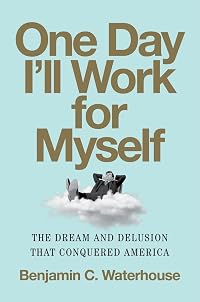
One Day I'll Work for Myself: The Dream and Delusion That Conquered America
by Benjamin C. Waterhouse
On This Page
Description
From side-hustlers to start-ups, freelancers to small business owners, Americans have a special affinity for people who make it on their own. But the dream has a dark side.Tags
Member Reviews
Cultural history of the myths Americans tell ourselves about small businesses/self-employment. Primary among them: they’re job creators. Reality: The proportion of jobs “created” by small business has been essentially static for decades; most businesses fail; most “small businesses” lack even one employee. Small businesses/self-employment are far more prevalent in other countries where the economy is much worse—self-employment is often the best of a bad set of options, both in the US and elsewhere. More significantly, the rhetoric of small business innovation functions to (1) assure people that they are on their own, with no structures in place to help them, (2) suppress employee rights, including minimum wage increases and show more health care, and (3) obscure the big businesses behind supposedly entrepreneurial endeavors—although I think we may have finally seen the truth with the “gig” economy that is nothing but enriching the middlemen. But then again, the same promises were made and broken before, including with multi-level marketing, so maybe we aren’t going to learn. show less
I found this book to be very disappointing. It gave a brief overview of trends and notable moments in "small business" without actually going into anything.
In particular, I hated the short section on MLMs where the author pretty much uncritically and inaccurately describes them without going into how predatory the business model is BY DESIGN, and then ends the chapter on the most milquetoast sentence about how sometimes people struggle in MLMs.
It's not just that MLMs are inherently a predatory business model and I dislike that the author discusses them totally uncritically. It's that this entire book will give a long description about something, like franchising (to pick just one example), and then gives a similar, extremely short show more milquetoast disclaimer ("it's not always great"), but then never really goes into specifics about what the issues around that topic could be. Like, can you tell a story about a specific issue that somebody had? The book just felt super impersonal. I didn't care to learn about the founder of some national organization about small businesses. I would like to learn about people who've been impacted (both positively and negatively) by different small business trends throughout the years. show less
In particular, I hated the short section on MLMs where the author pretty much uncritically and inaccurately describes them without going into how predatory the business model is BY DESIGN, and then ends the chapter on the most milquetoast sentence about how sometimes people struggle in MLMs.
It's not just that MLMs are inherently a predatory business model and I dislike that the author discusses them totally uncritically. It's that this entire book will give a long description about something, like franchising (to pick just one example), and then gives a similar, extremely short show more milquetoast disclaimer ("it's not always great"), but then never really goes into specifics about what the issues around that topic could be. Like, can you tell a story about a specific issue that somebody had? The book just felt super impersonal. I didn't care to learn about the founder of some national organization about small businesses. I would like to learn about people who've been impacted (both positively and negatively) by different small business trends throughout the years. show less
Ratings
Members
- Recently Added By
Lists

W. W. Norton & Company
47 works; 2 members
Author Information

3 Works 54 Members
Benjamin C. Waterhouse is a historian of American politics, business, and capitalism. Waterhouse graduated from Princeton University and received his PhD in history from Harvard University. He is currently an Associate Professor and Grauer Scholar at the University of North Carolina. He lives in Chapel Hill with his wife, Daniela, and their two show more children. show less
Classifications
- Genres
- Business, Nonfiction, Economics, History, General Nonfiction
- DDC/MDS
- 338.040973 — Society, government, & culture Economics Production Entrepreneurship History, geographic treatment, biography North America
- LCC
- HD8037 .U5 .W38 — Social sciences Industries. Land use. Labor Industries. Land use. Labor Labor. Work. Working class
- BISAC
Statistics
- Members
- 17
- Popularity
- 1,450,939
- Reviews
- 2
- Rating
- (2.67)
- Languages
- English
- Media
- Paper, Audiobook, Ebook
- ISBNs
- 3
- ASINs
- 2