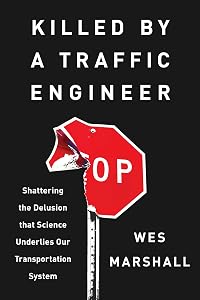
Killed by a Traffic Engineer: Shattering the Delusion That Science Underlies Our Transportation System
by Wes Marshall
On This Page
Description
Killed by a Traffic Engineer by Wesley Marshall critically examines the practices and underlying principles of traffic engineering. Marshall contends that the long-standing standards and methods used by traffic engineers often fail to enhance safety and efficiency, instead contributing to higher accident rates and hazardous conditions for pedestrians. The book addresses the disconnect between engineering practices and research findings, highlighting the need for reform in traffic management. show more Written for both professionals in the field and the general public, the book combines serious critique with wit to expose flaws and suggest practical improvements in traffic systems. show lessTags
Recommendations







Member Reviews
Where I live, you need to take a state highway out of town to get to the interstate freeway. It begins as a three lane road, the most demented invention of transportation engineers ever: an inspired design for guaranteed head-on collisions, no matter the weather, the time of day or time of year. There are no crosswalks despite the commercial buildings and homes on both sides.The speed limit is 45. Good luck. Eventually, it widens out to a four-lane, divided highway with a median, wide and flat as you get closer to the freeway ramps. There are no crosswalks needed, as this four-lane closely parallels the interstate, so all the buildings are on one side only. Yet the speed limit here is 35. This is why I needed to read Killed by a Traffic show more Engineer, from Wes Marshall, a passionate transportation engineer based in Denver. He explains how this can be, and a whole lot more that has changed my outlook and opinion.
It transpires that transportation engineers are barely educated in transportation, if at all. It doesn’t stop them from becoming transportation professionals one bit. They research what other experts have written and apply it to today’s roads. Not only is this intuitively wrong, as cars are bigger, heavier and faster, but distances traveled have lengthened, roads are wider and far more crowded, and on and on. But worse, perhaps, is that the knowledge they glean from their predecessors is itself false. Science never got a chance to leave the room, because it never entered. Studies were not done. Measurements were not taken. The twelve foot wide lane has no basis in science. Neither do speed limits. Or shoulders.
The result is roads that kill, but follow the standards and guidelines. Pedestrians and bicyclists are second class citizens, as everything is meant to move more cars, faster. Roads that are built straight, flat, wide and monotonous encourage drivers to speed. Crosswalks are so pathetic they can be totally overlooked. Bike lanes are just lines of paint, and oblivious drivers open their parked car doors into oncoming riders, killing them with nauseating regularity. Marshall says sharrows, the so-called share-the-road painted lanes “are worse than nothing.”
Worse still is that “most of the money we get for road safety research comes from ‘the major insurance, oil and automobile companies’” who simply want to sell more cars and fuels. That’s what they pay for, and that’s what they get. Transportation engineering is a science with all but no basis. Jane Jacobs called it “a ‘perfect’ example of antiscience masquerading as the science it betrayed.” When things go wrong, Marshall says “These aren’t accidents; these are results.” He (as I) calls them crashes, because there is little or nothing that is accidental about them.
That capitalism has usurped transportation should come as no surprise. Just as texting causes crashes, so do billboards. Removing billboards results in lower death rates. But if there’s a buck to be made, death rates are just part of the cost of doing business. Then consider that government funding focuses almost entirely on high capacity arterials and freeways, leaving lesser roads as deathtraps. Follow the money; the car industry does.
New road construction projects performance into the future, so that roads won’t become overcrowded later. But the formula, a compounded annual 5%, means that a road built to carry ten thousand cars daily will grow to millions of cars daily which is absurd, not science.
Similarly, many cities’ answer to congestion is to raise speed limits, causing worse traffic and more crashes. But it is set up so they pretty much have to. Because another idiot rule requires road speed to be set at the 85th percentile of existing traffic. So if most drivers speed, the rule says to increase the limit.
Autonomous cars are no answer, either to lower death rates or to improve traffic flow. Lane change assistance and adaptive cruise control fail once every eight miles, researchers found. These cars are programmed to ignore pedestrians as false positives, resulting in several high profile (and totally avoidable) deaths.
Cars are being designed to kill. Being hit by a small sedan means being rolled over the hood and off the windshield. Being hit by the front wall of an XL SUV means being obliterated where you stood. The figures are twice the death risk for the larger vehicles Americans adore.
Meanwhile, pedestrians who stay off the streets for fear of being killed, unwittingly prevent signage, crosswalks and other measure from being implemented because many engineers require at least 93 people to try to cross at the point in question – or it’s not worth considering. Where 93 came from is tradition and nothing more. But it continues to kill off remediation of bad design.
What does work is public transit. Trains and express buses coming out of city centers to local buses scheduled with train arrivals dramatically lower the number of cars on the road, particularly when the buses have their own lanes. But that doesn’t fit with the more-cars-is-better ethos of the past century and a half.
The book is a delight to read. The chapters are bite-sized. After three or four pages, when Marshall has said his piece on the topic, he moves on to the next one. So there are 88 short, to-the-point chapters. It is fast paced, filled with relatable stories and pop culture references, which he actually quotes and explains for those who don’t have his experience and tastes. Wonderfully accessible, in ways that word never merits in the sciences.
Marshall’s intensity is astounding. For his dissertation, he studied 230,000 individual crashes over an 11 year period for 24 cities to find the truths they held back. Everywhere he goes, he carries a gun – a radar gun. He rides a bike to school and parks it in his office. In this book he continuously exploits a journal called Traffic Quarterly, where engineers post their findings, and Marshall gets to undo everything they have said over the past hundred years. It is a fat, sloppy target, but his critiques create the steel superstructure of this all too revealing book.
The real issue here, as in many other domains, is not looking at transportation as a system. Instead, engineers, police, insurers and courts look at it as individual error. Rather than fix anything in the cars or on the roads, they are totally focused on assigning blame. Clearly, this will never result in improvement. And it is child’s play to find something to blame: didn’t have both hands on the wheel, not wearing glasses, reading a billboard, speeding, failing to signal a lane change, not using wipers, not coming to a full stop, one tail lamp out – there’s always something to make it driver error rather than the homicidal design.
Even so, “no improper action” comes in a respectable fifth in pedestrian and bicycling fatalities, despite all the efforts to assign culpability. And the fact that none of the fatalities get to tell their side of it, as dead pedestrians typically didn’t have passengers with them.
The irony of this whole exercise is that transportation has as its number one priority, the safety of travel. All the books and manuals say it first and foremost. So do the professional associations. It is everyone’s top goal. And it is all but completely bypassed when not totally ignored. Marshall is justifiably incensed over it. He says “Safety first is a lie. Safety has never been the top priority.”
He often deals with it using sarcasm: “A leading pedestrian interval, or LPI, gives pedestrians a short head start when crossing an intersection. We can’t be bothered to give pedestrians the time needed to get all the way across the street, so we instead wait until they get to the middle of the street before telling drivers they can proceed. In other words, an LPI is a half-assed way to prioritize pedestrian safety. Let’s use our whole ass.”
And one final irony: older cities tend to be the safest for everyone. The cities with short, narrow streets, uneven intersections and which have been in existence long before there were traffic engineers – are what work best for keeping the death and injury stats in check. In his own research, Marshall found people in these cities drive far less often, drive shorter distances, walked and biked far more and had ”drastically lower rates of obesity, diabetes, high blood pressure and heart disease.” Just sayin’.
My only complaint for this entire book is the notes, of all things. Marshall employs two systems simultaneously. End notes are numbered 1,2,3, chapter by chapter. Footnotes are lettered a,b,c. The numbered end notes are the standard citation type, with the usual ibids. The lettered footnotes are his comments on what he has just written, and are generally at least as interesting as the page content. But they are really tiny letters and numbers, and I often found myself looking for them in the wrong place. An odd and inelegant dual system, in my experience.
As for my demented three-lane, Marshall cites a nationwide program called Vision Zero: Toward Zero Deaths, in which some state departments of transportation actually proposed goals for pedestrian and bicyclist deaths that were higher than the current numbers.
So I give up.
David Wineberg show less
It transpires that transportation engineers are barely educated in transportation, if at all. It doesn’t stop them from becoming transportation professionals one bit. They research what other experts have written and apply it to today’s roads. Not only is this intuitively wrong, as cars are bigger, heavier and faster, but distances traveled have lengthened, roads are wider and far more crowded, and on and on. But worse, perhaps, is that the knowledge they glean from their predecessors is itself false. Science never got a chance to leave the room, because it never entered. Studies were not done. Measurements were not taken. The twelve foot wide lane has no basis in science. Neither do speed limits. Or shoulders.
The result is roads that kill, but follow the standards and guidelines. Pedestrians and bicyclists are second class citizens, as everything is meant to move more cars, faster. Roads that are built straight, flat, wide and monotonous encourage drivers to speed. Crosswalks are so pathetic they can be totally overlooked. Bike lanes are just lines of paint, and oblivious drivers open their parked car doors into oncoming riders, killing them with nauseating regularity. Marshall says sharrows, the so-called share-the-road painted lanes “are worse than nothing.”
Worse still is that “most of the money we get for road safety research comes from ‘the major insurance, oil and automobile companies’” who simply want to sell more cars and fuels. That’s what they pay for, and that’s what they get. Transportation engineering is a science with all but no basis. Jane Jacobs called it “a ‘perfect’ example of antiscience masquerading as the science it betrayed.” When things go wrong, Marshall says “These aren’t accidents; these are results.” He (as I) calls them crashes, because there is little or nothing that is accidental about them.
That capitalism has usurped transportation should come as no surprise. Just as texting causes crashes, so do billboards. Removing billboards results in lower death rates. But if there’s a buck to be made, death rates are just part of the cost of doing business. Then consider that government funding focuses almost entirely on high capacity arterials and freeways, leaving lesser roads as deathtraps. Follow the money; the car industry does.
New road construction projects performance into the future, so that roads won’t become overcrowded later. But the formula, a compounded annual 5%, means that a road built to carry ten thousand cars daily will grow to millions of cars daily which is absurd, not science.
Similarly, many cities’ answer to congestion is to raise speed limits, causing worse traffic and more crashes. But it is set up so they pretty much have to. Because another idiot rule requires road speed to be set at the 85th percentile of existing traffic. So if most drivers speed, the rule says to increase the limit.
Autonomous cars are no answer, either to lower death rates or to improve traffic flow. Lane change assistance and adaptive cruise control fail once every eight miles, researchers found. These cars are programmed to ignore pedestrians as false positives, resulting in several high profile (and totally avoidable) deaths.
Cars are being designed to kill. Being hit by a small sedan means being rolled over the hood and off the windshield. Being hit by the front wall of an XL SUV means being obliterated where you stood. The figures are twice the death risk for the larger vehicles Americans adore.
Meanwhile, pedestrians who stay off the streets for fear of being killed, unwittingly prevent signage, crosswalks and other measure from being implemented because many engineers require at least 93 people to try to cross at the point in question – or it’s not worth considering. Where 93 came from is tradition and nothing more. But it continues to kill off remediation of bad design.
What does work is public transit. Trains and express buses coming out of city centers to local buses scheduled with train arrivals dramatically lower the number of cars on the road, particularly when the buses have their own lanes. But that doesn’t fit with the more-cars-is-better ethos of the past century and a half.
The book is a delight to read. The chapters are bite-sized. After three or four pages, when Marshall has said his piece on the topic, he moves on to the next one. So there are 88 short, to-the-point chapters. It is fast paced, filled with relatable stories and pop culture references, which he actually quotes and explains for those who don’t have his experience and tastes. Wonderfully accessible, in ways that word never merits in the sciences.
Marshall’s intensity is astounding. For his dissertation, he studied 230,000 individual crashes over an 11 year period for 24 cities to find the truths they held back. Everywhere he goes, he carries a gun – a radar gun. He rides a bike to school and parks it in his office. In this book he continuously exploits a journal called Traffic Quarterly, where engineers post their findings, and Marshall gets to undo everything they have said over the past hundred years. It is a fat, sloppy target, but his critiques create the steel superstructure of this all too revealing book.
The real issue here, as in many other domains, is not looking at transportation as a system. Instead, engineers, police, insurers and courts look at it as individual error. Rather than fix anything in the cars or on the roads, they are totally focused on assigning blame. Clearly, this will never result in improvement. And it is child’s play to find something to blame: didn’t have both hands on the wheel, not wearing glasses, reading a billboard, speeding, failing to signal a lane change, not using wipers, not coming to a full stop, one tail lamp out – there’s always something to make it driver error rather than the homicidal design.
Even so, “no improper action” comes in a respectable fifth in pedestrian and bicycling fatalities, despite all the efforts to assign culpability. And the fact that none of the fatalities get to tell their side of it, as dead pedestrians typically didn’t have passengers with them.
The irony of this whole exercise is that transportation has as its number one priority, the safety of travel. All the books and manuals say it first and foremost. So do the professional associations. It is everyone’s top goal. And it is all but completely bypassed when not totally ignored. Marshall is justifiably incensed over it. He says “Safety first is a lie. Safety has never been the top priority.”
He often deals with it using sarcasm: “A leading pedestrian interval, or LPI, gives pedestrians a short head start when crossing an intersection. We can’t be bothered to give pedestrians the time needed to get all the way across the street, so we instead wait until they get to the middle of the street before telling drivers they can proceed. In other words, an LPI is a half-assed way to prioritize pedestrian safety. Let’s use our whole ass.”
And one final irony: older cities tend to be the safest for everyone. The cities with short, narrow streets, uneven intersections and which have been in existence long before there were traffic engineers – are what work best for keeping the death and injury stats in check. In his own research, Marshall found people in these cities drive far less often, drive shorter distances, walked and biked far more and had ”drastically lower rates of obesity, diabetes, high blood pressure and heart disease.” Just sayin’.
My only complaint for this entire book is the notes, of all things. Marshall employs two systems simultaneously. End notes are numbered 1,2,3, chapter by chapter. Footnotes are lettered a,b,c. The numbered end notes are the standard citation type, with the usual ibids. The lettered footnotes are his comments on what he has just written, and are generally at least as interesting as the page content. But they are really tiny letters and numbers, and I often found myself looking for them in the wrong place. An odd and inelegant dual system, in my experience.
As for my demented three-lane, Marshall cites a nationwide program called Vision Zero: Toward Zero Deaths, in which some state departments of transportation actually proposed goals for pedestrian and bicyclist deaths that were higher than the current numbers.
So I give up.
David Wineberg show less
This took me a very long time to read but was still worthwhile. It was a combination of trying to savour it but also being stuffed with food for thought. From a safety science perspective, there was discussion of Dekker and Reason and Perrow and Heinrich, and other references from a wide variety of pop culture: David Byrne, The Simpsons, and Project Hail Mary all got looks in at some point. I did find some of the footnotes a little bit on the discursive side (and I say this as someone who usually loves discursive footnotes). But overall this is a solid book. Visibly endnoted, abundantly referenced, well worth a read.
An example of a really good book that should be written in a more serious tone. The author cannot pull off the sarcastic tone and the constant Simpsons references are not amusing.
Structurally, I also thought the book lacked any kind of cohesive flow and the chapters were all way too short. I'm sure there was a narrative structure to the book but it just came off as a ramble to me. (Side note: I frequently skip the introductions to books where authors explain what they're going to cover in the book, but reading this book I understood why that can be important.)
But even though I didn't like the organization and tone of the book overall, it has an important message that I think more people should be aware of.
Structurally, I also thought the book lacked any kind of cohesive flow and the chapters were all way too short. I'm sure there was a narrative structure to the book but it just came off as a ramble to me. (Side note: I frequently skip the introductions to books where authors explain what they're going to cover in the book, but reading this book I understood why that can be important.)
But even though I didn't like the organization and tone of the book overall, it has an important message that I think more people should be aware of.
Ratings
Members
- Recently Added By
Lists

The War on Cars podcast
108 works; 1 member
Author Information
1 Work 60 Members
Common Knowledge
- Canonical title
- Killed by a Traffic Engineer: Shattering the Delusion That Science Underlies Our Transportation System
Classifications
- Genres
- Nonfiction, General Nonfiction, Politics and Government
- DDC/MDS
- 363.12 — Society, government, & culture Social problems and social services Public Safety - Police, Crime Investigation Public safety from hazards Transportation
- LCC
- HE333 .M289 — Social sciences Transportation and communications Transportation and communications Traffic engineering. Roads and highways.
- BISAC
Statistics
- Members
- 62
- Popularity
- 500,952
- Reviews
- 3
- Rating
- (4.15)
- Languages
- English
- Media
- Paper, Ebook
- ISBNs
- 3
- ASINs
- 1