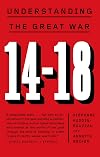
14-18: Understanding the Great War
by Stéphane Audoin-Rouzeau, Annette Becker
On This Page
Description
With this brilliantly innovative book, reissued for the 100th anniversary of the beginning of World War I, St phane Audoin-Rouzeau and Annette Becker have shown that the Great War was the matrix on which all subsequent disasters of the twentieth century were formed. Three elements of the conflict, all too often neglected or denied, are identified as those that must be grasped if we are to understand the war: First, what inspired its unprecedented physical brutality, and what were the effects show more of tolerating such violence? Second, how did citizens of the belligerent states come to be driven by vehement nationalistic and racist impulses? Third, how did the tens of millions bereaved by the war come to terms with the agonizing pain? With its strikingly original interpretative strength and its wealth of compelling documentary evidence drawn from all sides in the conflict, 14-18: Understanding the Great War has quickly established itself as a classic in the history of modern warfare. show lessTags
Recommendations









Member Reviews
14-18: Understanding the Great War represents an attempt by French historians to make World War I more intelligible and understandable from the perspective of the twenty-first century. Both authors are respected members of the French historical community who have chosen to specialize in the First World War. Audoin-Rouzeau is a professor at the University of Picardy and co-director of the Research Center of the Museum of the Great War based in the Somme. He is quite well known due to his contributions to the historiography of the First World War; he helped develop the concept of 'patriotic consent,' which hypothesized that the people of the Allied nations voluntarily supported the war effort. Becker--the daughter of Jean-Jacques Becker, show more another eminent World War I historian—teaches at the University of Paris and is also co-director of the research center of the Museum of the Great War. She specializes in the cultural representations of the war.
14-18 is not a typical history. It purports to analyze aspects of the war that have traditionally been overlooked by history. Instead of looking at battles, political decisions, or strategy, Audoin-Rouzeau and Becker have opted to identify more specific characteristics of the war, using the interdisciplinary research and study that they have conducted at the Museum of the Great War. They identify three aspects of the war that would not only illuminate the history of the war but also demonstrate how the Great War made subsequent European and world conflicts possible: the brutal violence of the conflict, the war as crusade, and the resultant almost universal grieving.
The authors claim that the purpose of the book is to provide a new way to understand the war, a fresh perspective into the hidden recesses of the war's history. They succeed admirably. 14-18 sparkles from a perspective that not only increases awareness of the importance of the war, but also a greater visceral understanding of the impact of the war upon soldiers, civilians, nations, and families. Violence and grieving are rendered somehow more real and less abstract through the striking and sometimes blunt language of the authors.
As a work of interdisciplinary history, 14-18 holds up rather well, considering the problems sometimes encountered with translated works. The arguments of the authors seem to stand up to further scrutiny, and generally conform to the existing scholarship of the war. Audouin-Rouzeau and Becker have met their objectives: they have succeeded in creating a work that rejuvenates scholarly understanding of the First World War, while directing attention toward aspects of the conflict that heretofore had languished in obscurity. Thanks to their scholarship the violence of the war comes alive, and the grieving of loved ones becomes almost palpable. show less
14-18 is not a typical history. It purports to analyze aspects of the war that have traditionally been overlooked by history. Instead of looking at battles, political decisions, or strategy, Audoin-Rouzeau and Becker have opted to identify more specific characteristics of the war, using the interdisciplinary research and study that they have conducted at the Museum of the Great War. They identify three aspects of the war that would not only illuminate the history of the war but also demonstrate how the Great War made subsequent European and world conflicts possible: the brutal violence of the conflict, the war as crusade, and the resultant almost universal grieving.
The authors claim that the purpose of the book is to provide a new way to understand the war, a fresh perspective into the hidden recesses of the war's history. They succeed admirably. 14-18 sparkles from a perspective that not only increases awareness of the importance of the war, but also a greater visceral understanding of the impact of the war upon soldiers, civilians, nations, and families. Violence and grieving are rendered somehow more real and less abstract through the striking and sometimes blunt language of the authors.
As a work of interdisciplinary history, 14-18 holds up rather well, considering the problems sometimes encountered with translated works. The arguments of the authors seem to stand up to further scrutiny, and generally conform to the existing scholarship of the war. Audouin-Rouzeau and Becker have met their objectives: they have succeeded in creating a work that rejuvenates scholarly understanding of the First World War, while directing attention toward aspects of the conflict that heretofore had languished in obscurity. Thanks to their scholarship the violence of the war comes alive, and the grieving of loved ones becomes almost palpable. show less
I found this work very interesting once I undestood what it was trying to accomplish. Initially I was lost as to the point, even after having read the summary on the inside flap. Shortly thereafter I got it. What the authors are about is discussing some areas of the Great War for study which to date for the most part have been overlooked or ignored. Signigicantly, they point out issues which are more social than military, economic or strategic. The latter three are what we usually see in books on WWI. However, this work discusses the violence of an industrial and how that was accepted on both sides. Also how the 'enemy' so vilified; considered barbaric, even sub-human. And finally how world wide grieving was handled, individually, show more locally and by the governments.
A fine work for those interested in expanding their knowledge and views of WWI via looking at little studied aspects of the war. show less
A fine work for those interested in expanding their knowledge and views of WWI via looking at little studied aspects of the war. show less
History with a difference; not a litany of facts but the exploration of certain themes such as the degree of violence, enthusiasm for the war and the experience of grief.
A great book but the liberal use of the words 'paradox/ically' and 'reticence' in almost every chapter really irked me. Perhaps it was just the French-English translation.
Magnifique analyse des impacts de la guerre.
Feb 8, 2014 (Edited)French
Ratings
Members
- Recently Added By
Lists

Books Cited in Wasteland by W. Scott Poole
120 works; 1 member
Author Information

36+ Works 363 Members

18+ Works 320 Members
Annette Becker is a professor of contemporary history at Paris-Nanterre La Dfense and a senior member of the Institut Universitaire de France. Kthe Roth has been a literary translator with a specialty in historical nonfiction for more than thirty years.
Some Editions
Awards and Honors
Awards
Series
Belongs to Publisher Series
Common Knowledge
- Canonical title*
- 14-18, retrouver la Guerre
- Original title
- 14-18, retrouver la Guerre
- Original publication date
- 2000-04-04 (1e édition originale française ∙ Bibliothèque des histoires ∙ Gallimard) (1e édition originale française ∙ Bibliothèque des histoires ∙ Gallimard); 2003-11-20 (Réédition française, Folio, Histoire, Gallimard (Réédition française ∙ Folio ∙ Histoire ∙ Gallimard) (Réédition française, Folio, Histoire, Gallimard | Réédition française ∙ Folio ∙ Histoire ∙ Gallimard)
- Important events
- World War I (1914 | 1918)
- Epigraph*
- /
- Dedication*
- À Jean-Jacques Becker
Gerd Krumeich
Jay Winter - First words*
- COMPRENDRE LA GRANDE GUERRE
La Grande Guerre, par sa dimension européenne et mondiale, par sa durée, par son poids immense et longtemps sous-estimé sur le siècle tout entier, est devenue un cas d'école pour une rÃ... (show all)©flexion sur ce qui est la matière même de l'Histoire : le poids des morts sur les vivants.
[...]
I
La violence
Que toute guerre soit violence, nul évidemment ne l'ignore, et pourtant beaucoup refusent, sinon de l'admettre, du moins d'en tirer les conséquences indispensables. [...] - Original language
- French
*Some information comes from Common Knowledge in other languages. Click "Edit" for more information.
Classifications
Statistics
- Members
- 222
- Popularity
- 146,388
- Reviews
- 5
- Rating
- (3.61)
- Languages
- Dutch, English, French
- Media
- Paper, Ebook
- ISBNs
- 8
- ASINs
- 3