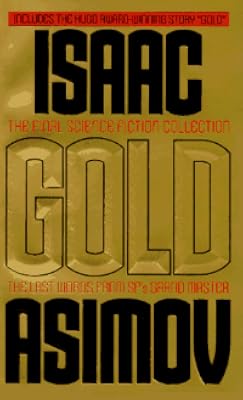
Gold : The Final Science Fiction Collection
by Isaac Asimov
Asimov's Universe (Collections and Selections — ), Isaac Asimov's Robot Series (Collections and Selections — )
On This Page
Description
Gold is the final and crowning achievement of the fifty-year career of science fiction's transcendent genius, the world-famous author who defined the field of science fiction for its practitioners, its millions of readers, and the world at large. The first section contains stories that range from the humorous to the profound, at the heart of which is the title story, "Gold," a moving and revealing drama about a writer who gambles everything on a chance at immortality: a gamble Asimov himself show more made -- and won. The second section contains the grand master's ruminations on the SF genre itself. And the final section is comprised of Asimov's thoughts on the craft and writing of science fiction. show lessTags
Recommendations

















Member Reviews
On the one hand, I very much enjoy Dr. Asimov's stories. All of the fiction in this volume was new to me, and a joy to read. That made up about 30% of the book.
A collection of essays, mostly introductions to anthologies and editorials from his magazine, filled the remaining 2/3 of the volume. They were sorted into two sections - On SF and On Writing SF, but there was no context given for any of them, nor were they in any particular order in each section. Many of the essays lost a lot from not being attached to the books they introduced. There was no way to know what Dr. Asimov meant by "In this volume". The book has the ghoulish feel to it, as if the publisher had simply thrown together a bunch of Dr. Asimov's writing, knowing it would show more sell.
When Dr. Asimov worked on an anthology, and in his SF magazine, he usually included a brief introduction to each story, telling abit about the author, or putting the story or essay into context. I very much wish the editor of this anthology had done the same. I'm very glad I get this from the library; I would feel quite short-changed had I purchased it.
That being said, the essays are good - just hard to follow in some cases. I'll return this copy to the library next week, so you can borrow it then :) show less
A collection of essays, mostly introductions to anthologies and editorials from his magazine, filled the remaining 2/3 of the volume. They were sorted into two sections - On SF and On Writing SF, but there was no context given for any of them, nor were they in any particular order in each section. Many of the essays lost a lot from not being attached to the books they introduced. There was no way to know what Dr. Asimov meant by "In this volume". The book has the ghoulish feel to it, as if the publisher had simply thrown together a bunch of Dr. Asimov's writing, knowing it would show more sell.
When Dr. Asimov worked on an anthology, and in his SF magazine, he usually included a brief introduction to each story, telling abit about the author, or putting the story or essay into context. I very much wish the editor of this anthology had done the same. I'm very glad I get this from the library; I would feel quite short-changed had I purchased it.
That being said, the essays are good - just hard to follow in some cases. I'll return this copy to the library next week, so you can borrow it then :) show less
For completists. Most entries are concise; I appreciate both that Asimov always has a point and that he gets to it. Of course I skimmed the non-fiction. But I did read the stories. The significant ones here are the one w/ Cal, the robot who wants increasingly badly to be a writer (the story that, upon this read, reminds me of Flowers for Algernon) and the title story, which is a nice nod to Shakespeare and to SF genre writers. (The SF story staged by the MC seems familiar... did someone actually write that up?)
2.5 stars rounded down in a feeble effort to correct for how over-rated this is by the GR community.
2.5 stars rounded down in a feeble effort to correct for how over-rated this is by the GR community.
Asimov is a treasure, god bless him, but his fiction is often little more than a competently written one-liner. I attempted re-reading this whole collection and I got about half way through before remembering that it's so slight, there's a reason I only remember a bit of it now.
I rather liked the first story ("Cal"), about a robot who wants to be a writer, and the title story has some interesting ideas about a future sensory medium and may give some indication of Asimov's feelings about The Gods Themselves. The rest of the stories are okay, but nothing special.
That's roughly the first third of the book; the rest reprints introductions to other anthologies and editorials from Asimov's Science Fiction magazine (though without any headnotes indicating what came from where; you're left to extrapolate from internal evidence and the copyright dates at the end). On the whole, these aren't worth the bother.
That's roughly the first third of the book; the rest reprints introductions to other anthologies and editorials from Asimov's Science Fiction magazine (though without any headnotes indicating what came from where; you're left to extrapolate from internal evidence and the copyright dates at the end). On the whole, these aren't worth the bother.
I liked the short stories but the random collection of musings, introductions to other books and anything else that the publisher seems to have had lying around was a bit of a hit and miss.
Published four years after Asimov's death, this book contains a number of previously unpublished stories and articles about the art of writing science fiction and the field of science fiction. Some of the stories are very good - particularly the title piece, but some are slightly less impressive and a reminder of why the pun is considered the lowest form of humour :-)
Cat
Left to Right
Freestation
Hallucination
Instability
Alexander the God
In the Canyon
Good Bye to Earth
Battle Hymn
Feghoot & the Courts
Fault Intolerant
Kid Brother
Narions in Space
Smile of the Chipper
Gold
Left to Right
Freestation
Hallucination
Instability
Alexander the God
In the Canyon
Good Bye to Earth
Battle Hymn
Feghoot & the Courts
Fault Intolerant
Kid Brother
Narions in Space
Smile of the Chipper
Gold
Members
- Recently Added By
Author Information

Isaac Asimov was born in Petrovichi, Russia, on January 2, 1920. His family emigrated to the United States in 1923 and settled in Brooklyn, New York, where they owned and operated a candy store. Asimov became a naturalized U.S. citizen at the age of eight. As a youngster he discovered his talent for writing, producing his first original fiction at show more the age of eleven. He went on to become one of the world's most prolific writers, publishing nearly 500 books in his lifetime. Asimov was not only a writer; he also was a biochemist and an educator. He studied chemistry at Columbia University, earning a B.S., M.A. and Ph.D. In 1951, Asimov accepted a position as an instructor of biochemistry at Boston University's School of Medicine even though he had no practical experience in the field. His exceptional intelligence enabled him to master new systems rapidly, and he soon became a successful and distinguished professor at Columbia and even co-authored a biochemistry textbook within a few years. Asimov won numerous awards and honors for his books and stories, and he is considered to be a leading writer of the Golden Age of science fiction. While he did not invent science fiction, he helped to legitimize it by adding the narrative structure that had been missing from the traditional science fiction books of the period. He also introduced several innovative concepts, including the thematic concern for technological progress and its impact on humanity. Asimov is probably best known for his Foundation series, which includes Foundation, Foundation and Empire, and Second Foundation. In 1966, this trilogy won the Hugo award for best all-time science fiction series. In 1983, Asimov wrote an additional Foundation novel, Foundation's Edge, which won the Hugo for best novel of that year. Asimov also wrote a series of robot books that included I, Robot, and eventually he tied the two series together. He won three additional Hugos, including one awarded posthumously for the best non-fiction book of 1995, I. Asimov. "Nightfall" was chosen the best science fiction story of all time by the Science Fiction Writers of America. In 1979, Asimov wrote his autobiography, In Memory Yet Green. He continued writing until just a few years before his death from heart and kidney failure on April 6, 1992. (Bowker Author Biography) show less
Some Editions
Series


Work Relationships
Contains
Cal by Isaac Asimov
Common Knowledge
- Canonical title
- Gold : The Final Science Fiction Collection
- Original title
- Gold: The Final Science Fiction Collection
- Alternate titles
- The Final Science Fiction Collection; The Last Words from SF's Grand Master
- Original publication date
- 1995 (Collection) (Collection)
- People/Characters
- Cal
- First words
- I am a robot. [from, "Cal," (1990)]
- Last words
- (Click to show. Warning: May contain spoilers.)But other writers, of course, may do as they please. [from, "Dialog"]
- Original language
- English US
- Disambiguation notice
- Contents:
Part One: The Final Stories
"Cal"
"Left to Right"
"Frustration"
"Hallucination"
"The Instability"
"Alexander the God"
"In the Canyon"
"Good-bye ... (show all)to Earth"
"Battle-Hymn"
"Feghoot and the Courts"
"Fault-Intolerant"
"Kid Brother"
"The Nations in Space"
"The Smile of the Chipper"
"Gold"
Part Two: On Science Fiction
"The Longest Voyage"
"Inventing a Universe"
"Flying Saucers and Science Fiction"
"Invasion"
"The Science Fiction Blowgun"
"The Robot Chronicles"
"Golden Age Ahead"
"The All-Human Galaxy"
"Psychohistory"
"Science Fiction Series"
"Survivors"
"Nowhere!"
"Outsiders, Insiders"
"Science Fiction Anthologies"
"The Influence of Science Fiction"
"Women and Science Fiction"
"Religion and Science Fiction"
"Time-Travel"
Part Three: On Writing Science Fiction
"Plotting"
"Metaphor"
"Ideas"
"Suspense"
"Serials"
"The Name of Our Field"
"Hints"
"Writing for Young People"
"Names"
"Originality"
"Book Reviews"
"What Writers Go Through"
"Revisions"
"Irony"
"Plagiarism"
"Symbolism"
"Prediction"
"Best-Seller"
"Pseudonyms"
"Dialog"
Classifications
Statistics
- Members
- 1,554
- Popularity
- 14,822
- Reviews
- 9
- Rating
- (3.63)
- Languages
- 5 — Dutch, English, French, German, Italian
- Media
- Paper, Ebook
- ISBNs
- 17
- ASINs
- 8