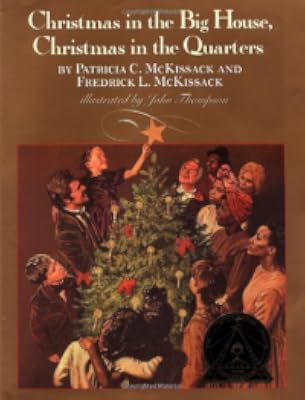
Christmas in the Big House, Christmas in the Quarters
by Patricia C. Mckissack, Fredrick McKissack
On This Page
Description
Describes the customs, recipes, poems, and songs used to celebrate Christmas in the big plantation houses and in the slave quarters just before the Civil War.Tags
Recommendations




Member Reviews
This book contrasts the Christmas Day of the enslaved and slaveowners without seeming to put a pointed lesson across, allowing the reader to examine the lives of both and draw their own conclusions.
The book includes songs, recipes and other touches that immerse the reader into the lives of the enslaved and the slaveowning class.The illustrations look like portraits of actual people, an antidote to the period art that depicts African Americans as either caricatures or bodies engaged in work. It also allows us to see ourselves in both the slaves and their captors, both of whom are depicted as equally possessing hopes and concerns about their lives and their happiness. It may make the young reader ask what they would do if they found show more themselves part of a system that subjugates others, but is thoroughly reinforced by society as normal. And how would they deal with being enslaved? show less
The book includes songs, recipes and other touches that immerse the reader into the lives of the enslaved and the slaveowning class.The illustrations look like portraits of actual people, an antidote to the period art that depicts African Americans as either caricatures or bodies engaged in work. It also allows us to see ourselves in both the slaves and their captors, both of whom are depicted as equally possessing hopes and concerns about their lives and their happiness. It may make the young reader ask what they would do if they found show more themselves part of a system that subjugates others, but is thoroughly reinforced by society as normal. And how would they deal with being enslaved? show less
In "Christmas in the Big House, Christmas in the Quarters" the reader learns of the times just before the Civil War. It depicts the life on plantations in Virginia. This story is depicted from the books about several plantations. It is easy to follow as it tells of the lives of the plantation owners and their families and of the slaves. It helps the reader to thoroughly understand the relationship between owner and slave. It goes beyond the history of the time and helps the reader to see the slaves’ desire for freedom and the owners’ fear of an uprising. It tells of the cruelty of the selling of slaves and how it separated them from their families. It has recipes and words of songs the people sang. I do not feel the illustrations show more add to the story. The cover does not draw the reader into the book, but once the story begins the reader gains information and insight. This is a valuable book to read to children. It helps young people better understand what was truly occurring. I would read it to third or fourth graders when they study the Civil War or the time preceding it. show less
Christmas in the Big House, Christmas in the Quarters by Patricia C. McKissack,
Enjoying not only learning how the slaves got the masters house in order for Christmas but their own.
They were also sent to other estates to help out as well. Very informative and I can picture being there, so descriptive.
I received this book from National Library Service for my BARD (Braille Audio Reading Device).
Enjoying not only learning how the slaves got the masters house in order for Christmas but their own.
They were also sent to other estates to help out as well. Very informative and I can picture being there, so descriptive.
I received this book from National Library Service for my BARD (Braille Audio Reading Device).
It's 1859, right before the Civil War, at a Virginia plantation at Christmas time. This book chronicles the way both the plantation owners and their slaves prepared for and celebrated Christmas on a time line starting 2 months before through New Year's Day, alternating illustrated scenes between the Big House and the Quarters.
Gives an accurate depiction of the dress, food, songs, customs and a picture of the times; talk about slave insurrections, John Brown's raid on Harper's Ferry, secession, and possible war. The Slaves have songs, stories, and customs that covertly point to their hopes for freedom.
Not so much a story about individuals as a people. Moving illustrations. The illustrator won an award for a series of paintings show more depicting the history of the Black West.
Contains useful epilogue, Extensive notes, and a bibliography show less
Gives an accurate depiction of the dress, food, songs, customs and a picture of the times; talk about slave insurrections, John Brown's raid on Harper's Ferry, secession, and possible war. The Slaves have songs, stories, and customs that covertly point to their hopes for freedom.
Not so much a story about individuals as a people. Moving illustrations. The illustrator won an award for a series of paintings show more depicting the history of the Black West.
Contains useful epilogue, Extensive notes, and a bibliography show less
Christmas in the Big House, Christmas in the Quarters by Patricia C. McKissack
It’s Christmas time on the Virginia Plantation in 1859. The slaves are told to clean the house and decorate it for Christmas. The house is filled with beautiful Christmas colors and smells. However, there is talk of a war beginning and a sense times might be changing. The shacks where the slaves live are dirty and cold, but they are hopeful for freedom to be coming soon. They sing songs of the freedom when they will get to work where they want and go where they want.
I like this story because it shows what slaves went through and how badly they were treated. It is a good reminder why people fought the civil war.
I would use this with second and third grade show more students at Christmas time. I would also talk about slavery and who was slaves and what they were told to do in this time period. I will also talk about the civil war and why we abolished slavery in the United States. I would ask students to write down reasons why they think slavery is a bad thing. show less
It’s Christmas time on the Virginia Plantation in 1859. The slaves are told to clean the house and decorate it for Christmas. The house is filled with beautiful Christmas colors and smells. However, there is talk of a war beginning and a sense times might be changing. The shacks where the slaves live are dirty and cold, but they are hopeful for freedom to be coming soon. They sing songs of the freedom when they will get to work where they want and go where they want.
I like this story because it shows what slaves went through and how badly they were treated. It is a good reminder why people fought the civil war.
I would use this with second and third grade show more students at Christmas time. I would also talk about slavery and who was slaves and what they were told to do in this time period. I will also talk about the civil war and why we abolished slavery in the United States. I would ask students to write down reasons why they think slavery is a bad thing. show less
Using a fictional format, the authors contrast holiday experiences of enslaved people and masters on a large plantation in 1859. Includes, songs and recipes. At the end there are notes and a bibliography.
This books describes the Christmas celebration on a Virginia plantation in 1859. With slavery, war, and secession going on, the book shows how the family still enjoys their Christmas celebration and the aftermath of the Christmas celebration.
Members
- Recently Added By
Published Reviews
ThingScore 50
Kirkus (Kirkus Reviews, 1994)
It's Christmas 1859 on a Virginia plantation. The family in the Big House and the slaves in the Quarters prepare for their celebrations. It is a happy time for everyone. Families are united. Feast are prepared. Singing and dancing are seen everywhere. The McKissacks (The Royal Kingdoms of Ghana, Mali, and Songhay, 1994, etc.) have written a strangely romantic view show more of a pre-emancipation Christmas. Not that there isn't talk of freedom among the slaves, and of uprising among the whites; it's just not clear why these slaves are unhappy. They are obviously poorer than their masters, but, except for a New Year's Day separation of black family members, plantation life doesn't seem at all bad. Thompson's glowing pictures, depicting well-dressed, healthy slaves and their masters celebrating together do nothing to dispel this impression. Perhaps if the McKissacks had shown the contrast between Christmas and the rest of the year more clearly, rather than assuming that their readers would all understand the evils of slavery, their book might have been more successful. It's tricky to reclaim traditions from an unhappy past. The line between glorifying aspects of slave culture and seeming to ignore the brute evil of slavery is thin. Unfortunately, the McKissacks have stepped over. 1994, Scholastic, $15.95. © 1994 Kirkus Reviews/VNU eMedia, Inc. All rights reserved. show less
It's Christmas 1859 on a Virginia plantation. The family in the Big House and the slaves in the Quarters prepare for their celebrations. It is a happy time for everyone. Families are united. Feast are prepared. Singing and dancing are seen everywhere. The McKissacks (The Royal Kingdoms of Ghana, Mali, and Songhay, 1994, etc.) have written a strangely romantic view show more of a pre-emancipation Christmas. Not that there isn't talk of freedom among the slaves, and of uprising among the whites; it's just not clear why these slaves are unhappy. They are obviously poorer than their masters, but, except for a New Year's Day separation of black family members, plantation life doesn't seem at all bad. Thompson's glowing pictures, depicting well-dressed, healthy slaves and their masters celebrating together do nothing to dispel this impression. Perhaps if the McKissacks had shown the contrast between Christmas and the rest of the year more clearly, rather than assuming that their readers would all understand the evils of slavery, their book might have been more successful. It's tricky to reclaim traditions from an unhappy past. The line between glorifying aspects of slave culture and seeming to ignore the brute evil of slavery is thin. Unfortunately, the McKissacks have stepped over. 1994, Scholastic, $15.95. © 1994 Kirkus Reviews/VNU eMedia, Inc. All rights reserved. show less
added by kthomp25
CCBC (Cooperative Children's Book Center Choices, 1994)
To depict daily life for the two communities living in parallel realities on a Virginia plantation during December, 1859, the authors gained access to primary source materials from Tidewater plantation records and held interviews there to find out more family histories. Wisely setting their text immediately before the outbreak of the Civil show more War, the McKissacks offer an amazing balance of perspectives while they report the distinctive culture of the Quarters. Showing the misery as well as the dignity of families in captivity, they allow readers to draw their own conclusions. Thompson's detailed paintings rendered in acrylic and reproduced in full-color recreate the season and the buildings as well as some of the individually distinct Afro-centric head-wraps of enslaved women and holiday decorations in the Big House. Both the text and the illustrations move far beyond conventional media-induced images of plantation life. Incomparable in scope, content and emotional impact, this well designed, easy-to-read account furnishes provocative information and offers dynamic year-round reading. Winner, 1994 CCBC Coretta Scott King Award Discussion: Writing. CCBC categories: Historical People, Places And Events; Seasons And Celebrations. 1994, Scholastic, 68 pages, $17.95. Ages 8-13. show less
To depict daily life for the two communities living in parallel realities on a Virginia plantation during December, 1859, the authors gained access to primary source materials from Tidewater plantation records and held interviews there to find out more family histories. Wisely setting their text immediately before the outbreak of the Civil show more War, the McKissacks offer an amazing balance of perspectives while they report the distinctive culture of the Quarters. Showing the misery as well as the dignity of families in captivity, they allow readers to draw their own conclusions. Thompson's detailed paintings rendered in acrylic and reproduced in full-color recreate the season and the buildings as well as some of the individually distinct Afro-centric head-wraps of enslaved women and holiday decorations in the Big House. Both the text and the illustrations move far beyond conventional media-induced images of plantation life. Incomparable in scope, content and emotional impact, this well designed, easy-to-read account furnishes provocative information and offers dynamic year-round reading. Winner, 1994 CCBC Coretta Scott King Award Discussion: Writing. CCBC categories: Historical People, Places And Events; Seasons And Celebrations. 1994, Scholastic, 68 pages, $17.95. Ages 8-13. show less
added by kthomp25
Author Information

152+ Works 26,728 Members
Patricia C. McKissack was born in Smyrna, Tennessee on August 9, 1944. She received a bachelor's degree in English from Tennessee State University in 1964 and a master's degree in early childhood literature and media programming from Webster University in 1975. After college, she worked as a junior high school English teacher and a children's book show more editor at Concordia Publishing. Since the 1980's, she and her husband Frederick L. McKissack have written over 100 books together. Most of their titles are biographies with a strong focus on African-American themes for young readers. Their early 1990s biography series, Great African Americans included volumes on Frederick Douglass, Marian Anderson, and Paul Robeson. Their other works included Black Hands, White Sails: The Story of African-American Whalers and Days of Jubilee: The End of Slavery in the United States. Over their 30 years of writing together, the couple won many awards including the C.S. Lewis Silver Medal, a Newbery Honor, nine Coretta Scott King Author and Honor awards, the Jane Addams Peace Award, and the NAACP Image Award for Sojourner Truth: Ain't I a Woman?. In 1998, they received the Coretta Scott King-Virginia Hamilton Award for Lifetime Achievement. She also writes fiction on her own. Her book included Flossie and the Fox, Stitchin' and Pullin': A Gee's Bend Quilt, A Friendship for Today, and Let's Clap, Jump, Sing and Shout; Dance, Spin and Turn It Out! She won the Newberry Honor Book Award and the King Author Award for The Dark Thirty: Southern Tales of the Supernatural in 1993 and the Caldecott Medal for Mirandy and Brother Wind. She dead of cardio-respiratory arrest on April 7, 2017 at the age of 72. (Bowker Author Biography) show less

65+ Works 5,275 Members
Some Editions
Awards and Honors
Awards
Common Knowledge
- Canonical title
- Christmas in the Big House, Christmas in the Quarters
- Important events
- Christmas
Classifications
- Genre
- Children's Books
- DDC/MDS
- 975.03 — History & geography History of North America Southeastern United States (South Atlantic states) 1776-1865: Antebellum Era & Civil War
- LCC
- F213 .M36 — Local History of the United States, Canada and Latin America United States local history The South. South Atlantic States
- BISAC
Statistics
- Members
- 325
- Popularity
- 97,674
- Reviews
- 11
- Rating
- (4.25)
- Languages
- English
- Media
- Paper
- ISBNs
- 6
- ASINs
- 1