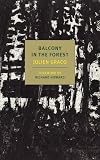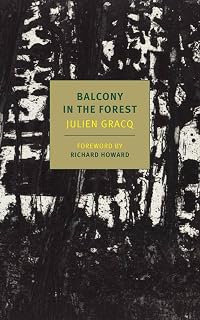
Balcony in the Forest
by Julien Gracq
On This Page
Description
It is the fall of 1939, and Lieutenant Grange and his men are living in a chalet above a concrete bunker deep in the Ardennes forest, charged with defending the French-Belgian border against the Germans in a war that seems unreal, distant, and unlikely. Far more immediate is the earthy life of the forest itself and the deep sensations of childhood it recalls from Grange's memory. Ostensibly readying for war, Grange instead spends his time observing the change in seasons, falling in love with show more a young free-spirited widow, and contemplating the absurd stasis of his present condition. This novel of long takes, dream states, and little dramatic action culminates abruptly in battle, an event that is as much the real incursion of the German army into France as it is the sudden intrusion of death into the suspended disbelief of life. Richard Howard's skilled translation captures the fairy-tale otherworldliness and existential dread of this unusual, elusive novel (first published in 1958) by the supreme prose stylist Julien Gracq. show lessTags
Recommendations

























Member Reviews
A Balcony in the Forest is a slow, poetic book that explores seclusion, waiting and anxiety in the midst of a war which is for most of the book still distant.
We follow an officer named Grange who commands a small unit somewhere in a forest in the Ardennes. He spends his days walking in the forest, visiting a nearby village, and even meeting a sprite-like lover. His experience is the core of this novel, his thoughts and meditations about life, war and nature. We know very few of the external details for any of the characters and there is a dream-like quality throughout this book.
The language is exquisite and while the book is quite simple in its concept, it is memorable because of the universality of themes it touches so subtly.
We follow an officer named Grange who commands a small unit somewhere in a forest in the Ardennes. He spends his days walking in the forest, visiting a nearby village, and even meeting a sprite-like lover. His experience is the core of this novel, his thoughts and meditations about life, war and nature. We know very few of the external details for any of the characters and there is a dream-like quality throughout this book.
The language is exquisite and while the book is quite simple in its concept, it is memorable because of the universality of themes it touches so subtly.
Not entirely my kind of thing--too much description of nature, too much manic pixie dream girl drama--but exceptionally well written and well done. I don't often get upset about the fate of characters, but I did here. This is the way to write about war.
I can make this quick and (not really) dirty. "Balcony in the Forest" was not Julien Gracq's best book but it is a great book and Gracq was a great writer. His prose is both detailed and beautiful. Some might find his descriptions somewhat overworked but the overall beauty of the work can't be questioned. There isn't a lot of "action" in the novel but Gracq clearly reveals how much of life takes place beyond our actions. Certainly worth investing the the time to read this short work.
This is a very sad story. But beautifully written (at least in French). I especially liked the beginning of the first chapter, perhaps because it was my first dip into this novel after having read many books in English, but most probably because sentences are so delicately chiselled.
The general tone of the novel reminded me my father's War Diaries I recently discovered in his belongings. Although he was not stationed at the Belgium border, but in a military camp in the southern Massif central, the atmosphere is very similar, especially dinners at the officers' mess.
Highly recommended for its melancholy poetry.
The general tone of the novel reminded me my father's War Diaries I recently discovered in his belongings. Although he was not stationed at the Belgium border, but in a military camp in the southern Massif central, the atmosphere is very similar, especially dinners at the officers' mess.
Highly recommended for its melancholy poetry.
The prose, mediated though it is through the translator, has a dreamlike quality that I enjoy, but which is also distancing. It's appropriate, because Grange's alienation from himself and from others is central to the book, but it prevents me from fully entering his mind or the world of the novel. It's still very beautiful, though some of the descriptions of women were off-putting.
No plot, written absolutely beautifully.
La guerra è (anche) un'estenuante incombenza che grava sull'uomo e sull'ambiente e Julien Gracq la descrive con maestria e con sensibilità.
Members
- Recently Added By
Author Information

Some Editions
Series
Belongs to Publisher Series
Common Knowledge
- Canonical title
- Balcony in the Forest
- Original title
- Un balcon en forêt
- Original publication date
- 1958
- People/Characters
- Lieutenant Grange; Mona; General Staff
- Important places
- Ardennes, Belgium; Belgium; Meuse River
- Epigraph
- He ! ho ! Waldhüter ihr
Schlafhüter mitsammen
So wacht doch mindest am Morgen.
Heigh! Ho! Forest Guardians!
Guardians of Sleep as well-
Waken at least with the dawn.
WAGNER: Parsifal - First words
- Neither document nor testimony (Gracq's own experiences in World War II were on an entirely different front, and in altogether other circumstances), Balcony in the Forest, Gracq's fourth novel, and actually the prec... (show all)ipitate of the encounter between a certain historical situation, one that was very unstable and indeed fugative, and the inclination of the author's fantasy, is the only one of this author's fictions - among so many legends, romances gestes - which can be presumed to be realistic. (Translator's Foreword)
Ever since his train had outdistanced the smoke and the suburbs of Charleville, it seemed to Lieutenant Grange that the world's ugliness was disappearing with them: he discovered there was no longer a single house in sight. - Last words
- (Click to show. Warning: May contain spoilers.)And what a boon to the translator of 1958, then, in what became the novel's final sentence, suggesting the kind of overdetermined, lyric necessity of this musical, mysterious text: "He lay for a moment more with his eyes wide open in the darkness.... Then he pulled the blanket up over his head and went to sleep." (Translator's Forward)
(Click to show. Warning: May contain spoilers.)Then he pulled the blanket up over his head and went to sleep. - Original language
- French
Classifications
Statistics
- Members
- 378
- Popularity
- 83,092
- Reviews
- 7
- Rating
- (4.11)
- Languages
- 8 — English, French, German, Japanese, Romanian, Spanish, Swedish, Turkish
- Media
- Paper, Ebook
- ISBNs
- 21
- ASINs
- 9