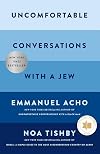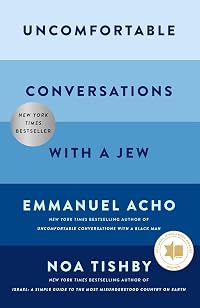
Uncomfortable Conversations with a Jew
by Emmanuel Acho
On This Page
Description
For Emmanuel Acho and Noa Tishby no question about Jews is off-limits. They go there. They cover Jews and money. Jews and power. Jews and privilege. Jews and white privilege. The Black and Jewish struggle. Emmanuel asks, Did Jews kill Jesus? To which Noa responds, "Why are Jewish people history's favorite scapegoat?" They unpack Judaism itself: Is it a religion, culture, a peoplehood, or a race? And: Are you antisemitic if you're anti-Zionist? The questions, and answers, might make you show more squirm, but together, they explain the tropes, stereotypes, and catalysts of antisemitism in America today. The topics are complicated and Acho and Tishby bring vastly different perspectives. Tishby is an outspoken Israeli American. Acho is a mild-mannered son of a Nigerian American pastor. But they share a superpower: an uncanny ability to make complicated ideas easy to understand so anyone can follow the straight line from the past to our immediate moment, and then see around corners. Acho and Tishby are united by the core belief that hatred toward one group is never isolated: if you see the smoke of bigotry in one place, expect that we will all be in the fire. show lessTags
Recommendations






Member Reviews
****.5
This book is essentially the sequel to both Acho's "Uncomfortable Conversations With a Black Man" and Tishby's "Israel: A Simple Guide."
While both authors are clearly more comfortable with social media than writing book-length content, the conversational tone works better in this one, which is formatted as an actual dialogue between the two. And since they don't always agree, it forces them to really focus their arguments more than the peachy soapbox monologuing of their solo works.
As to the content, it's fairly basic but also an excellent overview of the current wave of antisemitism, and more generally a basic introduction to Judaism and Zionism. As the authors themselves acknowledge, they're attempting to squeeze 10 show more multi-hundred page books into a single thin volume, so it's necessarily an abbreviated high-level view, but enough to cover the fundamentals and prepare the reader for further reading and study.
Although a lot of the content was previously covered in Tishby's previous book, the context of October 7 makes it all feel more real and less abstract this time around. It's one thing to learn about the Holocaust in a history book, and quite another to see it being livestreamed. I do wish that she spent at least a couple of pages covering the context of the attack, although it was definitely a surprise it also didn't happen out of nowhere. Her answer to the question of why Palestinians would support such violence was perhaps the weakest part of the book. And completely ignoring the Israeli response is a missed opportunity to discuss what is and what isn't legitimate when it comes to self-defense and fighting for rights. Especially in conversation with Acho, who is quite familiar with the similar debate regarding violent resistance and protest movements, from MLK/Malcom X to BLM/Jan 6. show less
This book is essentially the sequel to both Acho's "Uncomfortable Conversations With a Black Man" and Tishby's "Israel: A Simple Guide."
While both authors are clearly more comfortable with social media than writing book-length content, the conversational tone works better in this one, which is formatted as an actual dialogue between the two. And since they don't always agree, it forces them to really focus their arguments more than the peachy soapbox monologuing of their solo works.
As to the content, it's fairly basic but also an excellent overview of the current wave of antisemitism, and more generally a basic introduction to Judaism and Zionism. As the authors themselves acknowledge, they're attempting to squeeze 10 show more multi-hundred page books into a single thin volume, so it's necessarily an abbreviated high-level view, but enough to cover the fundamentals and prepare the reader for further reading and study.
Although a lot of the content was previously covered in Tishby's previous book, the context of October 7 makes it all feel more real and less abstract this time around. It's one thing to learn about the Holocaust in a history book, and quite another to see it being livestreamed. I do wish that she spent at least a couple of pages covering the context of the attack, although it was definitely a surprise it also didn't happen out of nowhere. Her answer to the question of why Palestinians would support such violence was perhaps the weakest part of the book. And completely ignoring the Israeli response is a missed opportunity to discuss what is and what isn't legitimate when it comes to self-defense and fighting for rights. Especially in conversation with Acho, who is quite familiar with the similar debate regarding violent resistance and protest movements, from MLK/Malcom X to BLM/Jan 6. show less
After reading [[Emmanuel Acho]]’s [Uncomfortable Conversations with a Black Man], I was interested to read this one.
This time Acho pairs with [[Noa Tishby]], an Israeli American Jewish advocate. It’s an interesting pairing as Jews and blacks here in America often view each other with skepticism and are sometimes on different sides of the sturggle, even as both often targets of white supremacy groups.
As Emnuel Acho says “One way to bring forth justice is through dialogue. Through respectful curiosity, asking and listening. …How to give someone else the space to speak plainly and communicate their own truth, while also examining your own – however inconvenient or painful that might be ” P xv
In the preface Tishby recounts her show more experience live-reporting the Hamas invasion of Israel on October 6. And although this book isn’t specifically about that atrocity, it provides background.
The authors examine anti-Jewish memes and why Jews are scapegoated. Some of those mentioned include stereotypes involving Jewish money and secret power and Jews as Christ-killers.
They also explore a bit of Jewish history – and the worldwide persecutions making Jews long for their own homeland.
They explain how being Jewish can be a religion, a bloodline, and/ora nationality.
Although the authors talk about political topics such as Zionism, most of Israel’s scorched earth policy against Palestinian Hamas in the current war is not covered, as the war has evolved since this writing.
The book is written in an easily understood and engaging way. After having read it, I believe I have a better background understanding as well as a better idea of what respectful questions can look like. show less
This time Acho pairs with [[Noa Tishby]], an Israeli American Jewish advocate. It’s an interesting pairing as Jews and blacks here in America often view each other with skepticism and are sometimes on different sides of the sturggle, even as both often targets of white supremacy groups.
As Emnuel Acho says “One way to bring forth justice is through dialogue. Through respectful curiosity, asking and listening. …How to give someone else the space to speak plainly and communicate their own truth, while also examining your own – however inconvenient or painful that might be ” P xv
In the preface Tishby recounts her show more experience live-reporting the Hamas invasion of Israel on October 6. And although this book isn’t specifically about that atrocity, it provides background.
The authors examine anti-Jewish memes and why Jews are scapegoated. Some of those mentioned include stereotypes involving Jewish money and secret power and Jews as Christ-killers.
They also explore a bit of Jewish history – and the worldwide persecutions making Jews long for their own homeland.
They explain how being Jewish can be a religion, a bloodline, and/ora nationality.
Although the authors talk about political topics such as Zionism, most of Israel’s scorched earth policy against Palestinian Hamas in the current war is not covered, as the war has evolved since this writing.
The book is written in an easily understood and engaging way. After having read it, I believe I have a better background understanding as well as a better idea of what respectful questions can look like. show less
Introduction to Jews with a special focus on modern social issues. Solid content, super readable, highly situated in the 2020s such that it will probably be less relevant come 2035 (but still relevant because this stuff doesn’t go away), and a good fit for folks interested in doing the work to educate themselves on what Jews are struggling with today.
Ratings
Members
- Recently Added By
Lists

Books Read in 2024
4,727 works; 128 members

Borrowed Books 2024 (Books We Have Read BUT do NOT Own)
20 works; 1 member

Jewish Books
367 works; 24 members
Author Information

4 Works 1,080 Members
Awards and Honors
Classifications
Statistics
- Members
- 104
- Popularity
- 311,905
- Reviews
- 3
- Rating
- (3.35)
- Languages
- English
- Media
- Paper, Audiobook, Ebook
- ISBNs
- 6
- ASINs
- 2