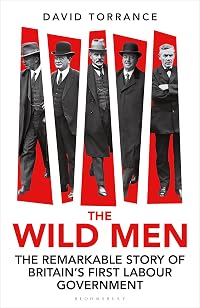
The Wild Men: The Remarkable Story of Britain's First Labour Government
by David Torrance
On This Page
Description
A WATERSTONES BOOK OF THE YEAR 2024 A century ago, a Labour government took power for the first time. Meet the "Wild Men" who led the way... 'Superb' -- New Statesman 'Fascinating' -- The Sunday Times. In 1923, the passing of the Act which gave all men the vote opened the door for a radically different sort of government: men from working-class backgrounds who had never before occupied the corridors of power at Westminster. Who were these 'wild men'? Ramsay MacDonald, their leader and show more Labour's first Prime Minster, was the illegitimate son of a Scottish farm labourer; Arthur Henderson was a Scottish iron moulder; J. H. Thomas, a Welsh railwayman; John Wheatley, an Irish-born miner and publican; and William Adamson, a Fife coal miner. The Wild Men - this new edition with a fully updated preface - tells the story of that first Labour administration - its unexpected birth, fraught existence, and controversial downfall - through the eyes of those who found themselves in the House of Commons, running the country for the people. Blending biography and history into a compelling narrative, David Torrance reassesses the UK's first Labour government a century after it shook up a British establishment still reeling from the War - and how the establishment eventually fought back. This is an extraordinary period in British political history which echoes down the years to our current politics and laid the foundations for the Britain of today. show lessTags
Recommendations








Member Reviews
NB: This was reviewed alongside The Men of 1924: Britain’s First Labour Government by Peter Clark and A Century of Labour by John Cruddas.
Ahead of a possible Labour victory in Britain’s next general election, three new histories published on the centenary of the party’s first government provide a useful opportunity for reflection and perspective. Peter Clark’s brisk and personable The Men of 1924 devotes roughly half its length to Labour’s early years, as the party transformed itself ‘from pressure group to government in waiting’. Formed in 1900 from the trade union movement and a patchwork of small and frequently fractious socialist parties, societies and groups with origins in the late 19th century, the party’s initial show more electoral successes were limited to the local level but had wide-ranging reach. In its early strongholds in the Welsh valleys and poorer London boroughs such as Poplar, Labour councillors focused on improving working conditions and on health, housing and education, often building in microcosm the mechanisms of welfare that would be introduced nationally under Labour governments of greater success and stability than that of 1924.
The election of December 1923, in which a shock electoral advance by Labour led to an unprecedented three-way split in the Commons, saw the party enter government a month later for the first time. At a century’s distance, this nine-month-long minority administration – a venture cautioned against at the time by some of its own members – tends to be treated as an embarrassing failure or false start at best. Both Clark and David Torrance, in his more tightly focused The Wild Men, offer more even-handed assessments of the 1924 government. Both authors also paint largely forgiving portraits of its leader Ramsay MacDonald – although his political achievements and his personal snobbery, prickliness and social climbing have been judged so harshly by the majority of Labour’s historians that the bar for sympathy is somewhat low. Clark’s series of biographical sketches, and Torrance’s more smoothly integrated study, bring in the personalities beyond MacDonald that shaped Labour’s brief time in power: Lancashire autodidacts Thomas Shaw and J.R. Clynes; Fabian intellectuals such as Sidney Webb; the avuncular Arthur Henderson and the brash and bibulous Jimmy Thomas.
Other than Margaret Bondfield, the former shop assistant and trade union activist who would later became Britain’s first female cabinet minister in the second Labour government of 1929-31, this story reflects the domination of 1920s British politics by what Clark, pre-empting the obvious observation, acknowledges as ‘white men in dark suits’. Both books do, however, draw on some of the many female voices behind the scenes, including Beatrice Webb, Dolly Ponsonby and journalist Mary Agnes Hamilton. The 1924 Housing Act, enabling the subsidised building of public housing, was driven by health secretary John Wheatley’s experience of rent strikes in Glasgow – collective actions which were largely led by women. Labour’s electoral success reflected the rising influence of newly enfranchised demographics – both women and working-class men – and, in terms of class, was unarguably groundbreaking. MacDonald himself was the illegitimate son of a housemaid and a farmhand, and his cabinet replaced Old Etonians with former miners, railwaymen and millworkers.
Read the rest of the review at HistoryToday.com.
Rhian E. Jones writes on history and politics. Her latest book, with Matthew Brown, is Paint Your Town Red: How Preston Took Back Control and Your Town Can Too (Repeater, 2021). show less
Ahead of a possible Labour victory in Britain’s next general election, three new histories published on the centenary of the party’s first government provide a useful opportunity for reflection and perspective. Peter Clark’s brisk and personable The Men of 1924 devotes roughly half its length to Labour’s early years, as the party transformed itself ‘from pressure group to government in waiting’. Formed in 1900 from the trade union movement and a patchwork of small and frequently fractious socialist parties, societies and groups with origins in the late 19th century, the party’s initial show more electoral successes were limited to the local level but had wide-ranging reach. In its early strongholds in the Welsh valleys and poorer London boroughs such as Poplar, Labour councillors focused on improving working conditions and on health, housing and education, often building in microcosm the mechanisms of welfare that would be introduced nationally under Labour governments of greater success and stability than that of 1924.
The election of December 1923, in which a shock electoral advance by Labour led to an unprecedented three-way split in the Commons, saw the party enter government a month later for the first time. At a century’s distance, this nine-month-long minority administration – a venture cautioned against at the time by some of its own members – tends to be treated as an embarrassing failure or false start at best. Both Clark and David Torrance, in his more tightly focused The Wild Men, offer more even-handed assessments of the 1924 government. Both authors also paint largely forgiving portraits of its leader Ramsay MacDonald – although his political achievements and his personal snobbery, prickliness and social climbing have been judged so harshly by the majority of Labour’s historians that the bar for sympathy is somewhat low. Clark’s series of biographical sketches, and Torrance’s more smoothly integrated study, bring in the personalities beyond MacDonald that shaped Labour’s brief time in power: Lancashire autodidacts Thomas Shaw and J.R. Clynes; Fabian intellectuals such as Sidney Webb; the avuncular Arthur Henderson and the brash and bibulous Jimmy Thomas.
Other than Margaret Bondfield, the former shop assistant and trade union activist who would later became Britain’s first female cabinet minister in the second Labour government of 1929-31, this story reflects the domination of 1920s British politics by what Clark, pre-empting the obvious observation, acknowledges as ‘white men in dark suits’. Both books do, however, draw on some of the many female voices behind the scenes, including Beatrice Webb, Dolly Ponsonby and journalist Mary Agnes Hamilton. The 1924 Housing Act, enabling the subsidised building of public housing, was driven by health secretary John Wheatley’s experience of rent strikes in Glasgow – collective actions which were largely led by women. Labour’s electoral success reflected the rising influence of newly enfranchised demographics – both women and working-class men – and, in terms of class, was unarguably groundbreaking. MacDonald himself was the illegitimate son of a housemaid and a farmhand, and his cabinet replaced Old Etonians with former miners, railwaymen and millworkers.
Read the rest of the review at HistoryToday.com.
Rhian E. Jones writes on history and politics. Her latest book, with Matthew Brown, is Paint Your Town Red: How Preston Took Back Control and Your Town Can Too (Repeater, 2021). show less
Ratings
Members
- Recently Added By
Lists

Library Non-Fiction
164 works; 1 member
Author Information

21 Works 135 Members
Awards and Honors
Distinctions
The Guardian Book of the Day (2024-01-13)
Classifications
- Genres
- History, Nonfiction, Politics and Government, Biography & Memoir, General Nonfiction
- DDC/MDS
- 941.083 — History & geography History of Europe British Isles Historical periods of British Isles 1837- Period of Victoria and House of Windsor 1910-1936 George V
- LCC
- DA566.7 .T67 — History of Europe, Asia, Africa and Oceania Great Britain History of Great Britain England History By period Modern, 1485- 20th century
- BISAC
Statistics
- Members
- 20
- Popularity
- 1,283,608
- Reviews
- 1
- Rating
- (4.00)
- Languages
- English
- Media
- Paper, Audiobook
- ISBNs
- 3
- ASINs
- 1