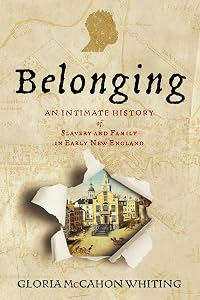
Belonging: An Intimate History of Slavery and Family in Early New England (Early American Studies)
by Gloria McCahon Whiting
On This Page
Description
"As winter turned to spring in the year 1699, Sebastian and Jane embarked on a campaign of persuasion. The two wished to marry, and they sought the backing of their community in Boston. Nothing, however, could induce Jane's enslaver to consent. Only after her death did Sebastian and Jane manage to wed, forming a union that was stable and long-lasting despite the fact that husband and wife were not always able to live in the same household. New England is often considered a cradle of liberty show more in American history, but this snippet of Jane and Sebastian's story reminds us that it was also a cradle of slavery. From the earliest years of colonization, New Englanders bought and sold people, most whom were of African descent. In Belonging, Gloria McCahon Whiting tells the region's early history from the perspective of the people, like Jane and Sebastian, who belonged to others and who struggled to maintain a sense of belonging among their kin. Through a series of meticulously reconstructed family narratives, Whiting traces the contours of enslaved people's intimate lives. Bondage created family problems for the enslaved, who tended to live in the same dwellings as those who bound them, but often lived apart from their kin. Enslaved spouses rarely were able to cohabit; fathers and their offspring routinely were separated by inheritance practices; children could be removed from their mothers at an enslaver's whim; and people in bondage had only partial control of their movement through the region, which made more difficult the task of maintaining distant relationships. But Belonging does more than lay bare the obstacles to family stability for those in bondage; the book also examines how people of African descent created kinship ties despite these limitations. Whiting charts Afro-New Englanders' persistent demands for intimacy throughout the century and a half stretching from New England's founding to the American Revolution. And she shows how the work of making and maintaining relationships influenced the region's law, religion, society, and politics. Ultimately, the actions taken by people in bondage to fortify their families played a pivotal role in bringing about the collapse of slavery in New England's most populous state, Massachusetts"-- Provided by publisher. show lessTags
Member Reviews
"Belonging" by Gloria McCahon Whiting is an intimate analysis of New England slaves up until the American Revolution. The author relies on primary sources as much as possible, piecing together each life with impressive accuracy. We're first introduced to Dorcas, the first member of African descent to join the Puritan Church. Then there is Jane and Sebastian, two lovers who wished to be married against the wishes of Jane's mistress. There's Lydia, a white woman, and Thomas a freed black man, who are married two years before the General Assembly passes a law forbidding interracial marriage in 1705. Administrative racial labels vs societal perception trail their "passing" descendants for generations. Then we meet Sue, a woman who was sold show more as an infant, only to suffer the sale of her own children . Such cold-hearted "trampling upon their intimate lives" could drive anyone to murder, as is the case of Mark, Phoebe and Phillis in 1755.
I adore historical studies like this, because they are usually the most respectful and yet honest. "Enslaved spouses rarely were able to cohabit; children could be removed from their mothers at an enslaver’s whim..." No two stories of enslavement are ever the same. Slavery is often taught in a removed, statistic-heavy manner. It's true that numbers are important, but slavery was present in every facet of American life, not just the plantations. Slavery is emotional, financial, societal, religious and economical. It was in the Church, in Court, in the market, in the house next door. I was surprised to learn that Samuel Sewall, the regretful judge from the Salem witch trials, was adamantly anti-slavery. Slavery was and is an abhorrent institution, but you'll learn that it is also complex and deeply personal. Parts of this book will break your heart, but you'll be glad when it sticks with you. show less
I adore historical studies like this, because they are usually the most respectful and yet honest. "Enslaved spouses rarely were able to cohabit; children could be removed from their mothers at an enslaver’s whim..." No two stories of enslavement are ever the same. Slavery is often taught in a removed, statistic-heavy manner. It's true that numbers are important, but slavery was present in every facet of American life, not just the plantations. Slavery is emotional, financial, societal, religious and economical. It was in the Church, in Court, in the market, in the house next door. I was surprised to learn that Samuel Sewall, the regretful judge from the Salem witch trials, was adamantly anti-slavery. Slavery was and is an abhorrent institution, but you'll learn that it is also complex and deeply personal. Parts of this book will break your heart, but you'll be glad when it sticks with you. show less
Members
- Recently Added By
Lists

Books in the Bibliography of Contested Continent by Peter Mancall
495 works; 1 member
Author Information
1 Work 14 Members
Awards and Honors
Classifications
- Genres
- History, Nonfiction, General Nonfiction
- DDC/MDS
- 974.4 — History & geography History of North America Northeastern United States (New England and Middle Atlantic states) Massachusetts
- LCC
- E185.86 .W4389 — History of the United States United States Elements in the population Afro-Americans Status and development since emancipation
- BISAC
Statistics
- Members
- 14
- Popularity
- 1,680,631
- Reviews
- 1
- Rating
- (5.00)
- Languages
- English
- Media
- Paper, Ebook
- ISBNs
- 2
- ASINs
- 1