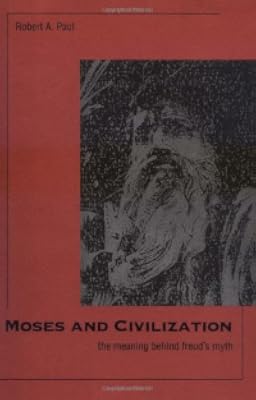
Moses and Civilization: The Meaning Behind Freud`s Myth
by Robert A. Paul
On This Page
Description
Freud's major cultural books, Totem and Taboo and Moses and Monotheism, have long been viewed as failed attempts at historical reconstruction. This book, by an anthropologist and practicing psychoanalyst, offers a brilliant reinterpretation of these works, presenting them instead as versions and unwitting analyses of the great mythic narrative underlying Judeo-Christian civilization, found principally in the Five Books of Moses.Synthesizing aspects of structural anthropology, symbolic show more anthropology, evolutionary theory, and psychoanalysis, Robert A. Paul reveals the numerous parallels between Freud's myth of the primal horde and the Torah text. He shows how the primal-horde scenario is the basis for the Christian myth of the life and death of Jesus. And he details the way Freud's myth corresponds to the unconscious fantasy structure of the obsessional personality—a style of personality dynamics Paul sees as essential to maintaining the bureaucratic institutions that make up Western civilization's most distinctive features. Paul thus corrects and completes Freud's project, creating a valid psychoanalytic account of Western civilization that rests not on faulty speculation, as Freud's did, but on a detailed reading of the biblical text and of the legends, folklore, commentaries, and social practices surrounding it. show lessTags
Members
- Recently Added By
Author Information
7 Works 45 Members
Robert A. Paul is the Charles Howard Candler Professor of Anthropology and Interdisciplinary Studies and director of the Emory University Psychoanalytic Institute at Emory University. He is the author of Moses and Civilization and The Tibetan Symbolic World, the latter published by the University of Chicago Press.
Awards and Honors
Awards
Classifications
Statistics
- Members
- 18
- Popularity
- 1,387,650
- Languages
- English
- Media
- Paper, Ebook
- ISBNs
- 2