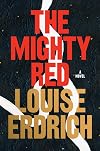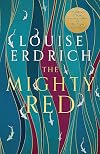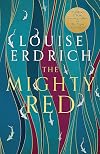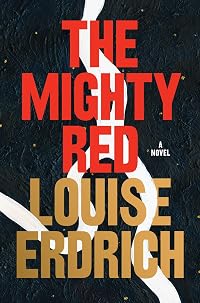
The Mighty Red
by Louise Erdrich
On This Page
Description
In this stunning novel, Pulitzer Prize and National Book Awardwinning author Louise Erdrich tells a story of love, natural forces, spiritual yearnings, and the tragic impact of uncontrollable circumstances on ordinary people's lives. History is a flood. The mighty red ... In Argus, North Dakota, a collection of people revolve around a fraught wedding. Gary Geist, a terrified young man set to inherit two farms, is desperate to marry Kismet Poe, an impulsive, lapsed Goth who can't read her show more future but seems to resolve his. Hugo, a gentle red-haired, home-schooled giant, is also in love with Kismet. He's determined to steal her and is eager to be a home wrecker. Kismet's mother, Crystal, hauls sugar beets for Gary's family, and on her nightly runs, tunes into the darkness of late-night radio, sees visions of guardian angels, and worries for the future, her daughter's and her own. Human time, deep time, Red River time, the half-life of herbicides and pesticides, and the elegance of time represented in fracking core samples from unimaginable depths, is set against the speed of climate change, the depletion of natural resources, and the sudden economic meltdown of 2008-2009. How much does a dress cost? A used car? A package of cinnamon rolls? Can you see the shape of your soul in the everchanging clouds? Your personal salvation in the giant expanse of sky? These are the questions the people of the Red River Valley of the North wrestle with every day. The Mighty Red is a novel of tender humor, disturbance, and hallucinatory mourning. It is about on-the-job pains and immeasurable satisfactions, a turbulent landscape, and eating the native weeds growing in your backyard. It is about ordinary people who dream, grow up, fall in love, struggle, endure tragedy, carry bitter secrets; men and women both complicated and contradictory, flawed and decent, lonely and hopeful. It is about a starkly beautiful prairie community whose members must cope with devastating consequences as powerful forces upend them. As with every book this great modern master writes, The Mighty Red is about our tattered bond with the earth, and about love in all of its absurdity and splendor. A new novel by Louise Erdrich is a major literary event; gorgeous and heartrending, The Mighty Red is a triumph. show lessTags
Recommendations


















Member Reviews
(audio) I was ready to chuck this novel after the second disc and was puzzled as to why an author who has always enchanted me in the past was wasting her skills writing about some really annoying high school seniors. Whew! I stuck with it and was absorbed by this story of the hardships of rural life and what one must do (rob banks, marry at seventeen, run off to the oil fields where you rent a refrigerator box for $200 a month while raccoons sneak in at night and nibble your toes, ride snowmobiles drunk and ruin lives, work at unloading trucks full of sugar beets, use deadly chemicals to ruin your source of income, join your frenemies at a book club, and more) to not just give up and move to the city. Life in Erdrich's Tabor, North show more Dakota, is inconceivably difficult, would be intolerable to anyone who moved there from elsewhere, and would be stultifying in any other author's hands. But Erdrich forces us to care about Kismet, pursued by two classmates until one catches her; Hugo, the rival; Crystal, Kismet's mother, abandoned by her husband, who has absconded with the church building fund; Gary, Diz, and Winnie, a family whose misfortunes evoke Kismet's sorrow; and Gary's teammates, who follow his drunken lead into a horrible disaster. By the end, or even by the middle, the reader is consumed by pity and by wonder at the ability of the characters to survive and to overcome their mistakes. What would a farm family make of this story? I'd love to know. show less
A teen love triangle, a high school football team struck by tragedy after a party, and beet farmers and beet haulers make up the cast of this small-town Midwestern tale. Erstwhile goth girl Kismet Poe is in love with Hugo Dumach but marries Gary Geist, the son of beet farmers Diz and Winnie Geist. Kismet is the daughter of Crystal Frechette, beet hauler, and Martin Poe, who absconds with the local church’s renovation fund. Gary and his former football teammates are haunted by friends who died after a drunken party at Gary’s party shed. Through all this drama winds the Red River and the specter of environmental degradation.
Told through multiple points of view, the story is touching, funny, tragic, and entirely satisfying. Replete show more with details of the characters’ everyday life and long-term dreams and aspirations, the narrative captures, and gently pokes fun at, life in the rural Midwest. show less
Told through multiple points of view, the story is touching, funny, tragic, and entirely satisfying. Replete show more with details of the characters’ everyday life and long-term dreams and aspirations, the narrative captures, and gently pokes fun at, life in the rural Midwest. show less
The Mighty Red refers to the Red River that flows by the small North Dakota town Louise Erdrich inhabits with her typically quirky community of people scraping by during the economic crisis in the late 2000s. At the novel's center are Kismet Poe, her parents Crystal and Martin, and the two young men vying for her attention, Gary and Hugo. Short chapters circulate through the main characters and many others revealing bits and pieces about a current scandal, a past traumatic incident, and the everyday events in town. Like so many of Erdrich’s books, The Mighty Red explores a myriad of things through the plot including agricultural pollution, mental health, Indigenous rights, trauma — both literal and familial — and she does it all show more with her ridiculous sense of humor that makes you laugh when you know you shouldn’t. Another great book from Erdrich who keeps getting better and better. show less
With The Mighty Red, Louise Erdrich delivers yet another rich, thought-provoking piece of fiction that allows us to look at our own times in new ways. The novel begins slowly focusing on Kismet, a high school student in a small farming community in North Dakota being courted (that sounds a bit to grand)/hit up on (it's not that trashy either) by two young men her own age. Both of the boys have put Karma at the center of their hopes. Each has his own version of how perfect life with her will be. Kismet has no deep interested in either of them, but doesn't push either away.
As the novel progresses, new threads weave in and gradually start making a fabric. The crops in this community are almost all sugar beets. Many of those who don't grow show more them have jobs transporting them or processing them. The focus is on high production, which involves chemicals and requires planting every bit of available land taking down the windbreaks that used to preserve the soil. The birds are gone, as are the insects, both good and bad.
Gary, one of the two young men interested in Kismet was in an accident a year ago. Terrible things happened, but we don't know what they are.
Hugo, the other young man, drives to Texas and finds a job in the oil fields, which pays well, but is dangerous. He's convinced that if he can just put enough cash together he can return home and Kismet will marry him.
So, besides the "love" triangle, we have have a triangle of a different sort: over-used soil and over-used chemicals, risk-taking that can end in sudden violence, and the perpetuation of our dependence on fossil fuels.
And Kismet says a reluctant "yes" to Gary's repeated proposals of marriage.
In the Mighty Red, life is messy in that way it can be, particularly when a community and individuals lack the funds to ride the mess out.
This most definitely isn't my favorite Erdrich novel, but it is an Erdrich novel—which means there are rewards for the readers who stick with it. It's like a hot fudge sundae with only one scoop of ice cream: a bit underwhelming, but not something a person with any sense would turn down.
I received a free electronic review copy of this title from the publisher via Edelweiss; the opinions are my own. show less
As the novel progresses, new threads weave in and gradually start making a fabric. The crops in this community are almost all sugar beets. Many of those who don't grow show more them have jobs transporting them or processing them. The focus is on high production, which involves chemicals and requires planting every bit of available land taking down the windbreaks that used to preserve the soil. The birds are gone, as are the insects, both good and bad.
Gary, one of the two young men interested in Kismet was in an accident a year ago. Terrible things happened, but we don't know what they are.
Hugo, the other young man, drives to Texas and finds a job in the oil fields, which pays well, but is dangerous. He's convinced that if he can just put enough cash together he can return home and Kismet will marry him.
So, besides the "love" triangle, we have have a triangle of a different sort: over-used soil and over-used chemicals, risk-taking that can end in sudden violence, and the perpetuation of our dependence on fossil fuels.
And Kismet says a reluctant "yes" to Gary's repeated proposals of marriage.
In the Mighty Red, life is messy in that way it can be, particularly when a community and individuals lack the funds to ride the mess out.
This most definitely isn't my favorite Erdrich novel, but it is an Erdrich novel—which means there are rewards for the readers who stick with it. It's like a hot fudge sundae with only one scoop of ice cream: a bit underwhelming, but not something a person with any sense would turn down.
I received a free electronic review copy of this title from the publisher via Edelweiss; the opinions are my own. show less
I listened to the audiobook which was wonderfully narrated by Marin Ireland. Although this book is set along the Red River which is one of the main rivers that flows through my home city, I felt like it was a foreign place. And, technically, it is, since the story is set in North Dakota. These days that really feels like a foreign place.
Most of this book takes place during the aftermath of the 2008 financial crisis that rocked the USA. Even a small town in North Dakota isn't immune to it. But then, farming communities are always teetering on financial ruin so this time isn't really different. Three young people in the town dream, as young people always do, of achieving something different from what their parents have. Kismet, with her show more Metis and Ojibway heritage, tried the goth route but that phase has passed. Her mother, Crystal, who works hauling sugar beets has managed to put aside money for Kismet's college education. Her father, Martin, certainly hasn't been any help with his meager earnings as a drama teacher and his extravagances like Italian silk ties and crafted coffees. Two of Kismet's male contemporaries think that Kismet could be the answer to their difficulties. Gary, the high school jock whose world was rocked when two of his friends died in a snowmobiling accident that he was leading, is the polar opposite of Hugo, a nerdy home-schooled son of a bookstore owner. Gary keeps proposing to Kismet who finally accepts him and agrees to a huge wedding right after high school graduation. She doeasn't really love him. In fact, she is much more drawn to Hugo but Hugo is wise enough to know that they are all too young for marriage. The reader keeps thinking that Kismet (or perhaps her mother) will realize the marriage to Gary is crazy and call it off but it goes ahead. In large part this is because Martin has disappeared and the church building fund he was managing is also missing. Following the wedding, Gary and Kismet spend their honeymoon in the new house on Gary's parents' farm which Kismet doesn't even have the means to leave. Instead she is put to work cleaning her in-laws' home which her mother-in-law hasn't been able to clean since the accident that killed Gary's two friends. Hugo, ventures out to the oil fields to make money which he hopes will enable him to woo Kismet back from Gary. Meanwhile, Crystal has discovered that Martin somehow managed to put a mortgage on the family house which is solely in Crystal's name. Her friend, the local lawyer, vows to fight the mortgage company but has to charge Crystal something. Unwilling to tap into Kismet's college fund, Crystal starts selling of household goods and Martin's wardrobe through E-bay. When she sees on the TV news that someone called the "Cutie-Pie Bandit" has been robbing banks across the western states, she realizes the robber is her husband, Martin. He's putting his dramatic skills to good use to dress up in various costumes to get the teller's cash and then exit quickly and ditch his costume. Will he get caught on one of theses outings? Will Gary and Kismet stay married? Will Crystal lose her house? I'm not telling but you can read (or listen) to the book yourself.
Sugar beet farming is enabled by clearing all the trees and using combinations of herbicides, pesticides, fertilizer and other chemicals. I felt a little better about Gary's mom when she reminisced with her book club about the meadowlarks and bluebirds and other song birds that used to be on this land. They are almost all gone now because the insects are gone. There are hopes for regeneration though; a friend of Gary's and his father are trying to revert their land to the original prairie. Kismet witnesses the "vesper flight" of birds flying around in the twilight after the insects that have returned to their land. A tactic that is taking hold in Canada is to encourage ranchers to allow beef cattle to free-range feed which enables the pasture land to revert to habitat suitable for song birds. Let's hope it is not too late. show less
Most of this book takes place during the aftermath of the 2008 financial crisis that rocked the USA. Even a small town in North Dakota isn't immune to it. But then, farming communities are always teetering on financial ruin so this time isn't really different. Three young people in the town dream, as young people always do, of achieving something different from what their parents have. Kismet, with her show more Metis and Ojibway heritage, tried the goth route but that phase has passed. Her mother, Crystal, who works hauling sugar beets has managed to put aside money for Kismet's college education. Her father, Martin, certainly hasn't been any help with his meager earnings as a drama teacher and his extravagances like Italian silk ties and crafted coffees. Two of Kismet's male contemporaries think that Kismet could be the answer to their difficulties. Gary, the high school jock whose world was rocked when two of his friends died in a snowmobiling accident that he was leading, is the polar opposite of Hugo, a nerdy home-schooled son of a bookstore owner. Gary keeps proposing to Kismet who finally accepts him and agrees to a huge wedding right after high school graduation. She doeasn't really love him. In fact, she is much more drawn to Hugo but Hugo is wise enough to know that they are all too young for marriage. The reader keeps thinking that Kismet (or perhaps her mother) will realize the marriage to Gary is crazy and call it off but it goes ahead. In large part this is because Martin has disappeared and the church building fund he was managing is also missing. Following the wedding, Gary and Kismet spend their honeymoon in the new house on Gary's parents' farm which Kismet doesn't even have the means to leave. Instead she is put to work cleaning her in-laws' home which her mother-in-law hasn't been able to clean since the accident that killed Gary's two friends. Hugo, ventures out to the oil fields to make money which he hopes will enable him to woo Kismet back from Gary. Meanwhile, Crystal has discovered that Martin somehow managed to put a mortgage on the family house which is solely in Crystal's name. Her friend, the local lawyer, vows to fight the mortgage company but has to charge Crystal something. Unwilling to tap into Kismet's college fund, Crystal starts selling of household goods and Martin's wardrobe through E-bay. When she sees on the TV news that someone called the "Cutie-Pie Bandit" has been robbing banks across the western states, she realizes the robber is her husband, Martin. He's putting his dramatic skills to good use to dress up in various costumes to get the teller's cash and then exit quickly and ditch his costume. Will he get caught on one of theses outings? Will Gary and Kismet stay married? Will Crystal lose her house? I'm not telling but you can read (or listen) to the book yourself.
Sugar beet farming is enabled by clearing all the trees and using combinations of herbicides, pesticides, fertilizer and other chemicals. I felt a little better about Gary's mom when she reminisced with her book club about the meadowlarks and bluebirds and other song birds that used to be on this land. They are almost all gone now because the insects are gone. There are hopes for regeneration though; a friend of Gary's and his father are trying to revert their land to the original prairie. Kismet witnesses the "vesper flight" of birds flying around in the twilight after the insects that have returned to their land. A tactic that is taking hold in Canada is to encourage ranchers to allow beef cattle to free-range feed which enables the pasture land to revert to habitat suitable for song birds. Let's hope it is not too late. show less
The Red River Valley in North Dakota is seeing hard times. The market crash of 2008 is taking its toll, the sugar beet industry has absorbed many of the local farms, and the pesticides, insecticides, and every other -cide is changing the very soil, never mind the local wildlife. Crystal works nights driving beets to the local processing plant. Her teenage daughter, Kismet, is engaged to one boy, but secretly seeing another. Gary is trying to act normal, while dealing with unprocessed trauma from a recent tragedy. He thinks marrying Kismet will save him. Hugo is in love with Kismet, but heads out to the oil fields to try and make some money. Together they and their families struggle to make sense of a world turned upside down.
It took me show more awhile to get into this book, although that may have been because I was listening on audio. Eventually I got into the rhythm of the back and forth perspectives and became caught up in the lives of ordinary people dealing with some major life issues. Erdrich takes a strong stand about the environment degradation being caused by the sugar beet industry, something I was unfamiliar with before this. Tribal issues are not the focus of this book, rather Erdrich approaches the topics of inheritance, identity, and the environment from a mixed small town perspective. An interesting read, even if it's not one of Erdrich's strongest works. show less
It took me show more awhile to get into this book, although that may have been because I was listening on audio. Eventually I got into the rhythm of the back and forth perspectives and became caught up in the lives of ordinary people dealing with some major life issues. Erdrich takes a strong stand about the environment degradation being caused by the sugar beet industry, something I was unfamiliar with before this. Tribal issues are not the focus of this book, rather Erdrich approaches the topics of inheritance, identity, and the environment from a mixed small town perspective. An interesting read, even if it's not one of Erdrich's strongest works. show less
This heavily populated story is set in a small town along the Red River in North Dakota during the 2008 financial crisis. Crystal Freshette and her daughter, Kismet Poe, are at the center of the story. Kismet, a lapsed Goth, is about to graduate from high school and is being pursued by two of young men. Gary, her classmate desperately pursues her and is aided by his mother, who is also desperate to have Kismet be part of their sugar beet farming family. Martin Poe, Kismet's father and Crystal's common law spouse, teaches acting a drama but barely contributes to the household income and has profligate tastes.
There are short chapters through out the book which introduces members of the community, who are often related to one another. show more There has been a tragedy which is hinted at through the first 2/3rds of the book then is revealed in the last third. There's a book store, and a book group. And there are environmental themes related to large scale agriculture, pesticide use, fracking, and fossil fuels.
But the author takes these dark topics and weaves her unique sense of humor through them so that you find yourself empathizing with the characters while chuckling at their foibles. show less
There are short chapters through out the book which introduces members of the community, who are often related to one another. show more There has been a tragedy which is hinted at through the first 2/3rds of the book then is revealed in the last third. There's a book store, and a book group. And there are environmental themes related to large scale agriculture, pesticide use, fracking, and fossil fuels.
But the author takes these dark topics and weaves her unique sense of humor through them so that you find yourself empathizing with the characters while chuckling at their foibles. show less
Members
- Recently Added By
Lists

Maybe This Year? Books to Look Forward To
412 works; 9 members

StoryTel 2024
61 works; 1 member

READ in 2024
262 works; 1 member

Top Five Books of 2024
795 works; 264 members

Books Read in 2025
4,091 works; 97 members

A Rainbow of Books: Colors in the Title
570 works; 24 members

Read with Jenna
91 works; 2 members
Top Five Books of 2025
954 works; 303 members

Fiction With Familiar Settings
280 works; 93 members
Author Information

71+ Works 45,388 Members
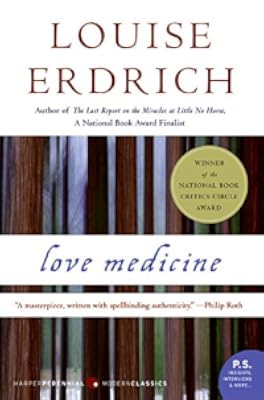
Karen Louise Erdrich was born on June 7, 1954 in Little Falls, Minnesota. Erdrich grew up in Wahpeton, North Dakota, where both of her parents were employed by the Bureau of Indian Affairs. She is a member of the Turtle Mountain Band of Chippewa. Erdrich graduated from Dartmouth College in 1976 with an AB degree, and she received a Master of Arts show more in creative writing from Johns Hopkins University in 1979. Erdrich published a number of poems and short stories from 1978 to 1982. In 1981 she married author and anthropologist Michael Dorris, and together they published The World's Greatest Fisherman, which won the Nelson Algren Award in 1982. In 1984 she won the National Book Critics Circle Award for Love Medicine, which is an expansion of a story that she had co-written with Dorris. Love Medicine was also awarded the Virginia McCormick Scully Prize (1984), the Sue Kaufman Prize (1985) and the Los Angeles Times Award for best novel (1985). In addition to her prose, Erdrich has written several volumes of poetry, a textbook, children's books, and short stories and essays for popular magazines. She has been the recipient of numerous awards for professional excellence, including the National Magazine Fiction Award in 1983 and a first-prize O. Henry Award in 1987. Erdrich has also received the Pushcart Prize in Poetry, the Western Literacy Association Award, the 1999 World Fantasy Award, and the Scott O'Dell Award for Historical Fiction in 2006. In 2007 she refused to accept an honorary doctorate from the University of North Dakota in protest of its use of the "Fighting Sioux" name and logo. Erdrich's novel The Round House made the New York Times bestseller list in 2013. Her other New York Times bestsellers include Future Home of the Living God (2017). (Bowker Author Biography) show less
Some Editions
Awards and Honors
Awards
Distinctions
Notable Lists
Common Knowledge
- Canonical title
- The Mighty Red
- Original title
- The Mighty Red
- Original publication date
- 2024
- Epigraph
- The Red River of the North is young. From the sky it looks like a length of string arranged on a flat board in a tight scrawl of twisting loops. The river gathers in the Ottertail and Bois de Sioux rivers and runs north on a ... (show all)slight incline from Wahpeton to Winnipeg. The river is muddy, opaque with sediment and toxic from field runoff. Not a river you'd swim but good to fish, at least at its source. The river is changeable, a slow and sleepy trickle in summer, rampaging like a violent toddler in spring, when it sweeps across the land reflecting the sky like its mother - a vast, prehistoric lake. Over millennia, the waters have given the Red River Valley earth its blackness, its life. The river is shallow, it is deep. I grew up there, it is everything.
- Dedication
- To those who love birds
and defend their place in the world - First words
- On a mild autumn night in the Red River Valley of North Dakota, Crystal pulled herself up behind the wheel of an International side-dump, steered out of the sugar processing plant, and started her haul. Out in the country the... (show all) sugar beets from Geist's field were piled in a massive load on the company piling ground. Crystal drove down the highway, turned onto the access road, and got loaded from the pile. She cruised back to the plant, unloaded. Repeated for as many times as fit into a twelve-hour shift. -The Night Drive, 2008: Crystal
- Original language
- English
- Canonical LCC
- PS3555.R42
Classifications
Statistics
- Members
- 860
- Popularity
- 31,757
- Reviews
- 38
- Rating
- (3.95)
- Languages
- English, German
- Media
- Paper, Audiobook, Ebook
- ISBNs
- 17
- ASINs
- 6