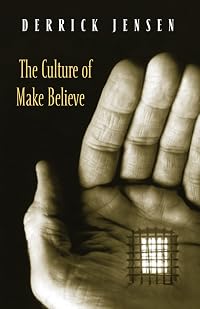
The Culture of Make Believe
by Derrick Jensen
On This Page
Description
Derrick Jensen takes no prisoners in The Culture of Make Believe, his brilliant and eagerly awaited follow-up to his powerful and lyrical A Language Older Than Words. What begins as an exploration of the lines of thought and experience that run between the massive lynchings in early twentieth-century America to today's death squads in South America soon explodes into an examination of the very heart of our civilization. The Culture of Make Believe is a book that is as impeccably researched show more as it is moving, with conclusions as far-reaching as they are shocking. show lessTags
Recommendations


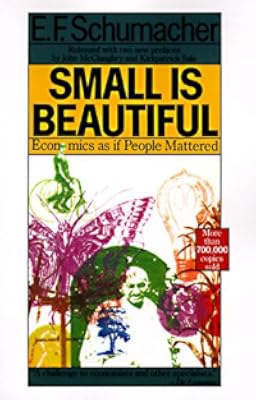

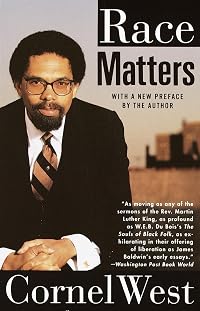

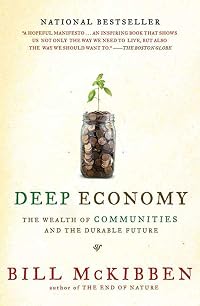


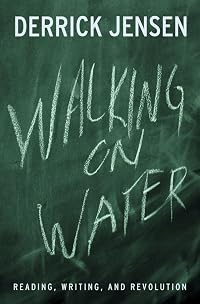










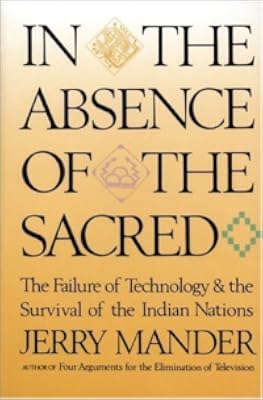

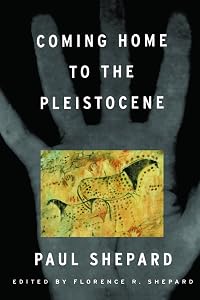



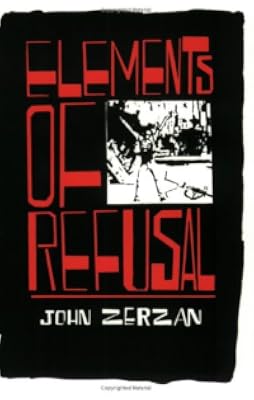


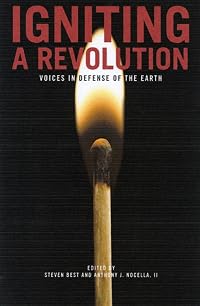






Member Recommendations

Member Reviews
Wow, one of the more intense books I have ever read. If you're prone to depression, I recommend taking this one in very small amounts, maybe a chapter a week. I read the whole thing in about a week and spent the last few days in a very pessimistic fog about our prospect as a species. Jensen has the strangest way with words when describing some of the most horrific historical events imagineable. He is eloquent and forceful without being too in-your-face. He does come off as a little arrogant at times, but I think anyone who is convinced that their radical (and under-represented) opinion is correct would do the same.
Ultimately, he takes thoughts and ideas that I have vaguely floating around in my head and organizes them elegantly into show more strong arguments. His treatment of the subject is a little diffuse: he starts out on a quest to define "hatred" and never really arrives at a concrete definition, but the journey is fascinating nonetheless. It normally bothers me quite a bit when an author offers all critique without any sort of feasible solutions, but here it seems appropriate -- Jensen honestly doesn't think there is hope for our civilization, and for him, the faster we help destroy it, the better. I look forward to reading the two Endgame volumes ([b:Endgame, Vol. 1: The Problem of Civilization|60971|Endgame, Vol. 1 The Problem of Civilization|Derrick Jensen|http://d.gr-assets.com/books/1348664730s/60971.jpg|59299] and [b:Endgame, Vol. 2: Resistance|60975|Endgame, Vol. 2 Resistance|Derrick Jensen|http://d.gr-assets.com/books/1348655934s/60975.jpg|59303]), hopefully for more ideas on what I can do to help. But I'm going to take a Jensen-free sabbatical for a couple weeks at least, until I can build up enough optimism to have it once more rudely ripped away (in a good way more or less). show less
Ultimately, he takes thoughts and ideas that I have vaguely floating around in my head and organizes them elegantly into show more strong arguments. His treatment of the subject is a little diffuse: he starts out on a quest to define "hatred" and never really arrives at a concrete definition, but the journey is fascinating nonetheless. It normally bothers me quite a bit when an author offers all critique without any sort of feasible solutions, but here it seems appropriate -- Jensen honestly doesn't think there is hope for our civilization, and for him, the faster we help destroy it, the better. I look forward to reading the two Endgame volumes ([b:Endgame, Vol. 1: The Problem of Civilization|60971|Endgame, Vol. 1 The Problem of Civilization|Derrick Jensen|http://d.gr-assets.com/books/1348664730s/60971.jpg|59299] and [b:Endgame, Vol. 2: Resistance|60975|Endgame, Vol. 2 Resistance|Derrick Jensen|http://d.gr-assets.com/books/1348655934s/60975.jpg|59303]), hopefully for more ideas on what I can do to help. But I'm going to take a Jensen-free sabbatical for a couple weeks at least, until I can build up enough optimism to have it once more rudely ripped away (in a good way more or less). show less
In the Culture of Make Believe, Derrick Jensen sets the bar as high as possible, examining the atrocities that characterize so much of our culture-from lynchings in early 20th-century America, modern slavery and corporate misdeeds to manufacturing disasters, death squads in developing nations and the destruction of the natural world. Interweaving political, historical, philosophical and deeply personal perspectives, Jensen argues that only by understanding past horrors can we hope to prevent future ones. Impeccably researched, The Culture of Make Believe arrives at some shocking and thought-provoking conclusions. As readers of A Language Older than Words can attest, Jensen is a public intellectual of rare abilities.
Wonderfully insightful dissection of western culture, which is based on a creed of violence and force to facilitate unendling acquisition and exploitation of materials and beings, wreaking havoc on labor, indigenous peoples and the natural world. The actions and beliefs of the KKK are a microcosm of the larger society. Bringing down civilization as we know it is the solution. (Rigorous editing would both tighten and shorten this tome, increasing its effectiveness.)
I recently heard someone remark that we are no longer able to think outside of a capitalist system. It seems that our entire world has been established and maintained upon principles of competition, utility, and self-interest; most people wouldn't know how to disrupt that system even if they wanted to. This is Derrick Jensen's misgiving about the establishment of civilization entirely - that it is by necessity a construction of systems of exploitation.
Capitalism gilds itself with mega-corporations with great images that create "cathedrals of consumption" - "All of these human-made settings are designed to create that sense of awe. They're designed to be spectacular. The starting point for all of this is the question: How do you draw show more people? You get people to come by creating a structure which overwhelms them, which wows them, which causes them to throw up their hands and say, 'This is extraordinary and I'm coming back again and again.'" This analysis works well enough with literal enterprises (think of the Vegas strip), but works in a more terrifying way when considering the enormity and complexity of the workings of society. I had a conversation recently about systemic injustice, and more conservative members of the discussion kept demurring from its confrontation with "Well, it's difficult. It's complicated." Systems of injustice are interwoven deliberately, to make it difficult to confront, because the feeling of being overwhelmed in that instance as well allows power structures to remain in place.
Ultimately, this book is chock-full of interesting if staggeringly depressing research and anecdotes about injustice, but I felt like his conclusions were weak. Since he's done the work and seen the multiplicity of injustices in our present system, I felt like he should've been more able, from his own perspective, to offer a radically different approach to 'society' in a way that perhaps fosters togetherness but otherwise looks entirely different. Instead, his primitivo-anarchism (we return back to the wild), while an interesting proposition, seems like a case of throwing the baby out with the bathwater in confronting the challenges of re-creating a healthier social dynamic beyond our present and corrupt limitations. show less
Capitalism gilds itself with mega-corporations with great images that create "cathedrals of consumption" - "All of these human-made settings are designed to create that sense of awe. They're designed to be spectacular. The starting point for all of this is the question: How do you draw show more people? You get people to come by creating a structure which overwhelms them, which wows them, which causes them to throw up their hands and say, 'This is extraordinary and I'm coming back again and again.'" This analysis works well enough with literal enterprises (think of the Vegas strip), but works in a more terrifying way when considering the enormity and complexity of the workings of society. I had a conversation recently about systemic injustice, and more conservative members of the discussion kept demurring from its confrontation with "Well, it's difficult. It's complicated." Systems of injustice are interwoven deliberately, to make it difficult to confront, because the feeling of being overwhelmed in that instance as well allows power structures to remain in place.
Ultimately, this book is chock-full of interesting if staggeringly depressing research and anecdotes about injustice, but I felt like his conclusions were weak. Since he's done the work and seen the multiplicity of injustices in our present system, I felt like he should've been more able, from his own perspective, to offer a radically different approach to 'society' in a way that perhaps fosters togetherness but otherwise looks entirely different. Instead, his primitivo-anarchism (we return back to the wild), while an interesting proposition, seems like a case of throwing the baby out with the bathwater in confronting the challenges of re-creating a healthier social dynamic beyond our present and corrupt limitations. show less
This book asks some deeply troubling questions about the darker side of our culture, about its injustices and inherent destructiveness. We don't like to be reminded, or hear for the first time, of the true cost of our life-styles. We don't want to think that there is any negative byproduct to our cultural advancement. A conservative's instinctive reaction would be to discredit the whole concept without a moment of concern. It's much easier to adopt pat phrases about our rights and God-given privileges; the modern-day equivalent of Manifest Destiny. That would be a comfortable attitude to adopt for most of us. But we are reminded over and over in this book of the groups (human and non-human) who really paid the price for our show more freedoms.
Reading the book can leave one in a profoundly depressed state of mind and heart. It's too bad that the author didn't suggest more solutions to the problems he spotlights. After all we cannot simply discard or replace the culture we have inherited. We can only seek one-by-one to address the injustices and atrocities that the author has so eloquently described. show less
Reading the book can leave one in a profoundly depressed state of mind and heart. It's too bad that the author didn't suggest more solutions to the problems he spotlights. After all we cannot simply discard or replace the culture we have inherited. We can only seek one-by-one to address the injustices and atrocities that the author has so eloquently described. show less
This book will cause you to not just think, but feel that is something is wrong with the way we are living. Something is sincerely wrong with our culture and the precarious civilization we have built. Derrick Jensen lays out an emotional plea to consider how hatred is not only rampant, but inherent in our civilization. He tears down old arguments and on top of the rubble he builds hope for a new and less violent world. READ THIS BOOK.
Derrick Jensen takes no prisoners in The Culture of Make Believe, his brilliant and eagerly awaited follow-up to his powerful and lyrical A Language Older Than Words. What begins as an exploration of the lines of thought and experience that run between the massive lynchings in early twentieth-century America to today's death squads in South America soon explodes into an examination of the very heart of our civilization. The Culture of Make Believe is a book that is as impeccably researched as it is moving, with conclusions as far-reaching as they are shocking.
Members
- Recently Added By
Lists

Best Environmental Books
32 works; 2 members

Favourite Books
1,820 works; 316 members
Author Information

51+ Works 4,427 Members
Derrick Jensen is the best-known voice, of the growing deep ecology movement. Winner of numerous awards and honors including the Eric Hoffer Book Award, USA Today's Critic's Choice, and Press Action s Person of the Year, Jensen is the author of over fifteen books, including Endgame, A Language Older Than Words, What We Leave Behind (with Aric show more McBay) and Deep Green Resistance (with McBay and Lierre Keith). Philosopher, teacher, and radical activist, he regularly stirs packed auditoriums across the country with revolutionary spirit. Jensen holds degrees in creative writing and mineral engineering physics. He lives in Crescent City, California. show less
Awards and Honors
Awards
Common Knowledge
- Quotations
- The journey of our culture has been one of increasing abstraction from direct personal experience, manifesting in every aspect of our lives, from our pornography (and, more broadly, our intimate relationships) to our economic... (show all)s - which, time after tedious time, values abstractions such as ideology or money (what's a dollar worth, really?) over living beings - to our violence.
Classifications
- Genres
- Nonfiction, Sociology, General Nonfiction, Science & Nature, Anthropology, Philosophy, History, Politics and Government
- DDC/MDS
- 305.8 — Society, government, & culture Social sciences, sociology & anthropology Social group - Age, Gender, Ethnicity Ethnic and national groups
- LCC
- HT1523 .J46 — Social sciences Communities. Classes. Races Communities. Classes. Races Races
- BISAC
Statistics
- Members
- 534
- Popularity
- 56,146
- Reviews
- 10
- Rating
- (4.41)
- Languages
- English
- Media
- Paper, Ebook
- ISBNs
- 3
- ASINs
- 1