
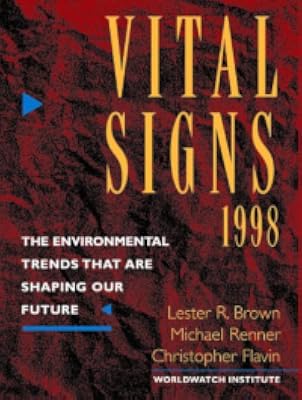
Vital Signs 1993: the Trends That Are Shaping Our Future
by Lester R. Brown, Ed Ayres, Hal Kane, Linda Starke (Editor)
Vital Signs (1993)
On This Page
Description
"Vital Signs: The Trends That Are Shaping Our Future concisely presents the good news, the bad news, and some surprises about the health of our planet and civilization. The Worldwatch Institute's award-winning researchers have culled information from around the globe to come up with 36 key indicators that best track change in our environmental, economic, and social health. Vital Signs analyzes each indicator - whether on food or forests, nuclear warheads or infant mortality - in text and in show more easy-to-read graphs." "Vital Signs finds military expenditures declining. Infant mortality on the wane. Cigarette smoking down." "But down, too, is per capita grain production. Forest cover. And equity in income distribution." "Vital Signs analyzes what the trends tell us about the history, and future, of our food supply. Our population. The global economy. Production of oil, natural gas, solar, and nuclear energy. How population growth affects economic growth. How the Third World debt burden affects the environment." "Vital Signs is an invaluable guide for public policymakers and environmentally concerned citizens everywhere who wish to better understand our changing world. It provides an excellent companion volume to the Worldwatch Institute's annual State of the World report." "Founded in 1974, the Worldwatch Institute is designed to inform policymakers and the public about the complex links between the world economy and its environmental support systems. An efficient early-warning system, the Worldwatch research team was among the first to note such trends as global warming, fuelwood shortages in the Third World, world water shortages, soil erosion, and the ecological disasters in eastern Europe." "The results of Worldwatch's unique inter-disciplinary research is covered regularly by all the world's wire services and major newspapers, from the New York Times to the Asahi Shimbun, from Le Monde to the Journal do Brasil. Worldwatch environmental and policy experts regularly appear on television and radio networks including ABC, BBC, CBC, CBS, CNN, NBC, NPR, PBS, and VOA."--BOOK JACKET.Title Summary field provided by Blackwell North America, Inc. All Rights Reserved show lessTags
Recommendations

























Members
- Recently Added By
Author Information

109+ Works 3,434 Members
The son of farmers, Lester Brown was born in New Jersey in 1934 and attended Rutgers University, receiving a B.S. in agricultural science in 1955. He earned an M.S. in agricultural economics from the University of Maryland in 1959 and an M.P.A. from Harvard University in 1962. He worked as adviser on foreign agricultural policy for the secretary show more of the U.S. Department of Agriculture, served as administrator of the International Agricultural Development Service, and helped establish the Overseas Development Council. In 1974, Brown founded the Worldwatch Institute, a private, nonprofit, environmental think tank designed to act as a global early warning system and to study overpopulation, famine, and other world problems. Located in Washington, D.C., the institute publishes the Worldwatch Papers series, Worldwatch Magazine, and the annual State of the World report. Although sometimes criticized for his emphasis on population control, this author of more than a dozen books and the recipient of a MacArthur Foundation fellowship has been highly praised for his understanding of the threats to the ecology of our planet. (Bowker Author Biography) Lester R. Brown, founder & now chairman of the Worldwatch Institute in Washington, D.C., is a MacArthur Fellow. He is a senior author of "State of the World". (Bowker Author Biography) show less
7+ Works 142 Members
Ed Ayres is the former editor of World Watch magazine, one of the first periodicals to focus on the emerging challenges of environmental degradation and destabilized climate.
7 Works 140 Members
Series

Common Knowledge
- Canonical title
- Vital Signs 1993: the Trends That Are Shaping Our Future
Classifications
- Genres
- Economics, Nonfiction, Science & Nature, General Nonfiction
- DDC/MDS
- 363.7 — Society, government, & culture Social problems and social services Public Safety - Police, Crime Investigation Environmental Issues - Pollution, Recycling, Global Warming
- LCC
- TD193.2 .B76 — Technology Environmental technology. Sanitary engineering Environmental technology. Sanitary engineering Environmental pollution
- BISAC
Statistics
- Members
- 35
- Popularity
- 820,573
- Languages
- English
- Media
- Paper
- ISBNs
- 3


