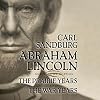
Abraham Lincoln: The Prairie Years and The War Years
by Carl Sandburg 
On This Page
Tags
Recommendations



















Member Reviews
This book ended up being a conundrum for me. At times I really liked it, at times it drug on and at other times I did not care for it. This large volume is a condensation of a six volume set, which cannot be an esay task and I'm sure it suffered in some details as all condensations must. At times this resulted in certain details just being recited as bullet points on a list which did nothing for me. The language at times does tend to get flowery as you would expect from a poet, but did not juxtapose well with the horrific civil war subject matter, I felt. I was appalled at some of the re-enactments of slaves speaking in Brer Rabbit/Uncle Remus style dialects. I also did not appreciate the obvious bias favoring Lincoln, as if we must show more view every word and action of his in a positive light. Lincoln was a superb leader and a genius; but he was also human and not infallible and not without flaws. Likewise, I did not like the negative bias given to those who opposed Lincoln in any way. I, for one, don't think those who advocated for peace or for total and immediate abolition of slavery should have been cast in a negative light. Some of those portrayals really bothered me, such as with Sumner.
But at the end of the day, this is truly a great and historic work. It is in particular a collection of seemingly endless anecdotes of Lincoln, and ultimately I ended up truly feeling that I got a flavor for Lincoln, the person, through these anectodes he was nearly constantly telling. He had one for every occasion, it seems. Though it was relatively brief in this volume, I most enjoyed the portions covering The Prairie Years of Lincoln. I think I should have enjoyed the volumes devoted to just that subject quite a bit better than this condensation of Prairie Years and War Years. Of course, the War Years were just too depressing but there is much history here with list after list of battles and casualties and who won what, as well as strategy and military personnel turnovers.
The end of the book covers Lincoln's assasination in detail. show less
But at the end of the day, this is truly a great and historic work. It is in particular a collection of seemingly endless anecdotes of Lincoln, and ultimately I ended up truly feeling that I got a flavor for Lincoln, the person, through these anectodes he was nearly constantly telling. He had one for every occasion, it seems. Though it was relatively brief in this volume, I most enjoyed the portions covering The Prairie Years of Lincoln. I think I should have enjoyed the volumes devoted to just that subject quite a bit better than this condensation of Prairie Years and War Years. Of course, the War Years were just too depressing but there is much history here with list after list of battles and casualties and who won what, as well as strategy and military personnel turnovers.
The end of the book covers Lincoln's assasination in detail. show less
This book has been on my shelf for years and I've just never gotten around to it. I was not expecting much. I was very surprised. Joyfully surprised. To say this was better than I had hoped would be an understatement. After completing this book I feel like I know the man. It was also very cool to read about a distant relative of mine (Nancy Hanks).
The part leading up to the assassination through his death was incredibly well done. I found myself near tears a half dozen times over the course of the final 40-50 pages.
The sense of fatigue that Lincoln felt during his presidency was astonishing and after completing the book, David Locke's words remain in my mind.
"I saw him, or what was mortal of him in his coffin. The face had an show more expression of absolute content, of relief, at throwing off a burden such as few men have been called upon to bear - a burden which few men could have born... Wilkes Booth did Abraham Lincoln the greatest service man could possibly do for him - he gave him peace." show less
The part leading up to the assassination through his death was incredibly well done. I found myself near tears a half dozen times over the course of the final 40-50 pages.
The sense of fatigue that Lincoln felt during his presidency was astonishing and after completing the book, David Locke's words remain in my mind.
"I saw him, or what was mortal of him in his coffin. The face had an show more expression of absolute content, of relief, at throwing off a burden such as few men have been called upon to bear - a burden which few men could have born... Wilkes Booth did Abraham Lincoln the greatest service man could possibly do for him - he gave him peace." show less
Carl Sandburg's famous biography of Lincoln. It's difficult to know how accurate or comprehensive this biography is; Sandburg wrote it in the 1920's; historical scholarship may not have been what it is today, and Sandburg may have had stars in his eyes when he wrote this too. On the other hand, it is certainly an enthralling read; Sandburg can certainly belt out a bio. And he may have had access to living contemporaries of Lincoln; at any rate, his sources were certainly fresher than they would be now.
Fascinating read from beginning to end
Ratings
Members
- Recently Added By
Lists

Mensa for Kids Excellence in Reading Award Program (Grades 9-12)
116 works; 5 members
Author Information

233+ Works 12,988 Members
The son of Swedish immigrants, Sandburg was born in Galesburg, Illinois. At age 13 he left school to roam the Midwest; he remained on the road for six years, working as a day laborer. Sandburg served in the Spanish-American War and then, from 1898 to 1902, attended Lombard College in Galesburg. After college, he went to Milwaukee, where he worked show more as a journalist; he also married Lillian Steichen there in 1908. During World War I, he served as a foreign correspondent in Stockholm; after the war he returned to Chicago and continued to write about America, especially the common people. Sandburg's first poems to gain wide recognition appeared in Poetry magazine in 1914. Two years later he published his Chicago Poems (1916), and Cornhuskers appeared in 1918. Meanwhile, Sandburg set out to become an authority on Abraham Lincoln (see Vol. 3). His exhaustive biography of the president, which took many years to complete, appeared as Abraham Lincoln: The Prairie Years (2 vols., 1926) and Abraham Lincoln: The War Years (4 vols., 1939), which won a Pulitzer Prize. Sandburg's poetry is untraditional in form. Drawing on Whitman as well as the imagists, its rhymeless and unmetered cadences reflect Midwestern speech, and its diction ranges from strong rhetoric to easygoing slang. Although he often wrote about the uncouth, the muscular, and the primitive, there was a pity and loving kindness that was a primary motive for his poetry. At Sandburg's death, Mark Van Doren, Archibald MacLeish, and President Lyndon Johnson delivered eulogies. In his tribute, President Johnson said that "Carl Sandburg was more than the voice of America, more than the poet of its strength and genius. He was America. . . . He gave us the truest and most enduring vision of our own greatness." The N.Y. Times described Sandburg as "poet, newspaper man, historian, wandering minstrel, collector of folk songs, spinner of tales for children, [whose] place in American letters is not easily categorized. But it is a niche that he has made uniquely his own." Sandburg was the labor laureate of the United States. Sandburg received the Pulitzer Prize for poetry in 1951 for his Complete Poems (1950). Among his many other awards were the gold medal for history and biography (1952) from the American Academy of Arts and Letters; the Poetry Society of America's gold medal (1953) for distinguished achievement; and the Boston Arts Festival Award (1955) in recognition of "continuous meritorious contribution to the art of American poetry." In 1959 he traveled under the auspices of the Department of State to the U.S. Trade Fair in Moscow, and to Stockholm, Paris, and London. In 1960 he received a citation from the U.S. Chamber of Commerce as a great living American for the "significant and lasting contribution which he has made to American literature." (Bowker Author Biography) show less
Carl Sandburg has a Legacy Library. Legacy libraries are the personal libraries of famous readers, entered by LibraryThing members from the Legacy Libraries group.
Common Knowledge
- Canonical title
- Abraham Lincoln: The Prairie Years and The War Years
Classifications
Statistics
- Members
- 450
- Popularity
- 67,799
- Reviews
- 4
- Rating
- (4.41)
- Languages
- English
- Media
- Paper, Audiobook, Ebook
- ASINs
- 22