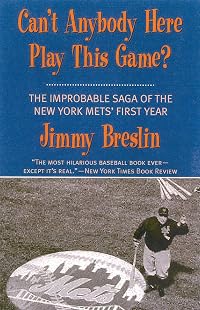
Can't Anybody Here Play This Game?: The Improbable Saga of the New York Mets' First Year
by Jimmy Breslin
On This Page
Description
Jimmy Breslin's nostalgic, rollicking look back at the worst baseball team in history Five years after the Dodgers and Giants fled New York for California, the city's National League fans were offered salvation in the shape of the New York Mets: an expansion team who, in the spring of 1962, attempted to play something resembling the sport of baseball. Helmed by the sagacious Casey Stengel and staffed by the league's detritus, the new Mets played 162 games and lost 120 of them, making them show more statistically the worst team in the sport's modern history. It's possible they were even worse than that. Starring such legends as Marvin Throneberry-a first baseman so inept that his nickname had to be "Marvelous"-the Mets lost with swashbuckling panache. In an era when the fun seemed to have gone out of sports, the Mets came to life in a blaze of delightful, awe-inspiring ineptitude. They may have been losers, but a team this awful deserves to be remembered as legends. This ebook features an illustrated biography of Jimmy Breslin including rare photos and never-before-seen documents from the author's personal collection. show lessTags
Recommendations

















Member Reviews
Jimmy Breslin’s Can’t Anybody Here Play This Game? is a great baseball book, hilariously recounting the horrendous first year of the New York Mets, the 1962 season in which the team lost an incredible 120 games, while winning only 40. For the best effect, you need to conjure up Breslin’s distinctive cadence and thick New Yawk accent as you’re reading it.
Full of anecdotes and Breslin’s fine wit, and spooled out in his conversational style, this is a really quick, really fun read: tales of their colorful manager Casey Stengel; team owner Joan Payson; General Manager George Weiss; the scheming National League brass; the hapless first baseman Marv Throneberry, the perfect embodiment of the team; the other woeful castoff players show more selected in the expansion draft; the growing “new breed” of die-hard fans; and, by way of prologue, the Brooklyn Dodgers and New York Giants, who left town after the 1957 season, paving the way for the birth of the Mets and the return of National League Baseball to New York. The chronicling of the Mets special brand of ineptitude that year is, well, amazin’.
The book ends with a story about Gil Hodges, who was then at the tail end of a great career. It’s a reflective story about the passage of time, and how growing old just kind of sneaks up on you. That’s classic Breslin, making you think about such things as you lay the book down. show less
Full of anecdotes and Breslin’s fine wit, and spooled out in his conversational style, this is a really quick, really fun read: tales of their colorful manager Casey Stengel; team owner Joan Payson; General Manager George Weiss; the scheming National League brass; the hapless first baseman Marv Throneberry, the perfect embodiment of the team; the other woeful castoff players show more selected in the expansion draft; the growing “new breed” of die-hard fans; and, by way of prologue, the Brooklyn Dodgers and New York Giants, who left town after the 1957 season, paving the way for the birth of the Mets and the return of National League Baseball to New York. The chronicling of the Mets special brand of ineptitude that year is, well, amazin’.
The book ends with a story about Gil Hodges, who was then at the tail end of a great career. It’s a reflective story about the passage of time, and how growing old just kind of sneaks up on you. That’s classic Breslin, making you think about such things as you lay the book down. show less
I celebrated the beginning of the 2015 baseball season by pulling this wonderful, short, book down off my shelf, where it had been waiting patiently for my attention for many years. This is Breslin's look at the very first season of the New York Mets. Those 1962 Mets set a record for futility, losing 120 of their 162 games. But in the process, they created a sensation, becoming much beloved in New York City, which had been starved for National League baseball since the Giants and Dodgers had left for California in 1957. Breslin has a breezy, Runyonesque writing style, and since the book was written and published in 1963, before the team even began their second season, it really is a time-piece.
While Breslin chronicles in detail the show more ways in which the 1962 Mets were terrible, describing many of the bonehead plays they pulled off during the year, he also gets inside the phenomenon they created on the way to their wild popularity. Breslin makes a believable case that the team came to represent an era that New Yorkers instinctually felt was fading in the city, a time of community and fun. He decries the ways in which the coming of television has kept people inside and away from smaller events like sandlot ballgames. So we get, in this book, not just a picture of the Mets, but one writer's look at New York in the early 60s, and earlier. For example, there is the following passage that comes up as Breslin is describing Joan Payson, the Mets' first owner, about a group of fans of those departed New York Giants:
"{Payson} was talking about the late Jack White, a comedian who subsisted on brandy and ran a saloon called the 18 Club. White was considered the town's number one Giant fan. It was natural that he considered Joan Payson a pal. The 18 Club is no more, and the only reminders of it are Pat Harrington, the great old comic, and Jackie Gleason, who was a third-stringer in the 18 Club lineup. When the 18 was operating, waiters would spit ice cubes at customers, and White either was loaded or was out on the floor telling unprintable stories. A linescore of the day's Giant game was always hung in front of the bandstand. But only if they won. The "No Game" sign went out after a loss. It was Mrs. Payson's idea of a helluva night joint.
Every afternoon when the Giants were at home, a mob from the 18 Club, White, Harrington, bartenders, waiters, a big singer named Hazel McNulty and the inevitable group of loan sharks would sit in the upper tier in left field, open shirt collars, lean back and get the sun. . . . "
Breslin also spends a lot of time quoting and describing the great and colorful Casey Stengel and providing snapshot profiles of some of those original Mets. He tries to understand what it must have been like to be a player on that team, often through the eyes of the players themselves, and tells us what it was like to root for them. show less
While Breslin chronicles in detail the show more ways in which the 1962 Mets were terrible, describing many of the bonehead plays they pulled off during the year, he also gets inside the phenomenon they created on the way to their wild popularity. Breslin makes a believable case that the team came to represent an era that New Yorkers instinctually felt was fading in the city, a time of community and fun. He decries the ways in which the coming of television has kept people inside and away from smaller events like sandlot ballgames. So we get, in this book, not just a picture of the Mets, but one writer's look at New York in the early 60s, and earlier. For example, there is the following passage that comes up as Breslin is describing Joan Payson, the Mets' first owner, about a group of fans of those departed New York Giants:
"{Payson} was talking about the late Jack White, a comedian who subsisted on brandy and ran a saloon called the 18 Club. White was considered the town's number one Giant fan. It was natural that he considered Joan Payson a pal. The 18 Club is no more, and the only reminders of it are Pat Harrington, the great old comic, and Jackie Gleason, who was a third-stringer in the 18 Club lineup. When the 18 was operating, waiters would spit ice cubes at customers, and White either was loaded or was out on the floor telling unprintable stories. A linescore of the day's Giant game was always hung in front of the bandstand. But only if they won. The "No Game" sign went out after a loss. It was Mrs. Payson's idea of a helluva night joint.
Every afternoon when the Giants were at home, a mob from the 18 Club, White, Harrington, bartenders, waiters, a big singer named Hazel McNulty and the inevitable group of loan sharks would sit in the upper tier in left field, open shirt collars, lean back and get the sun. . . . "
Breslin also spends a lot of time quoting and describing the great and colorful Casey Stengel and providing snapshot profiles of some of those original Mets. He tries to understand what it must have been like to be a player on that team, often through the eyes of the players themselves, and tells us what it was like to root for them. show less
Dedicated to the 922,530 brave souls who paid their way into the Polo Grounds in 1962. Never has so much misery loved so much company.
Right off the bat I knew I was in good hands with Mr. Breslin, as he recounts the historical ineptitude of the New York Mets in 1962, their first year of existence in the National League. The '62 Mets set a record for futility, losing 120 of the 160 games they played, that still stands. Of course, any expansion team is bound to struggle at first, but Breslin recounts — between one-liners — all the ways that the National League and its owners put their thumb on the scale to make sure the Mets were worse than bad. Greedy owners and collusion have always been with us in baseball, it seems.
I was born and show more spent the first 8 years of my life on Long Island (or Lawn Guyland, as the local accent renders it), so I came by my Mets fandom honestly, even though they are two years older than I am. I can still rattle off many names of players from the era, from Ed Kranepool (my favorite) to Marv Throneberry to Gil Hodges. They were terrible, but they were ours:
You see, the Mets are losers, just like nearly everybody else in life. This is a team for the cab driver who gets held up and the guy who loses out on a promotion because he didn't maneuver himself to lunch with the boss enough. It is the team for every guy who has to get out of bed in the morning and go to work for short money on a job he does not like. And it is the team for every woman who looks up ten years later and sees her husband eating dinner in a T-shirt and wonders how the hell she ever let this guy talk her into getting married.
In some ways, reading Jimmy Breslin on baseball is a lot like reading Roger Angell, another favorite of mine. Both have a keen eye and a gift for description that gives you a perfect picture. But while the writing of Angell (an editor at The New Yorker) wears a bespoke three-piece suit, Breslin's writing does its best work in shirtsleeves, with the collar unbuttoned and the tail half untucked.
(Congressman) Keating brought with him all the attributes of a great campaigner. An excellent right hand, for one thing. This is a man who can shake hands with a polar bear and the bear is going to let out the first yelp.
(William) Shea has dark hair, blue eyes, and the square jaw of a guy who would know how to punch back.
I don't know if Breslin ever wrote a sequel to Can't Anybody Here Play This Game? to detail the Mets' triumph in the 1969 World Series (just seven seasons removed from the utter haplessness he chronicles here. Imagine!). On the other hand, maybe it's better to quite while you're behind. Losers are a lot more interesting than winners. show less
Right off the bat I knew I was in good hands with Mr. Breslin, as he recounts the historical ineptitude of the New York Mets in 1962, their first year of existence in the National League. The '62 Mets set a record for futility, losing 120 of the 160 games they played, that still stands. Of course, any expansion team is bound to struggle at first, but Breslin recounts — between one-liners — all the ways that the National League and its owners put their thumb on the scale to make sure the Mets were worse than bad. Greedy owners and collusion have always been with us in baseball, it seems.
I was born and show more spent the first 8 years of my life on Long Island (or Lawn Guyland, as the local accent renders it), so I came by my Mets fandom honestly, even though they are two years older than I am. I can still rattle off many names of players from the era, from Ed Kranepool (my favorite) to Marv Throneberry to Gil Hodges. They were terrible, but they were ours:
You see, the Mets are losers, just like nearly everybody else in life. This is a team for the cab driver who gets held up and the guy who loses out on a promotion because he didn't maneuver himself to lunch with the boss enough. It is the team for every guy who has to get out of bed in the morning and go to work for short money on a job he does not like. And it is the team for every woman who looks up ten years later and sees her husband eating dinner in a T-shirt and wonders how the hell she ever let this guy talk her into getting married.
In some ways, reading Jimmy Breslin on baseball is a lot like reading Roger Angell, another favorite of mine. Both have a keen eye and a gift for description that gives you a perfect picture. But while the writing of Angell (an editor at The New Yorker) wears a bespoke three-piece suit, Breslin's writing does its best work in shirtsleeves, with the collar unbuttoned and the tail half untucked.
(Congressman) Keating brought with him all the attributes of a great campaigner. An excellent right hand, for one thing. This is a man who can shake hands with a polar bear and the bear is going to let out the first yelp.
(William) Shea has dark hair, blue eyes, and the square jaw of a guy who would know how to punch back.
I don't know if Breslin ever wrote a sequel to Can't Anybody Here Play This Game? to detail the Mets' triumph in the 1969 World Series (just seven seasons removed from the utter haplessness he chronicles here. Imagine!). On the other hand, maybe it's better to quite while you're behind. Losers are a lot more interesting than winners. show less
Can't Anybody Here Play This Game? by Jimmy Breslin. 124 pages, non-fiction (and proof that truth can, indeed, be stranger than fiction!)
In 1962, the baseball world was taken by storm by the unique phenomenon that was the first year of New York Mets baseball. (When I say "storm," think of a DISASTER.) The 1962 Mets set a whole new standard of ineptitude for Major League Baseball. They were also, almost certainly, the most beloved losing team in MLB history -- perhaps in all of pro sports.
This is Jimmy Breslin's classic baseball book, written between the 1962 and 1963 seasons, and re-issued in 1982 as part of the Penguin Sports Library (the edition I own). It is laugh-out-loud funny at times as Breslin describes (in his inimitable style) show more the improbable progress of games on the field (think of Keystone Cops playing baseball), and shares off-the-field comments by those close to the team and ordinary fans. A two-page appendix lists the dubious records which the Mets set in their rookie season as a team.
However, this book is also thought-provoking. At times, it is clear that it was written in a totally different era. Breslin's description of the wages of those laborers constructing Shea Stadium (then in progress) suggested great expense to readers at the time -- but it is all well below minimum wage for workers today. But much of the commentary sounds familiar to today's fan, as Breslin mourns the fall of "sport" and the rise of "business" in the major leagues. It was his contention that the Mets were beloved in 1962 because of, not in spite of, their shortcomings. In an era when pro athletes were already becoming too "perfect," too "professional," these were ballplayers to whom fans could relate.
One statement, however, has perhaps proved false, if my choice to re-read this book is any indication:
"Someday, when George Weiss's cold, automatic methods of running an organization turn the team into just another boring winner, everything happening now probably will be forgotten."
On the contrary, it was the memory of the 1962 Mets that made the world-champion 1969 Mets such a miracle for fans. And I do believe the memory still lingers on today.
This book is still a fun read; it's a blast from the past, well written, with something to say that's still worthwhile. show less
In 1962, the baseball world was taken by storm by the unique phenomenon that was the first year of New York Mets baseball. (When I say "storm," think of a DISASTER.) The 1962 Mets set a whole new standard of ineptitude for Major League Baseball. They were also, almost certainly, the most beloved losing team in MLB history -- perhaps in all of pro sports.
This is Jimmy Breslin's classic baseball book, written between the 1962 and 1963 seasons, and re-issued in 1982 as part of the Penguin Sports Library (the edition I own). It is laugh-out-loud funny at times as Breslin describes (in his inimitable style) show more the improbable progress of games on the field (think of Keystone Cops playing baseball), and shares off-the-field comments by those close to the team and ordinary fans. A two-page appendix lists the dubious records which the Mets set in their rookie season as a team.
However, this book is also thought-provoking. At times, it is clear that it was written in a totally different era. Breslin's description of the wages of those laborers constructing Shea Stadium (then in progress) suggested great expense to readers at the time -- but it is all well below minimum wage for workers today. But much of the commentary sounds familiar to today's fan, as Breslin mourns the fall of "sport" and the rise of "business" in the major leagues. It was his contention that the Mets were beloved in 1962 because of, not in spite of, their shortcomings. In an era when pro athletes were already becoming too "perfect," too "professional," these were ballplayers to whom fans could relate.
One statement, however, has perhaps proved false, if my choice to re-read this book is any indication:
"Someday, when George Weiss's cold, automatic methods of running an organization turn the team into just another boring winner, everything happening now probably will be forgotten."
On the contrary, it was the memory of the 1962 Mets that made the world-champion 1969 Mets such a miracle for fans. And I do believe the memory still lingers on today.
This book is still a fun read; it's a blast from the past, well written, with something to say that's still worthwhile. show less
Underwhelming. There's a good story to be told about the disastrous first year of the New York Mets -- several good stories, probably -- but this isn't it. Since Jimmy Breslin wrote this one before the 1963 season even started, he was probably still too close to the story, and the lack of perspective hurts the book. Indeed, there barely seems to be enough material here to make a book out of: the now-famous "yo la tengo" incident isn't even mentioned. A few personalities do come through, like Casey Stengel, Joan Payson, the team's first owner, and maybe even poor, cursed Marvin Thorneberry, as does Breslin's obvious love of baseball. Still, he spends a lot of time in a nostalgic mode, complaining about how big money has changed the game show more for the worse. Of course, this was decades before Alex Rodriguez got a contract that might have allowed him to purchase one of baseball's smaller franchises, and I sort of wonder what he makes of it now. Also, I was expecting something straightforward and newspaper-ish, but Breslin's prose, while appropriately masculine, often seems curiously padded and stagey. I picked this one up to get myself mentally prepared for baseball season, and I suppose it did its job, but I can't really recommend it. Fans of stories involving athletic calamities and lovable losers are advised to search elsewhere. show less
Ratings
Members
- Recently Added By
Author Information

31+ Works 1,853 Members
Jimmy Breslin was born James Earle Breslin on October 17, 1928 in Queens, New York. In the late 1940's, The Long Island Press hired him as a copy boy. After getting a job as a sportswriter for The New York Journal-American, he wrote a book about the first season of the Mets entitled Can't Anybody Here Play This Game? This book led to him being show more hired as a news columnist for The New York Herald Tribune in 1963. He later wrote for The New York Post, The Daily News, New York Newsday, and New York magazine. He wrote both fiction and nonfiction books. His novels included The Gang That Couldn't Shoot Straight; World Without End, Amen; and Table Money. His nonfiction books included The Good Rat, The Short Sweet Dream of Eduardo Gutierrez, I Want to Thank My Brain for Remembering Me, The Church That Forgot Christ, and biographies of Damon Runyon and Branch Rickey. He died on March 19, 2017 at the age of 88. (Bowker Author Biography) show less
Some Editions
Common Knowledge
- Canonical title
- Can't Anybody Here Play This Game?: The Improbable Saga of the New York Mets' First Year
- Important places
- New York, New York, USA; Polo Grounds (New York, New York, USA)
- Epigraph
- The Mets is a very good thing. They give everybody a job. Just like the WPA. -- Bill Loes, the only pitcher in the history of baseball to be defeated in a World Series game because he lost a ground ball in the sun.
- Dedication
- To the 922,530 brave souls who paid their way into the Polo Grounds in 1962. Never has so much misery loved so much company.
- First words
- The job progress sheet in the office says the weather is clear, with a high for the day of 54 and a low of 40, which is fine to keep work moving along on this $19,100,000 stadium New York City is having built alongside its Wo... (show all)rld's Fair grounds.
- Last words
- (Click to show. Warning: May contain spoilers.)The Mets lose an awful lot? Listen, mister. Think a little bit. When was the last time you won anything out of life?
Classifications
- Genres
- Sports and Leisure, Nonfiction
- DDC/MDS
- 796.357 — Arts & recreation Recreation, sports, and performing arts Sports Ball sports Ball and stick sports Baseball
- LCC
- GV875 .N45 .B73 — Geography, Anthropology and Recreation Recreation. Leisure Recreation. Leisure Sports Ball games: Baseball, football, golf, etc.
- BISAC
Statistics
- Members
- 130
- Popularity
- 250,495
- Reviews
- 5
- Rating
- (3.75)
- Languages
- English
- Media
- Paper, Ebook
- ISBNs
- 6
- ASINs
- 5