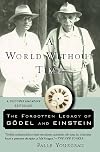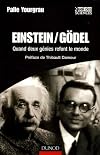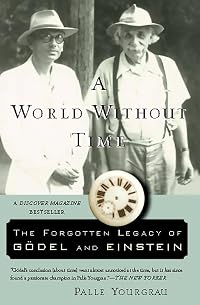
A World Without Time: The Forgotten Legacy of Gödel and Einstein
by Palle Yourgrau
On This Page
Description
It is a widely known but little considered fact that Albert Einstein and Kurt Godel were best friends for the last decade and a half of Einstein's life. The two walked home together from Princeton's Institute for Advanced Study every day; they shared ideas about physics, philosophy, politics, and the lost world of German science in which they had grown up. By 1949, Godel had produced a remarkable proof: In any universe described by the Theory of Relativity, time cannot exist. Einstein show more endorsed this result-reluctantly, since it decisively overthrew the classical world-view to which he was committed. But he could find no way to refute it, and in the half-century since then, neither has anyone else. Even more remarkable than this stunning discovery, however, was what happened afterward: nothing. Cosmologists and philosophers alike have proceeded with their work as if Godel's proof never existed-one of the greatest scandals of modern intellectual history. A World without Time is a sweeping, ambitious book, and yet poignant and intimate. It tells the story of two magnificent minds put on the shelf by the scientific fashions of their day, and attempts to rescue from undeserved obscurity the brilliant work they did together. show lessTags
Recommendations





Member Reviews
Palle Yourgrau deserves much credit for putting together this fun. informative, and eminently readable work.
Although the book purports to focus on the friendship between Einstein and Godel, it seems to me that their friendship is really a kind of deus ex machina that provides some set up for a book that's really about Godel and Godel's ideas. Now, this is not a criticism at all. I happen to think that this is the best popular level book on Godel, and would recommend it to anyone interested in "the greatest logician since Aristotle".
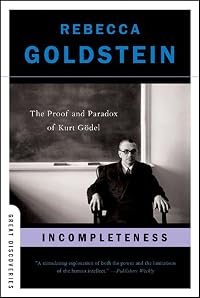
I say this is the best popular level book on Godel because Yourgrau, a serious academic philosopher in his own right, is able to come up with a mix of erudition and levity that is suitable for a work of show more this nature. Additionally, and I think in many ways most importantly, he has authored the only popular work that is at all sympathetic to Godel or to philosophical rationalism in general. Yourgrau actually likes his subject and it shows. The extent to which he supports any of Godel's specific philosophical positions is left unclear, but, at the very least, he treats the man as a serious thinker with reasonable ideas. This is in sharp contrast to Rebbecca Goldstein's idiotic screed "Incompleteness". Therein Godel is presented as something of an idiot savant who stumbled on a neat proof but showed his true idiot colors when he had the audacity to support a Platonist ontology for mathematics.
I also want to note that Yourgrau offers a pretty solid, utterly non-techincal explication of the incompleteness proofs, a nice explication of the set-theoretic paradoxes, and does a nice job of setting Godel's results in their proper historical context. Unlike the reviewer below, I would not call Yourgrau's version "obtuse". I think he certainly does a decent job of offering a short, intuitive explanation of some very difficult material, and does a better job than say, Nagel and Newman, of presenting something that is intelligible to the educated layman.
I would perhaps assign this portion of the book to an advanced undergraduate class if we were studying the philosophy of mathematics or doing some introductory meta-logic. It's the kind of thing you might have students read to fill in background during, say, the first week or so of a course.
Finally, I rather enjoyed the portion at the end where Yourgrau took Dreben and his disciples to task for their willful misreading of Godel. I mean, the whole Dreben line is *obviously* a bunch of baloney, but it's nice to see it in print.
Given the paucity of secondary literature and the challenging nature of Godel's work, it may be quite a while before philosophers begin to really take him seriously. Nonetheless, I think there has been a shift in the philosophical culture, to the extent that we will start to see folks addressing Yorugrau's complaints about Godel's underappreciation and under-representation in contemporary philosophy. show less
Although the book purports to focus on the friendship between Einstein and Godel, it seems to me that their friendship is really a kind of deus ex machina that provides some set up for a book that's really about Godel and Godel's ideas. Now, this is not a criticism at all. I happen to think that this is the best popular level book on Godel, and would recommend it to anyone interested in "the greatest logician since Aristotle".
I say this is the best popular level book on Godel because Yourgrau, a serious academic philosopher in his own right, is able to come up with a mix of erudition and levity that is suitable for a work of show more this nature. Additionally, and I think in many ways most importantly, he has authored the only popular work that is at all sympathetic to Godel or to philosophical rationalism in general. Yourgrau actually likes his subject and it shows. The extent to which he supports any of Godel's specific philosophical positions is left unclear, but, at the very least, he treats the man as a serious thinker with reasonable ideas. This is in sharp contrast to Rebbecca Goldstein's idiotic screed "Incompleteness". Therein Godel is presented as something of an idiot savant who stumbled on a neat proof but showed his true idiot colors when he had the audacity to support a Platonist ontology for mathematics.
I also want to note that Yourgrau offers a pretty solid, utterly non-techincal explication of the incompleteness proofs, a nice explication of the set-theoretic paradoxes, and does a nice job of setting Godel's results in their proper historical context. Unlike the reviewer below, I would not call Yourgrau's version "obtuse". I think he certainly does a decent job of offering a short, intuitive explanation of some very difficult material, and does a better job than say, Nagel and Newman, of presenting something that is intelligible to the educated layman.
I would perhaps assign this portion of the book to an advanced undergraduate class if we were studying the philosophy of mathematics or doing some introductory meta-logic. It's the kind of thing you might have students read to fill in background during, say, the first week or so of a course.
Finally, I rather enjoyed the portion at the end where Yourgrau took Dreben and his disciples to task for their willful misreading of Godel. I mean, the whole Dreben line is *obviously* a bunch of baloney, but it's nice to see it in print.
Given the paucity of secondary literature and the challenging nature of Godel's work, it may be quite a while before philosophers begin to really take him seriously. Nonetheless, I think there has been a shift in the philosophical culture, to the extent that we will start to see folks addressing Yorugrau's complaints about Godel's underappreciation and under-representation in contemporary philosophy. show less
I read this book and "Incompleteness" by Rebecca Goldstein at the same time. They are both quite good books and, as written by academic philosophers, generally mitigate my general negative opinion of academic philosophy. If you are interested in Goedel's ideas about "time travel" then this is your book. (It's actually not a "Star Trek" type concept, as Yourgrau makes clear.) If you are more interested in the proof itself, read Goldstein, who goes into more detail. But really you should read both, because unlike some philosophers from Austria that I could name (ahem! cough, cough!), they actually take the time to try to explain things to you. I should say that it improves my opinion of academic philosophy, except for one problem -- both show more books make clear, this one even more than Goldstein's, that Goedel was rejected by most of academic philosophy, many of the members of which didn't even understand what Goedel was talking about. There is an explanation of "Goedel's proof" of the incompleteness of mathematics (actually two proofs, as it turns out) which is quite accessible. You also get a good idea of how Goedel's mind worked, sometimes for the better and sometimes for the worse, and why his ideas about time are philosophically important. If time travel is possible, even if it is in a world with different properties (a rotating non-expanding universe or whatever), then the whole concept of time as experienced subjectively needs to be re-evaluated. It is really astounding that this master logician, who should be the hero of all the "analytic" philosophers in the U. S. A. -- since he proved something really significant about logic and mathematics that rivals or exceeds Aristotle -- is hardly even regarded as a philosopher at all, a fact which reveals the shallowness of modern academic philosophy. show less
An interesting read if you have any interest at all in philosophy of time and how it relates to Einstein's theory of relativity. Yourgrau highlights an intriguing and under-appreciated relationship between the logician Kurt Gödel and Einstein, which led to a surprise finding by the former: if we accept relativity, then we cannot treat our notion of time as a physically-real property of the universe. The whole idea sounds daunting, and the subject matter most certainly is if you dig into the guts, but Yourgrau wrote this book for the lay audience and did a wonderful job of it.
A little long winded at times. The last chapter is an absolute throwdown against some perceived disrespect of Gödel the philospher. "... worse than misguided..." -- those are fightin' words!
Yourgrau's book does have some redeeming qualities: an intriguing theme and an impressive cast of characters, presented with a wealth of historical and personal detail. Unfortunately, however, the line between detail and minutiae can be a fine one, and the reader is occasionally subjected to a celebrity-magazine level of the latter, as when Yourgrau explains, "History, sadly, does not record which of the seven dwarfs was Gödel's favorite." He also gives Gödel's date of death as January 11, 1978, which is interesting, since other sources, the New York Times included, seem to consistently place it three days later, on the 14th of the month.
The style of the book veers from grandiosity to flippancy in the early chapters, although it show more settles down in the more philosophically-oriented sections. Awkward turns of phrase abound, and the text is sprinkled with such inanities as, "Time itself must have been smiling over the puzzle it had created." Most of the technical material is covered clearly enough, however, although a few more definitions might not have been amiss in a work intended for what Yourgrau calls "normal readers." show less
The style of the book veers from grandiosity to flippancy in the early chapters, although it show more settles down in the more philosophically-oriented sections. Awkward turns of phrase abound, and the text is sprinkled with such inanities as, "Time itself must have been smiling over the puzzle it had created." Most of the technical material is covered clearly enough, however, although a few more definitions might not have been amiss in a work intended for what Yourgrau calls "normal readers." show less
Another good account of KG's life and work, philosophically deeper than Goldstein's, with some emphasis on his use of general relativity to conclude that time as intuitively "understood" is an illusion.
Fairly interesting, but a slow read to follow all the logic. I didn't realize when I picked it up that it was so much of a deep philosophy book, and clearly written by the author who disagrees with the established views on this subject, though I am in no place to assess the difference of opinions.
Members
- Recently Added By
Published Reviews
ThingScore 75
This book will appeal to fans of Douglas Hofstadter's Gödel, Escher, Bach and to Einstein junkies, and makes a fascinating companion to Rebecca Goldstein's Incompleteness (Forecasts, Dec. 20), but all readers who enjoy a good thought experiment or having basic preconceptions about their world challenged will enjoy this.
added by SandraArdnas
Author Information

7+ Works 603 Members
Palle Yourgrau is associate professor of Philosophy at Brandeis University.
Common Knowledge
- Canonical title
- A World Without Time: The Forgotten Legacy of Gödel and Einstein
- Original title
- A World Without Time: The Forgotten Legacy of Gödel and Einstein
- Alternate titles
- World Without Time
- Original publication date
- 2005
- People/Characters
- Kurt Gödel; Albert Einstein
- First words
- In the summer of 1942, while German U-boats roamed in wolf packs off the coast of Maine, residents in the small coastal town of Blue Hill were alarmed by the sight of a solitary figure, hands clasped behind his back, hunched ... (show all)over like a comma with his eyes fixed on the ground, making his way along the shore in a seemingly endless midnight stroll.
- Last words
- (Click to show. Warning: May contain spoilers.)In a deep sense, it is clear enough that we all do live in Gödel's universe.
- Original language
- English
Classifications
- Genres
- Philosophy, Science & Nature, Nonfiction, General Nonfiction, History, Biography & Memoir
- DDC/MDS
- 115 — Philosophy & psychology Metaphysics (existence, purpose, and the nature of reality) Time
- LCC
- BD638 .Y73 — Philosophy, Psychology and Religion Speculative philosophy Speculative philosophy Cosmology
- BISAC
Statistics
- Members
- 483
- Popularity
- 62,833
- Reviews
- 8
- Rating
- (3.82)
- Languages
- 5 — English, French, German, Italian, Spanish
- Media
- Paper, Ebook
- ISBNs
- 11
- ASINs
- 2