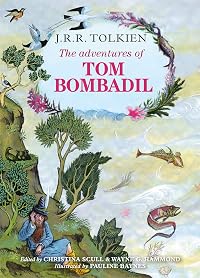
The Adventures of Tom Bombadil and other Verses from The Red Book
by J. R. R. Tolkien
On This Page
Description
A revised and expanded edition of Tolkien's own Hobbit-inspired poetry, including previously unpublished poems and notes, and beautiful illustrations by Narnia artist Pauline Baynes. One of the most intriguing characters in The Lord of the Rings, the amusing and enigmatic Tom Bombadil also appears in verses said to have been written by Hobbits and preserved in the "Red Book" with stories of Bilbo and Frodo Baggins and their friends. The Adventures of Tom Bombadil collects these and other show more poems, mainly concerned with legends and jests of the Shire at the end of the Third Age. This edition includes earlier versions of some of Tolkien's poems, a fragment of a prose story with Tom Bombadil, comprehensive notes by acclaimed Tolkien scholars Christina Scull and Wayne G. Hammond, and stunning illustrations by Narnia artist Pauline Baynes. show lessTags
Recommendations









Member Reviews
This is about the 2014 edition.
A fat little Hobbit of a book – if Hobbits have university professors of literature and philology.
The original of this book was a slim volume of slim poems, illustrated by charming drawings. This edition is rather more, such that it's now three or four times the size. The first volume is a preface, introducing the context for the collection and the poems themselves. A worthy read. Then the poems, which are still light and charming, with their original illustrations. Now the real meat of this edition: the third volume is a series of literary critiques of each, usually including the full text of an earlier version, often very different.
For a light read, read the second volume. Preferably aloud, and ideally show more to an audience of cheese and ale-stuffed Hobbits.
The Tolkien scholar though will want to plough through all of it, including that third critique. I say "plough" deliberately, as it's not the easiest of going. But if your interest is in Tolkien himself, or just deeply that of the Legendarium's development, rather than only scampering along to Sam's present, then this will be a heavy but rewarding read for you. show less
A fat little Hobbit of a book – if Hobbits have university professors of literature and philology.
The original of this book was a slim volume of slim poems, illustrated by charming drawings. This edition is rather more, such that it's now three or four times the size. The first volume is a preface, introducing the context for the collection and the poems themselves. A worthy read. Then the poems, which are still light and charming, with their original illustrations. Now the real meat of this edition: the third volume is a series of literary critiques of each, usually including the full text of an earlier version, often very different.
For a light read, read the second volume. Preferably aloud, and ideally show more to an audience of cheese and ale-stuffed Hobbits.
The Tolkien scholar though will want to plough through all of it, including that third critique. I say "plough" deliberately, as it's not the easiest of going. But if your interest is in Tolkien himself, or just deeply that of the Legendarium's development, rather than only scampering along to Sam's present, then this will be a heavy but rewarding read for you. show less
Hobbit poems. It's Middle Earth like you've never seen it before. And once you've read it, you'll know why. Yikes.
I enjoyed this book very much. Tolkien is probably better at prose than poems, but in this small book, he's expanded a great deal on Middle Earth mythology. He has poems by Bilbo and by Sam. He has goofy Hobbit folk poems. He's got Hobbits being silly and serious, sometimes trying to imitate Men and Elves with varying degrees of success. It's got Elvish gibberish, words that Hobbits have made up to sound Elvish but which don't mean anything. If this sounds funny, it is. I know that real languages and their histories inspired Tolkien to invent his own languages, and I also know that his own languages were the inspiration for show more Middle Earth. Reading these poems, I kind of felt like I was getting closer to some of the joy of invention; I could really understand why so many people have loved Middle Earth. Tolkien even makes some fun of his own poetry skills. Most of his poems keep a rigid rhyme scheme, but Tolkien also complains about all the rhyming, saying, "in their simplicity Hobbits evidently regarded such things as virtues." He also describes an annoying-on-purpose kind of poem by saying that it "may be recited until the hearers revolt." It really is cute.
However, this book is not perfect. It has a very uneven tone, and I'm not sure that I like either extreme.
This is a children's book, yet parts of it don't seem all that children-y to me. For one thing, it assumes that the reader has read The Lord of the Rings, and for another, it gets pretty dark (really, really creepy-dark) in some places. One of the poems, for example, tells of Frodo: "Like a dark mole groping I went, to the ground falling . . . beetles were tapping in the rotten trees, spiders were weaving . . . I saw my hair hanging grey . . . I have lost myself". This poem touches on old age and insanity and solitude; while I'm certainly not denying that children's literature can be dark, this just doesn't seem to be trying to appeal to children. Frodo isn't even described in the book--you'd have to read The Lord of the Rings for that.
On the other hand, this book has some lighthearted moments, to put it mildly, and those are certainly geared for children. If I could just quote one stanza:
"He battled with the Dumbledors,
the Hummerhorns, and Honeybees,
and won the Golden Honeycomb;
and running home on sunny seas
in ship of leaves and gossamer
with blossom for a canopy,
he sat and sang, and furbished up
and burnished up his panoply"
That about says it all. What a mouthful. show less
I enjoyed this book very much. Tolkien is probably better at prose than poems, but in this small book, he's expanded a great deal on Middle Earth mythology. He has poems by Bilbo and by Sam. He has goofy Hobbit folk poems. He's got Hobbits being silly and serious, sometimes trying to imitate Men and Elves with varying degrees of success. It's got Elvish gibberish, words that Hobbits have made up to sound Elvish but which don't mean anything. If this sounds funny, it is. I know that real languages and their histories inspired Tolkien to invent his own languages, and I also know that his own languages were the inspiration for show more Middle Earth. Reading these poems, I kind of felt like I was getting closer to some of the joy of invention; I could really understand why so many people have loved Middle Earth. Tolkien even makes some fun of his own poetry skills. Most of his poems keep a rigid rhyme scheme, but Tolkien also complains about all the rhyming, saying, "in their simplicity Hobbits evidently regarded such things as virtues." He also describes an annoying-on-purpose kind of poem by saying that it "may be recited until the hearers revolt." It really is cute.
However, this book is not perfect. It has a very uneven tone, and I'm not sure that I like either extreme.
This is a children's book, yet parts of it don't seem all that children-y to me. For one thing, it assumes that the reader has read The Lord of the Rings, and for another, it gets pretty dark (really, really creepy-dark) in some places. One of the poems, for example, tells of Frodo: "Like a dark mole groping I went, to the ground falling . . . beetles were tapping in the rotten trees, spiders were weaving . . . I saw my hair hanging grey . . . I have lost myself". This poem touches on old age and insanity and solitude; while I'm certainly not denying that children's literature can be dark, this just doesn't seem to be trying to appeal to children. Frodo isn't even described in the book--you'd have to read The Lord of the Rings for that.
On the other hand, this book has some lighthearted moments, to put it mildly, and those are certainly geared for children. If I could just quote one stanza:
"He battled with the Dumbledors,
the Hummerhorns, and Honeybees,
and won the Golden Honeycomb;
and running home on sunny seas
in ship of leaves and gossamer
with blossom for a canopy,
he sat and sang, and furbished up
and burnished up his panoply"
That about says it all. What a mouthful. show less
As this isn't the first time I've read these poems, I already knew I was going to like them. The added elements in this edition are the commentaries on every poem by the editors, which usually include earlier variants of the core poems, together with a very brief outline by Tolkien of a never realised, stand-alone Tom Bombadil story. Well worth the relatively modest cover price, but I'd have happily paid more for better paper, a larger format and colour illustrations.
Not Tolkien's most amazing work (meaning I enjoyed his poems in LotR and the Hobbit more), but it was fun to read all the same. It is a mix of (seemingly) happy poems and other poems with darker undertones. Only two poems are actually about Tom, the rest are from the folklore of the Hobbits or similar to Lord of the Rings in style. Of the few poems in this 75 page book, "Shadow Bride" was one of my favorites. Part of the middle of the poem:
"...He woke, as he had sprung of stone,
and broke the spell that bound him;
he clasped her fast, both flesh and bone,
and wrapped her shadow round him."
"...He woke, as he had sprung of stone,
and broke the spell that bound him;
he clasped her fast, both flesh and bone,
and wrapped her shadow round him."
I’m gonna have to do a reread of this because I think the verse really made it hard to take it in. Something about rhyme means I have to listen to something a bunch of times to understand what’s going on. Or maybe that’s just Tolkien’s style of writing verse. It was interesting, and I really liked Perry-The-Winkle, but overall it’s hard to take in with all the whimsical words that Tolkien uses.
Look, I’ve read the Hobbit and LOTR over a dozen times. Tolkien shaped my life. I love the man. But, his poetry basically sucks. With every reading, I started out with every intention of finding the brilliant gems in the poems and songs, but... With two notable exceptions, the poems here are more of the same.
I loved finding this book in a little shop on Charing Cross in London, though.
I loved finding this book in a little shop on Charing Cross in London, though.
This is basically a collection of poems. They're all similar in style to the Bombadil section of [b:The Fellowship of the Ring|34|The Fellowship of the Ring (The Lord of the Rings, #1)|J.R.R. Tolkien|https://d202m5krfqbpi5.cloudfront.net/books/1298411339s/34.jpg|3204327] and the first few are actually about Tom Bombadil. But, after those are done there are a number of other poems about various topics, some of which are clearly set in Middle-Earth. There's a few about "The Man in the Moon", but there's also ones about hobbits as well.
I've always liked the Tom Bombadil section of Fellowship and Tolkien's other poems, so with a few exceptions, I quite liked this collection. That said, if you don't like that section, you'll probably not show more like much of this as even the ones not about Bombadil are very similar in style.
I listened to an audiobook version read by Derek Jacobi. Since these are poems, having them read out loud by someone skilled really elevated the experience. show less
I've always liked the Tom Bombadil section of Fellowship and Tolkien's other poems, so with a few exceptions, I quite liked this collection. That said, if you don't like that section, you'll probably not show more like much of this as even the ones not about Bombadil are very similar in style.
I listened to an audiobook version read by Derek Jacobi. Since these are poems, having them read out loud by someone skilled really elevated the experience. show less
Members
- Recently Added By
Lists

Bibliography for Among Others
159 works; 15 members

CCE 1000 Good Books List
1,033 works; 12 members

Books Read in 2018
4,360 works; 110 members

Books Read in 2021
5,361 works; 114 members
Author Information

610+ Works 519,546 Members
A writer of fantasies, Tolkien, a professor of language and literature at Oxford University, was always intrigued by early English and the imaginative use of language. In his greatest story, the trilogy The Lord of the Rings (1954--56), Tolkien invented a language with vocabulary, grammar, syntax, even poetry of its own. Though readers have show more created various possible allegorical interpretations, Tolkien has said: "It is not about anything but itself. (Certainly it has no allegorical intentions, general, particular or topical, moral, religious or political.)" In The Adventures of Tom Bombadil (1962), Tolkien tells the story of the "master of wood, water, and hill," a jolly teller of tales and singer of songs, one of the multitude of characters in his romance, saga, epic, or fairy tales about his country of the Hobbits. Tolkien was also a formidable medieval scholar, as evidenced by his work, Beowulf: The Monster and the Critics (1936) and his edition of Anciene Wisse: English Text of the Anciene Riwle. Among his works published posthumously, are The Legend of Sigurd and Gudrún and The Fall of Arthur, which was edited by his son, Christopher. In 2013, his title, TheHobbit (Movie Tie-In) made The New York Times Best Seller List. (Bowker Author Biography) show less
Some Editions
Series
Belongs to Publisher Series
Work Relationships
Is contained in
Tolkien Fantasy Tales Box Set (The Tolkien Reader/The Silmarillion/Unfinished Tales/Sir Gawain and the Green Knight) by J. R. R. Tolkien (indirect)
Tales from the Perilous Realm: Farmer Giles of Ham / The Adventures of Tom Bombadil / Leaf by Niggle / Smith of Wootton Major by J. R. R. Tolkien
Has as a reference guide/companion
Has as a supplement
Common Knowledge
- Canonical title
- The Adventures of Tom Bombadil and other Verses from The Red Book
- Original title
- The Adventures of Tom Bombadil and other Verses from The Red Book
- Original publication date
- 1962-11-22
- People/Characters
- Tom Bombadil; Goldberry; Old Man Willow; Barrow-wright; Little Bird; Willow-wren (show all 20); Goodman Maggot; Princess Mee; Princess Shee; Man in the Moon; Mrs Bunce; Old Pott the Major; Farmer Hogg; Bill Butcher; Grip; Perry-the-Winkle; Peeping Jack; Fastitocalon; Firiel; Amroth
- Important places
- Withywindle; Mithe; Elvet-isle; Withy-weir; Brandywine; Shirebourn (show all 31); Marish; Rushey; Maggot's Lane; Bamfurlong; Hays-end; Grindwall; Derrilyn; Belmarie; Thellamie; Fantasie; Aerie; Faerie; Bay of Bel; Seaward Tower; Mountains of the Moon; Faraway; Weathertop; The Shire; Delving; Bree; Lockholes; Merlock Mountains; Tode; Elvenhome; Anduin
- First words
- Old Tom Bombadil was a merry fellow;
bright blue his jacket was and his boots were yellow;
green were his girdle and his breeches all of leather;
he wore in his tall hat a swan-wing feather. - Last words
- (Click to show. Warning: May contain spoilers.)Year still after year flows
down the Seven Rivers;
cloud passes, sunlight glows,
reed and willow quivers
as morn and eve, but never more
westward ships have waded
in mortal waters as before,
and their song has faded. - Original language*
- Anglais (Royaume-Uni) (Royaume-Uni)
*Some information comes from Common Knowledge in other languages. Click "Edit" for more information.
Classifications
Statistics
- Members
- 1,908
- Popularity
- 11,262
- Reviews
- 22
- Rating
- (3.66)
- Languages
- 13 — Dutch, English, Finnish, French, German, Hebrew, Italian, Polish, Portuguese, Russian, Spanish, Swedish, Turkish
- Media
- Paper, Audiobook, Ebook
- ISBNs
- 45
- ASINs
- 28