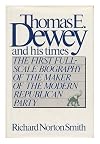
Thomas E. Dewey and His Times
by Richard Norton Smith
On This Page
Description
Thomas E. Dewey, unfortunately, is probably best remembered by most Americans as the little fellow who lost the 1948 Presidential election to Harry S. Truman in one of the greatest upsets in American history. But thanks to the work of Richard Norton Smith, we can now see Dewey for what he really was - a crusading, crime-busting district attorney; perhaps the best governor New York State ever had; and the man who "modernized" the Republican Party and allowed it to survive through the show more Depression years and the 1940's. Dewey grew up in a small town in Michigan (his father owned and published the local newspaper), and his rise to fame and fortune came remarkably fast. A compulsive workaholic and "neat freak", Dewey graduated from the University of Michigan and Columbia University Law School in the 1920's. He briefly considered a career as a singer - he had an award-winning baritone voice and liked to sing Broadway tunes in his bathtub - but decided that the law would be a more stable and suitable career. He married an actress, settled in New York City (although he never really liked the Big Apple, and in 1938 he bought a large farm 65 miles north of Manhattan and happily became a weekend farmer and country squire). In 1933 Dewey, only 31, became the assistant District Attorney for Manhattan and helped to send several gangsters to prison. In 1937 he was elected District Attorney for New York City, and he soon achieved national fame as the "gangbuster" - the honest lawyer who sent dozens of famous mafia leaders to jail. His most famous target was "Lucky" Luciano, the mafia boss of all New York and who was even more powerful than Al Capone. Dewey's conviction of Luciano (for running a massive prostitution racket in the New York/New Jersey area) made him a national hero and propelled him into presidential politics at the incredible age of 38. Hollywood even made movies about him. In 1940 he ran for the Republican presidential nomination and nearly won, despite his youth and inexperience. In 1942 he was elected governor of New York. During his twelve years as governor he passed the first state civil rights laws in America, lowered taxes AND cut a budget deficit in half, and founded the State University of New York. He also rooted out political crooks and ran a remarkably honest administration. In 1944 he ran for President and came closer to defeating Franklin D. Roosevelt than any of his four opponents. Dewey's great moment was supposed to have been in 1948, when he was considered to be a sure bet to defeat President Harry S. Truman and restore the Republicans to the White House. All the polls showed Dewey winning easily, and Dewey refused to even mention Truman's name - even as Truman insulted and ridiculed him in speech after speech. This was a costly mistake - Truman won a narrow victory in one of the great political upsets of all time. At the age of 46, Dewey was a "has-been". Smith does a wonderful job of explaining why, despite Dewey's honesty, intelligence, and obvious leadership skills he was never able to win the White House. Partly this was due to Dewey's personality - many people felt him to be cold and calculating, a short man with a bad temper and an arrogant attitude towards others. Smith fills this biography with plenty of delicious quotes (Dewey's secretary - "He was as cold as a February icicle"), and he also offers a superb history of the Republican Party in its lean years between the 1920's and the Eisenhower Fifties. Several parts of this book are so well-written - such as the first chapter covering Election Night in 1948, or the section describing Dewey's beloved farm of Dapplemere in upstate New York and the community of Quaker Hill it was located in - that you get the feeling you're actually there. Although Dewey will probably always be remembered more for his epic 1948 election upset than for his substantial achievements, Smith's biography will at least ensure that those who read this book will come away with a m. show lessTags
Recommendations
















Member Reviews
A two-time Republican nominee for president, Thomas E. Dewey dominated Republican party politics during the 1940s. Yet to assert, as does the dustjacket of the hardcover edition of Richard Norton Smith's biography of Dewey, that the former prosecutor and three-time governor of New York was "the maker of the modern Republican Party" seems an exaggeration. Nonetheless, Smith has written a thorough account of Dewey's life and career, from his childhood and early years as an attorney to his two successive defeats in the presidential elections of 1944 and 1948. Extensively researched, it is a favorable account but not an uncritical one, and will satisfy anyone seeking to learn about this iconic figure and his many achievements.
1919 Thomas E. Dewey and His Times, by Richard Norton Smith (read 7 Apr 1985) I found this 1982 biography exceptionally enjoyable reading. Dewey was born 24 Mar 1902 in Owosso, Mich. He went to New York to study music and law and the rest of his life was new York-based. The story of his prosecutor days was not really interesting--they sure had a different mode of operations than would be necessary now, what with wiretaps and extensive questioning sans Miranda. But the accounts of 1940 and the effort to be nominated was very interesting and relatively fresh to me. The time since covered well-known ground, but I found it all fascinating reading, even though the author (born in 1953) is not overly perceptive and also not a great writer. show more Dewey died in Florida on March 16, 1971. Near the end of the book is this sentence: "How does one assess a man who came so far, so fast--too fast for his own good, as he readily admitted--in spite of a personality that had never had a chance to grow up to his dazzling potential?" show less
Ratings
Members
- Recently Added By
Author Information

12+ Works 906 Members
Richard Norton Smith is the director of the Robert J. Dole Institute of Politics at the University of Kansas
Awards and Honors
Awards
Common Knowledge
- People/Characters
- Thomas E. Dewey
- Important places
- USA
Classifications
- Genres
- Nonfiction, History, Biography & Memoir, General Nonfiction, Politics and Government
- DDC/MDS
- 973.91 — History & geography History of North America United States 1901- World Wars and Depression Era (1901-1953)
- LCC
- E748 .D48 .S65 — History of the United States United States Twentieth century General Biography
Statistics
- Members
- 87
- Popularity
- 367,447
- Reviews
- 2
- Rating
- (3.10)
- Languages
- English
- Media
- Paper
- ISBNs
- 2
- ASINs
- 2