On This Page
Description
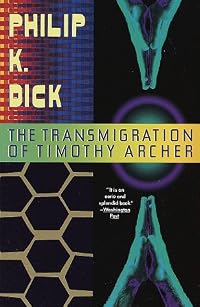
The final novel in the trilogy that also includes Valis and The divine invasion, is an anguished, learned, and very moving investigation of the paradoxes of belief. It is the story of Timothy Archer, an urbane Episcopal bishop haunted by the suicides of his son and mistress and driven by them into a bizarre quest for the identity of Christ.Tags
Recommendations













Member Reviews
This is a re-read for me and perhaps not exactly my favorite of his last and greatest sequence of linked novels that began with VALIS, but it is still profound and beautiful.
Truly, it is a very good book, but it stands as both a major departure from PKD's normal fiction. That's to say, it's a novel that explores all the same themes that he's is known for, but he does it in a very firmly grounded and mainstream way that very much does NOT touch upon his more traditional SF style.
Suicide, madness, drug use, heavy intellectualism comes right to the fore... but rather than deal with it from inside the person most afflicted with it or get funky with some really strange happenings, we follow Timothy Archer's daughter in law, Angel, as she show more tries to come to grips with the grief of losing Tim along with all of Tim's friends.
Sound simple? Well, grief isn't simple and Tim's life and intellect was pretty fantastic and the impact he had upon everyone was pretty profound. His struggles with faith and his eventually giving up the cloth and going to great lengths, intellectual or otherwise, to discover the real truth about Jesus, has long term effects on everyone.
That's not to say there isn't a lot of really strange things happening here, however, but they're all based on reality and scholarship and the deepest quest for meaning that anyone can or ought to strive.
What if Christianity was a mushroom cult, that systematic drug use and hallucinations WAS the body of Christ? That all the early Christians were, after all, drug pushers? I love it. It's even based on some really impressive scholarship. But beyond that, there's also the idea that this mushroom also opens our minds to see the truth of reality and in so doing, allows us to link-in with the system of the universe and carry on past death for real. So, blithe and humorous assumptions aside, this was the real aspect of faith and the promise... and the tragedy is... that we lost this bridge.
Even so, my takeaway from this book, with this topic, is only a single feature in a very rich tapestry of characterizations, explorations, and fundamental human experience. Don't take my word for it. Read it with the other VALIS novels and get really surprised that this was so mainstream. I know I was.
And now I really can't wait to pick up Radio Free Albemuth again! It, perhaps more than all the rest, is the capstone of all these ideas and it is a firm adventure in revolution and science fiction greatness as well! All the ideas and themes come back in full force.
What a fantastic storyteller! show less
Truly, it is a very good book, but it stands as both a major departure from PKD's normal fiction. That's to say, it's a novel that explores all the same themes that he's is known for, but he does it in a very firmly grounded and mainstream way that very much does NOT touch upon his more traditional SF style.
Suicide, madness, drug use, heavy intellectualism comes right to the fore... but rather than deal with it from inside the person most afflicted with it or get funky with some really strange happenings, we follow Timothy Archer's daughter in law, Angel, as she show more tries to come to grips with the grief of losing Tim along with all of Tim's friends.
Sound simple? Well, grief isn't simple and Tim's life and intellect was pretty fantastic and the impact he had upon everyone was pretty profound. His struggles with faith and his eventually giving up the cloth and going to great lengths, intellectual or otherwise, to discover the real truth about Jesus, has long term effects on everyone.
That's not to say there isn't a lot of really strange things happening here, however, but they're all based on reality and scholarship and the deepest quest for meaning that anyone can or ought to strive.
What if Christianity was a mushroom cult, that systematic drug use and hallucinations WAS the body of Christ? That all the early Christians were, after all, drug pushers? I love it. It's even based on some really impressive scholarship. But beyond that, there's also the idea that this mushroom also opens our minds to see the truth of reality and in so doing, allows us to link-in with the system of the universe and carry on past death for real. So, blithe and humorous assumptions aside, this was the real aspect of faith and the promise... and the tragedy is... that we lost this bridge.
Even so, my takeaway from this book, with this topic, is only a single feature in a very rich tapestry of characterizations, explorations, and fundamental human experience. Don't take my word for it. Read it with the other VALIS novels and get really surprised that this was so mainstream. I know I was.
And now I really can't wait to pick up Radio Free Albemuth again! It, perhaps more than all the rest, is the capstone of all these ideas and it is a firm adventure in revolution and science fiction greatness as well! All the ideas and themes come back in full force.
What a fantastic storyteller! show less
One of Dick's best dives into warped mental states and their various outcomes. Though it's often lumped with his sci-fi work, it's more a straight novel than even the least fanciful of his late works. A great examination of religious purpose and over-intellectualization.
A great ride through Philip K. Dick's mind. This is a novel not to be missed for those who enjoy his work. The scenes are palatable, and the plot wanders- but it always comes back to where it needs to be. This is a glimpse into what made Dick what he was. I believe it was very self-autobiographical and the revealing that goes on throughout the duration of the book is immense and, almost, heartfelt. Dick is trying to explain something here, both to himself and the reader. Through this, he paints a portrait of himself. That is commendable and the book is worthwhile.
4.5 stars. This was worth reading the whole trilogy for.
4.5 stars. This was worth reading the whole trilogy for.
For years I avoided reading anything by Phillip K. Dick. I have always liked the movie "Bladerunner" (though I haven't read "Do Androids Dream of Electric Sheep" on which it is based. That movie was dark, and I didn't really want to read anything much darker. Also, I had heard that most of Dick's other works were way weirder than Bladerunner/Androids.
A few months ago I finally gave in. I started with Ubik. That was some weird stuff. I am not completely convinced that Joe is dead and Runciter is alive. Or was it the other way around?
For various reasons, I decided to to try The Transmigration of Timothy Archer next. I can say two things about this book right off the bat - what this book is not: science fiction; and what this book is: some show more weird-ass shit. I'm not usually prone to foul language in my reviews, but that's the only way I can put it.
Berkeley CA in the seventies, multiple suicides, people coming (or maybe not coming) back from the dead, long discourses on philosophy and theology (Bishop George Berkeley comes across as pretty sane - previously I had thought him a lunatic), a character who is actually a lunatic (maybe all the characters are lunatics?), even an Alan Watts figure.
If you're looking for futuristic sci-fi, you won't find it here. The only technology is either early personal computers or cars from the late 1970's. If you're looking for meditations on the nature of reality, this is a book for you. show less
A few months ago I finally gave in. I started with Ubik. That was some weird stuff. I am not completely convinced that Joe is dead and Runciter is alive. Or was it the other way around?
For various reasons, I decided to to try The Transmigration of Timothy Archer next. I can say two things about this book right off the bat - what this book is not: science fiction; and what this book is: some show more weird-ass shit. I'm not usually prone to foul language in my reviews, but that's the only way I can put it.
Berkeley CA in the seventies, multiple suicides, people coming (or maybe not coming) back from the dead, long discourses on philosophy and theology (Bishop George Berkeley comes across as pretty sane - previously I had thought him a lunatic), a character who is actually a lunatic (maybe all the characters are lunatics?), even an Alan Watts figure.
If you're looking for futuristic sci-fi, you won't find it here. The only technology is either early personal computers or cars from the late 1970's. If you're looking for meditations on the nature of reality, this is a book for you. show less
This is a challenging, yet compelling third book of the VALIS trilogy, although it stands alone as a novel. It's an empowering and intellectual glimpse into the interpretation of madness, theology and philosophical illusion. Mind twisting, thought provoking and at times disturbing; the obsession with God and metaphysics, schizophrenia and suicide, and the characters themselves drove this book for me and it has definitely made me think and perceive intellect in a new way. Absolutely fantastic......
This is probably my favorite Philip K. Dick novel . . . despite the author's lapses in style, such as not knowing how to use the subjunctive. It's an amazing slice of life. It's a harrowing glipse at mysticism. It's a profound meditation on the (as they say it in Literature 101) "the human condition."
It's a whopping good yarn.
Ooops. Forget I wrote anything so crass.
It's a whopping good yarn.
Ooops. Forget I wrote anything so crass.
This is the final book in Dick’s trilogy exploring and arguing concepts of religion and belief. Look, I’ll be honest – I was going to try a nice little plot synopsis. But you can find that anywhere, and that isn’t what is important. What is important here is that Dick uses his writing skills to keep these arguments about life and belief from bogging down. The people are interesting, their lives are interesting, and the discussions that ensue from these people asking the questions about their lives are interesting.
The book is a worthy completion of the trilogy. (Okay, trilogy is the wrong word – it is not like these books are continuing one story. Rather, they are continuing one long discussion, with three different show more stories.)
You should read all three.
And you should read this one. show less
The book is a worthy completion of the trilogy. (Okay, trilogy is the wrong word – it is not like these books are continuing one story. Rather, they are continuing one long discussion, with three different show more stories.)
You should read all three.
And you should read this one. show less
Members
- Recently Added By
Lists

Slipstream or Interstitial Fiction
160 works; 19 members

Top Five Books of 2022
736 works; 272 members
Author Information

668+ Works 146,483 Members
Phillip Kindred Dick was an American science fiction writer best known for his psychological portrayals of characters trapped in illusory environments. Born in Chicago, Illinois, on December 16, 1928, Dick worked in radio and studied briefly at the University of California at Berkeley before embarking on his writing career. His first novel, Solar show more Lottery, was published in 1955. In 1963, Dick won the Hugo Award for his novel, The Man in the High Castle. He also wrote a series of futuristic tales about artificial creatures on the loose; notable of these was Do Androids Dream of Electric Sheep?, which was later adapted into film as Blade Runner. Dick also published several collections of short stories. He died of a stroke in Santa Ana, California, in 1982. (Bowker Author Biography) show less
Some Editions
Awards and Honors
Awards
Series

Belongs to Publisher Series
Work Relationships
Common Knowledge
- Canonical title
- The Transmigration of Timothy Archer
- Original title
- The Transmigration of Timothy Archer
- Original publication date
- 1982-05
- People/Characters
- Bishop Timothy Archer; Angel Archer; Kirsten Lundborg; Bill Lundborg; Edgar Barefoot; Jeff Archer
- Epigraph*
- EINE ODE AN IHN
O Ben!
Sag, werden wir denn
Wieder deine Gäste sein
Bei den Festen voller Lyrik und Wein,
Der Sonne zum Lohn,
Und dem Hund, dem Dreifachton?
Wo uns solche Trauben labten,
Die un... (show all)s kühn und wild, nicht rasend machten;
Und wo dennoch deiner Verse Klang
Das Fleisch ausstach, des Weines Lust bezwang.
Mein Ben,
Oder komm behend;
Oder schenk uns den Genuß
Deines Geistes Überfluß;
Aber lehre uns beizeiten,
Weise damit hauszuhalten;
Auf daß er nicht zur Neige geht:
Denn ist er erst erschöpft, verweht,
Der teure Schatz, der Erde Glück
An solchem Geist, kehrt nimmermehr zurück.
Robert Herrick, 1648 - First words*
- Barefoot hält seine Seminare auf seinem Hausboot in Sausalito ab.
- Last words*
- (Click to show. Warning: May contain spoilers.)Tim hätte es gefallen. Wäre er noch am Leben.
- Publisher's editor
- Hartwell, David G.
- Blurbers*
- Le Guin, Ursula K.
- Original language
- English
*Some information comes from Common Knowledge in other languages. Click "Edit" for more information.
Classifications
Statistics
- Members
- 1,854
- Popularity
- 11,603
- Reviews
- 15
- Rating
- (3.86)
- Languages
- 13 — Czech, English, Finnish, French, German, Greek, Hungarian, Italian, Japanese, Polish, Portuguese, Spanish, Turkish
- Media
- Paper, Audiobook, Ebook
- ISBNs
- 38
- ASINs
- 9