His Unburned Heart (Selected Papers from the Consortium for the Study of Anomalous Phenomena)
by David Sandner
On This Page
Description
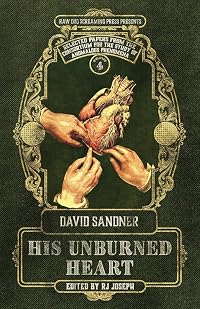
His Unburned Heart, tells the story of Mary Shelley's quest to retrieve her husband's heart from his publisher. History tells us that Percy Shelley was cremated, though his heart failed to burn, but the rest of the details are lost to time. Sandner has channeled Mary Shelley herself to share the story with us. That story is paired here with a second, related, piece. The Journal of Sorrow is named after Mary Shelley's personal journal, and imagines Percy Shelley's demise. "Sandner presents a show more tender examination on the nature of grief as a literary icon speculates on her lover's demise and the strange effort to recover the last physical remnant of her dead poet. Compelling and very moving prose." --Tim McGregor, author of Wasps in the Ice Cream and Eynhallow. His Unburned Heart opens in Tuscany, Italy, in August 1822 as Percy Shelley's body burns upon a beachside pyre. Attending his cremation following his untimely drowning are prideful, hot-tempered Lord Byron; dishonest, pagan ritual-performing Edward John Trelawny; publisher and supposed friend Leigh Hunt; and other locals, including Mary Shelley, forced to disguise herself as a male servant in order to attend. For Mary, the sight of Percy's post-mortem figure is chilling and horrifying, as is the strange occurrence of his heart, pillaged from his cracked chest by Trelawny after it fails to burn. From there, the storyline moves back and forth in time, always with the burning day as the focal point, chronicling Mary's furious revolt against period-standard misogyny and personal betrayal, the most pointed and grating of which involves Leigh, who claims Percy's heart and tells Mary point-blank that she doesn't deserve it, and who attacks her lifestyle, gender, and credibility and undermines her love and devotion, leaving her infuriated and determined to claim what's rightfully hers. he novella then progresses into The Journal of Sorrow, "Mary's Shelley's epigraph to her new journal," begun in October 1822, an account of Percy's fatal sea journey and Mary's feelings of regret and culpability. The text also includes 12 imagined versions of the ill-fated voyage, where the men aboard the ship fail to thwart death and destiny, their demise interwoven with supernatural elements and private musings. Through smooth and moving prose, the story immerses the reader in the early 19th century while resurrecting a literary icon, laying bare lower class humiliations, female tensions and challenges, Mary's intense internal struggles with grief and self-regard, and her resolved quest to reclaim her true love's heart. As the real details have been lost to history, this historical gothic horror work reimagines what may have transpired, producing a startlingly clear, morbidly fascinating peek into a much-lauded life -- an expertly crafted, in-depth examination and a powerful tribute. Both heartfelt and compelling, it's a deeply resonant read and a haunting meditation on the monstrously finite and fickle enigmas that are man, existence, and mortality. -- From Goodreads. show lessTags
Member Reviews
"His Unburned Heart" is a small novella based on the events immediately leading up to and right after the death of Percy Bysshe Shelley. It opens on August 16, 1822 as the young poet's body burns on a funeral pyre on an Italian beach. Byron, Trelawney, Hunt, Byron's manservant Tita, and - unbeknownst to the men - Mary, are all there in attendance. Trelawney is the first to rip the famously unburnt heart from Shelley, but gives it to a demanding Hunt. None consider that Mary should rightfully have it. She conspires and successfully steals it back. The latter half consists of ten thoughtful scenarios of Shelley's final moments with Ned Williams on that fateful night out at sea. The final one is a spiritual reunion between Mary and show more Percy.
Written beautifully, this one is exclusively for the Shelly fans. As we know, neither Hunt or Mary attended, but that I didn't mind. However, if you know next to nothing about Mary and Percy Byron, or Romantic mourning, it appears as a thoughtless and selfish group of close acquaintances vying over a dead man's heart. But the lesson in this tale is did any of them really know Shelley at all? Even the fictional depictions of Shelley's final moments are written in the third person. It's voyeuristic, knowing that a man so beloved for his work is so incredibly alone. Poor Ned Williams is an afterthought, which was disappointing. Mary is written as a bit conceited, as "Author of Frankenstein," and not a little jealous of her "guiding star," as even in death Shelley overshadows her. Mary's crossdressing to attend her husband's funeral was not the act of "feminine strength overcoming adversity" that I was looking for. Actions that follow made her no better than Hunt. I would've preferred a Mary that stood her ground, as herself, the Mary that Percy adored. show less
Written beautifully, this one is exclusively for the Shelly fans. As we know, neither Hunt or Mary attended, but that I didn't mind. However, if you know next to nothing about Mary and Percy Byron, or Romantic mourning, it appears as a thoughtless and selfish group of close acquaintances vying over a dead man's heart. But the lesson in this tale is did any of them really know Shelley at all? Even the fictional depictions of Shelley's final moments are written in the third person. It's voyeuristic, knowing that a man so beloved for his work is so incredibly alone. Poor Ned Williams is an afterthought, which was disappointing. Mary is written as a bit conceited, as "Author of Frankenstein," and not a little jealous of her "guiding star," as even in death Shelley overshadows her. Mary's crossdressing to attend her husband's funeral was not the act of "feminine strength overcoming adversity" that I was looking for. Actions that follow made her no better than Hunt. I would've preferred a Mary that stood her ground, as herself, the Mary that Percy adored. show less
Thank you NetGalley for the chance to read and review this book.
I love David Sandners writing style in this and I enjoyed this story. That being said, I feel like the second part with the snippets was unnecessary and I think we could have touched upon what happened with Byron and Allegra a bit more. Had that happened this book would have been 5 stars, and had those snippets not been added this would be 4 stars.
Strong 3.75
I love David Sandners writing style in this and I enjoyed this story. That being said, I feel like the second part with the snippets was unnecessary and I think we could have touched upon what happened with Byron and Allegra a bit more. Had that happened this book would have been 5 stars, and had those snippets not been added this would be 4 stars.
Strong 3.75
Members
- Recently Added By
Lists

Horror (Owned TBR)
60 works; 1 member
Author Information
10+ Works 146 Members
David Sandner is a professor of English at California State University, Fullerton.
Awards and Honors
Awards
Classifications
Statistics
- Members
- 6
- Popularity
- 3,034,247
- Reviews
- 2
- Rating
- (3.25)
- Languages
- English
- Media
- Paper
- ISBNs
- 1