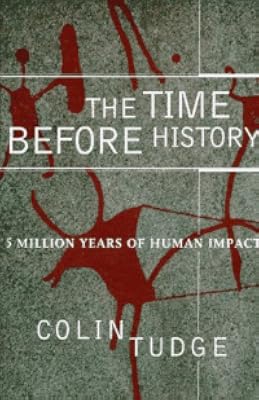
Time Before History: 5 Million Years of Human Impact
by Colin Tudge
On This Page
Description
In this lyrical and engaging exploration, Colin Tudge undertakes an ambitious task: to place the narratives of human and planetary coevolution within the same frame, to expand our perspective on our own history, and to tell the story of the human impact on planet Earth. Our sense of history, the author argues, has become so truncated that it is measured in months and years, occasionally decades, infrequently centuries. The Time Before History is a corrective, a record of the preface to show more modern life - of the period known as the Plio/Pleistocene, from 5 million years past to the birth of civilization some 10,000 years ago. Tudge paints a broad canvas of our last 5 million years with fascinating descriptions of the waxing and waning of species and populations because of climate changes and plate tectonics, including massive migrations around the planet; the fabulous animals that covered the earth when our ancestors first emerged; the unique and exquisitely destructive characteristics of the first neo-apes, from their ability to exploit the savanna while living safely in the trees to the advantages of the rotating shoulder joint, which permitted missile throwing and thus changed the risk-reward balance of hunting forever. Drawing upon the disciplines of geology, anthropology, archaeology, earth science, and climatology, the Time Before History is the first popular account of this critical period and is a truly original contribution to the intertwined narratives of humanity and its planet. show lessTags
Recommendations












Member Reviews
This is easily the best summary of evolution, ecology, and classification that I have encountered. Tudge presents a balanced view by presenting all of the competing theories regarding such matters as continental drift, the evolution of various species, and the history of man during the millions of years previous to "history." He then synthesizes the various elements and brings out the implications on our current course (as we will repeat ancient history too). The last part of his book comes as somewhat of a surprise as he then argues adamantly for tight controls on population, conservation, and the environment. The views are supported by the hypothesis that man has already destroyed much of Earth's fauna, but this still represents the show more arrogant perspective that we own evolution and nature. Regarding the ideas themselves, I found much of it intriguing (e.g. it sparked ideas about object-oriented simulation). His combining the various theories on human evolution into an expanded candelabra hypothesis makes sense. The modern refinements on classical evolution involve the addition of game theory (species prevail over another by being better able to make it through hard times and thus gaining in territory). There are also a good number of basic ecological principles expounded, regarding predators tending to hunt for their own size, carnivores having to take bigger risks, species numbering in proportion to their size. Humans are presented as having come about because the swinging arms of apes were needed to be used in other ways once we came back to the ground -- to make tools and throw missiles. According to Tudge, we are the ultimate generalists and that has meant worldwide success for us and the devastation of other species, including the giant sloths, mammoths, and baby elephants that were all allegedly still in North America at even the beginning of "ancient" history. I can't close without touching on the declared impact of contintental drift, creating mountains and islands, causing the necessary separation of clades and joining (around to the other side of the earth) and providing explanation for the Biblical phenomena of floods. The effect of the Himalaya's on the climate is not quite defended yet but is an interesting speculation. The "overkill hypothesis" -- that we became completely dominant with farming, communication, roads, and tools -- is credible and leaves me in thought about whether such superiority does call for a better approach to active management. show less
The author places the development of Homo sapiens within the context of evolutionary theory, highlighting the instability of the environment and the key to our species' success, viz., its supreme adaptability. The last chapter, a political rant that largely disregards what went before, can be skipped. The writing style is often intolerably cozy.
Ratings
Members
- Recently Added By
Author Information

27+ Works 2,658 Members
Colin Tudge is one of Britain's leading science writers. A research fellow at the Centre for Philosophy at the London School of Economics, he is the author of, most recently, "The Second Creation" (FSG, 2000) with Ian Wilmut & Keith Campbell. (Bowker Author Biography)
Some Editions
Awards and Honors
Awards
Common Knowledge
- Original title
- The Time Before History: 5 Million Years of Human Impact
- Original publication date
- 1995
- Dedication
- To my children:
Mandy, Amy and Robin - First words
- How odd it is to suggest, as historians conventionally do, that the Assyrians, the Egyptians, the Greeks and the Romans were "ancient."
- Last words
- (Click to show. Warning: May contain spoilers.)In short, as I commented in the Prologue, we cannot claim to be taking our species and our planet seriously until we acknowledge that a million years is a proper unit of political time.
Classifications
- Genres
- Anthropology, Science & Nature, Nonfiction, General Nonfiction, History
- DDC/MDS
- 573.2 — Natural sciences & mathematics Biology Specific physiological systems in animals, regional histology and physiology in animals Origin of man
- LCC
- GN281 .T84 — Geography, Anthropology and Recreation Anthropology Anthropology Physical anthropology. Somatology Human evolution
- BISAC
Statistics
- Members
- 310
- Popularity
- 102,696
- Reviews
- 2
- Rating
- (3.53)
- Languages
- English
- Media
- Paper
- ISBNs
- 4
- UPCs
- 1
- ASINs
- 3