
On This Page
Description
Describes how the Constitution was drafted and ratified.Tags
Recommendations










Member Reviews
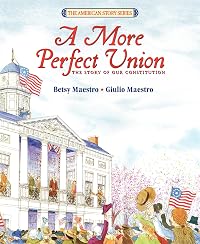
Author/illustrator team (and husband and wife) Betsy and Giulio Maestro explore the story of the U.S. Constitution in this work of picture book history. Opening in 1787, as the new country faced a crisis of noncooperation between the states, the book covers the Constitutional Convention in Philadelphia, and the major arguments and compromises made, before a new constitution was written and eventually ratified. These included the Connecticut or Great Compromise, which settled the question of whether congressional representation should be equally divided between the states or based upon population, as well as the passage of the first ten amendments to the Constitution, known collectively as the Bill of Rights, which secured the individual show more liberties of the American people. The book closes with extensive back matter, including a summary of the various sections of the Constitution and what they address, a list of signers of the Constitution, a table of dates, a note on the Connecticut Compromise, a list of interesting facts about the Constitution and delegates, the order and dates of state ratification, and a summary of the amendments to the Constitution...
Fairly or not, A More Perfect Union: The Story of Our Constitution suffers in comparison to the other volumes in the Maestro's picture book history series, The American Story, of which it is now a part. It was originally published in 1987, well before the first volume of that series, The Discovery of the Americas, which appeared in 1991, and despite predating the series, seems to have been added in after the fact. I'm not sure why it was placed fifth, before Liberty or Death: The American Revolution 1763-1783, as it covers events subsequent to that book, but in any case, it clearly wasn't originally intended as part of this larger project. As a result, it is significantly less detailed than the preceding four books in the series, which I read first, and while it does offer a good overview of the subject, feels a little bit light in comparison to them. It's well organized, and is a good basic introduction, so I don't want to overstate the issue, but the simpler, shorter text immediately struck me, having read the other books in the series first. I was also struck by the fact that no mention was made in the main text of the Three-fifths Compromise, which counted enslaved people as being three-fifths of a person, when it came to determining population in states which had slavery. While reference is made to this in the back matter, in the section devoted to the Connecticut Compromise, I thought it was too passing a reference. One thing I have appreciated, in other Maestro titles, is the balance that has been shown, in addressing the less noble aspects of our history. While such issues and events—slavery, the treatment of Native Americans—have not being allowed to overtake the entire narrative, in ways they might have done in more recently published titles, they also haven't been omitted. Here I feel that this is not so much the case, and it is to the detriment of the book and its readers. If I were using this series for educational purposes with young people—and I do recommend the series for that purpose, both in classrooms and in home-schooling—I would feel some supplemental material would be in order for this title. show less
Fairly or not, A More Perfect Union: The Story of Our Constitution suffers in comparison to the other volumes in the Maestro's picture book history series, The American Story, of which it is now a part. It was originally published in 1987, well before the first volume of that series, The Discovery of the Americas, which appeared in 1991, and despite predating the series, seems to have been added in after the fact. I'm not sure why it was placed fifth, before Liberty or Death: The American Revolution 1763-1783, as it covers events subsequent to that book, but in any case, it clearly wasn't originally intended as part of this larger project. As a result, it is significantly less detailed than the preceding four books in the series, which I read first, and while it does offer a good overview of the subject, feels a little bit light in comparison to them. It's well organized, and is a good basic introduction, so I don't want to overstate the issue, but the simpler, shorter text immediately struck me, having read the other books in the series first. I was also struck by the fact that no mention was made in the main text of the Three-fifths Compromise, which counted enslaved people as being three-fifths of a person, when it came to determining population in states which had slavery. While reference is made to this in the back matter, in the section devoted to the Connecticut Compromise, I thought it was too passing a reference. One thing I have appreciated, in other Maestro titles, is the balance that has been shown, in addressing the less noble aspects of our history. While such issues and events—slavery, the treatment of Native Americans—have not being allowed to overtake the entire narrative, in ways they might have done in more recently published titles, they also haven't been omitted. Here I feel that this is not so much the case, and it is to the detriment of the book and its readers. If I were using this series for educational purposes with young people—and I do recommend the series for that purpose, both in classrooms and in home-schooling—I would feel some supplemental material would be in order for this title. show less
This book is very informative but not very entertaining. This would be a good book for students who are older I would say that would be good for an 8th grade American History class. The book is about the creation of the constitution. It goes into the reason why it was made, who made it, when it was made, and how American people felt about it after it was made. It is very good to inform the read about this subject.
This book is about how the US constitution was thought up, agreed upon, and written. It also addresses how it effects the USA now. Informational
reviewed
Ratings
Members
- Recently Added By
Lists

Beautiful Feet Books
304 works; 7 members

The Playful Pioneers
166 works; 1 member
Author Information

53+ Works 15,373 Members
Betsy Maestro was born in Brooklyn, New York in 1944. She received a bachelor's degree in early childhood education and a master's degree in elementary guidance from Southern Connecticut State College. Before becoming a writer, she worked as a kindergarten and first grade teacher for eleven years. During that time she became aware of the need for show more imaginative nonfiction to spark children's interests. She has been creating books with her husband Giulio since 1974. She writes and he does the illustrating. They are best known for their nonfiction titles which include the American Story series. Together, they have produced over ninety titles. Her other works include How Do Apples Grow? and Why Do Leaves Change Color? (Bowker Author Biography) show less
All Editions
Awards and Honors
Awards
Series

Classifications
- Genre
- Nonfiction
- DDC/MDS
- 342.73 — Society, government, & culture Law U.S. Constitution - Bill of Rights, Amendments North America Constitutional law--United States
- LCC
- KF4520 .Z9 .M33 — Law Law of the United States Law of the United States (Federal) Constitutional law Works on legislative history of the Constitution
- BISAC
Statistics
- Members
- 1,304
- Popularity
- 18,530
- Reviews
- 4
- Rating
- (4.26)
- Languages
- English, Spanish
- Media
- Paper
- ISBNs
- 13
- ASINs
- 7