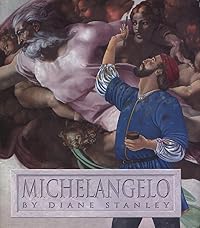
Michelangelo
by Diane Stanley
On This Page
Description
A biography of the Renaissance sculptor, painter, architect, and poet, well known for his work on the Sistine Chapel in Rome's St. Peter's Cathedral.Tags
Recommendations



















Member Reviews
Diane Stanley’s book reads almost like a work of fiction. She has woven a flowing story about Michelangelo who created some of humankind’s most beautiful works of art during the Italian Renaissance in 15th and 16th century. This includes the sculpture of David ‘Michelangelo had chosen the perfect subject to show off his remarkable skills - the young David, in a moment of intense concentration, about to do battle with Goliath’ (Stanley, 2000, p. 19) and the paintings inside the Sistine Chapel ‘For the next four years, he spent all his waking hours more than sixty feet up in the air’ (Stanley, 2000, p.29). Her authority to write on this topic can be seen from the other beautifully executed biographies she has produced on show more Leonardo da Vinci and Joan of Arc. ‘In many ways non-fiction books require more skills to produce than does fiction’ (Saxby & Winch, 1994, p. 257).
Michelangelo was born on 6 March 1475 and as a young child raised by a nurse in the village of stonecutters ‘the infant Michelangelo fell asleep to the odd lullaby of chisel striking stone’ (Stanley, 2000, p. 4). At the age of thirteen he begged his father to become a lowly artist's apprentice ‘Lodovico tried beating some sense into the boy, but Michelangelo would not give up’ (Stanley, 2000, p. 7). Later the ruler of Venice, Lorenzo Medici, recognised his talent and brought him to live with him as his own son and Michelangelo was ‘suddenly thrown into the midst of the Medici circle, where poetry, science, philosophy, and art were subjects of dinner table conversation (Stanley, 2000, p. 11).
Other historical events are interwoven with the story. ‘In April 1492, just a few months before his fellow Italian Christopher Columbus set sail from Spain and found a New World, Lorenzo de’ Medici died’ (Stanley, 2000, p. 13). She explores other facts, such as Michelangelo spending hours dissecting bodies at the local morgue in order to perfect his representation of the human body in his art. ‘It was there that he gained his astonishing power to bring forth life from a block of stone’ (Stanley, 2000, p. 13).
Inside the book there is an Authors note on Michelangelo and the Renaissance. ‘He would tower over the last years of the Renaissance, not merely shining in one of the arts - painting, sculpture, or architecture - but mastering all three’ (Stanley, 2000, p. 2). Opposite the author’s note is a beautiful historical map of Italy. The vivid blue of the sea and green of the land is visually appealing. Inside the front cover is the following synopsis ‘Michelangelo had a turbulent, quarrelsome life. He was obsessed with perfection and felt that everyone - from family members to his demanding patrons - took advantage and let him down’.
This edition is in a durable hardcover and the cover illustration that Diane Stanley has created is what first attracted me to the book. I wasn’t disappointed when I looked inside. The illustrations are beautifully created. She combines photographs of Michelangelo’s true artwork with her own paintings using watercolours, coloured pencil, and gouache creating a true visual background to the story. The full page pictures always relate to the story being told and the pages of text are decorated with period coins, coats of arms, stonecutting tools, portraits, sketches and reproductions.
The book seems quite well researched with twelve works listed in the bibliography and permissions provided. There is excellent use of white area and ample margins with the font and font size being clear and easy to read. The height of the book is A4 with the width being slightly wider making it a very nice picture book size.
I chose this book because Michelangelo is a curriculum topic at the school where I work and sourcing good children’s books on this topic has been difficult due to the poor appeal of those available. The disappointments with this book are mainly that there are no page numbers, no index, no contents page, no pronunciation guide, no timeline and no glossary. This is a great failing and flaws an otherwise brilliant book. All in all though, I think this is a beautifully crafted work and the best contribution to children’s books on Michelangelo to date. Hopefully one day a new edition will be produced that will correct some of the failings outlined above. show less
Michelangelo was born on 6 March 1475 and as a young child raised by a nurse in the village of stonecutters ‘the infant Michelangelo fell asleep to the odd lullaby of chisel striking stone’ (Stanley, 2000, p. 4). At the age of thirteen he begged his father to become a lowly artist's apprentice ‘Lodovico tried beating some sense into the boy, but Michelangelo would not give up’ (Stanley, 2000, p. 7). Later the ruler of Venice, Lorenzo Medici, recognised his talent and brought him to live with him as his own son and Michelangelo was ‘suddenly thrown into the midst of the Medici circle, where poetry, science, philosophy, and art were subjects of dinner table conversation (Stanley, 2000, p. 11).
Other historical events are interwoven with the story. ‘In April 1492, just a few months before his fellow Italian Christopher Columbus set sail from Spain and found a New World, Lorenzo de’ Medici died’ (Stanley, 2000, p. 13). She explores other facts, such as Michelangelo spending hours dissecting bodies at the local morgue in order to perfect his representation of the human body in his art. ‘It was there that he gained his astonishing power to bring forth life from a block of stone’ (Stanley, 2000, p. 13).
Inside the book there is an Authors note on Michelangelo and the Renaissance. ‘He would tower over the last years of the Renaissance, not merely shining in one of the arts - painting, sculpture, or architecture - but mastering all three’ (Stanley, 2000, p. 2). Opposite the author’s note is a beautiful historical map of Italy. The vivid blue of the sea and green of the land is visually appealing. Inside the front cover is the following synopsis ‘Michelangelo had a turbulent, quarrelsome life. He was obsessed with perfection and felt that everyone - from family members to his demanding patrons - took advantage and let him down’.
This edition is in a durable hardcover and the cover illustration that Diane Stanley has created is what first attracted me to the book. I wasn’t disappointed when I looked inside. The illustrations are beautifully created. She combines photographs of Michelangelo’s true artwork with her own paintings using watercolours, coloured pencil, and gouache creating a true visual background to the story. The full page pictures always relate to the story being told and the pages of text are decorated with period coins, coats of arms, stonecutting tools, portraits, sketches and reproductions.
The book seems quite well researched with twelve works listed in the bibliography and permissions provided. There is excellent use of white area and ample margins with the font and font size being clear and easy to read. The height of the book is A4 with the width being slightly wider making it a very nice picture book size.
I chose this book because Michelangelo is a curriculum topic at the school where I work and sourcing good children’s books on this topic has been difficult due to the poor appeal of those available. The disappointments with this book are mainly that there are no page numbers, no index, no contents page, no pronunciation guide, no timeline and no glossary. This is a great failing and flaws an otherwise brilliant book. All in all though, I think this is a beautifully crafted work and the best contribution to children’s books on Michelangelo to date. Hopefully one day a new edition will be produced that will correct some of the failings outlined above. show less
This was an interesting yet informative read. I could not help myself glancing at the illustrations after reading each paragraph; they are enthralling. Michelangelo is depicted as a craftsman whose brillance expanded through architecture, painting, and sculpture. He had a turbulent life that left him isolated through extended periods of his life. It was not until his final years that he found two individuals who he had grown fond of. At times I was captivated on his remarkable designs and other times I felt pity for him. It seemed as though he was cursed by his art. Although through history, the best of artists are the most tortured.
I found it fascinating that he received his lessons on the human form from the morgue. In other words, show more he would spend hours dissecting bodies in order to understand how the body was constructed. My favorite piece of art done by Michelango has always been the painting in the Sistine Chapel. I did not realize until reading this book that the Sistine Chapel was painted upon request by Pope Julius II. show less
I found it fascinating that he received his lessons on the human form from the morgue. In other words, show more he would spend hours dissecting bodies in order to understand how the body was constructed. My favorite piece of art done by Michelango has always been the painting in the Sistine Chapel. I did not realize until reading this book that the Sistine Chapel was painted upon request by Pope Julius II. show less
The main idea of this book was to tell the life story of the artist Michelangelo in a short yet informative book. I enjoyed this book for two main reasons. The first, the author was able to use language and writing style to his advantage. The book could have become very confusing for a child because it intertwines many lives into one book (Leonardo Da Vinci), yet the author was able to create a center on Michelangelo. The second reason I enjoyed this book was that even though it was a biography there were still pictures that helped the story. I learn the best when I am able to visual connect what I am reading to an illustration. For children, it is earlier to understand a picture by reading and looking at it than only reading about it. show more This is what the author did on page 11. He described one of Michelangelo’s paintings and had an illustration for them to look at. show less
A beautiful book which tells of Michelangelo's life. One reads of the history that surrounds his life, as well as his personality and great gifts. The reader truly gets to know Michelangelo as a person. The illustrations are beautifully created showing his actual work within the illustration. This is a must read book for anyone going to Rome or Florence. Mrs. Stanley's book has a lengthy bibliography.
I read this book aloud to my daughters.
The book is beautifully illustrated, and it provided just enough biographical information to make it suitable for young listeners.
We plan to read more of Stanley's biographies.
The book is beautifully illustrated, and it provided just enough biographical information to make it suitable for young listeners.
We plan to read more of Stanley's biographies.
Another great biography story book from Diane Stanley. This is not just a compilation of facts about the artist but rather a the actual story of his life. An enjoyable and educational read.
This book takes the reader through the life of Michelangelo Buonarroti from when he starts out in a stonecutter's home to how he studied the human body in order to replicate it's perfection. This story captures the intensity of his life and the great works of art that he created during his lifetime.
Members
- Recently Added By
Lists

Sonlight Books
1,487 works; 25 members

Read Alouds for CC Cycle 2
17 works; 2 members

Ambleside Y3
36 works; 1 member

The Story of the World: History for the Classical Child: Activity Book Two
415 works; 2 members

Ambleside Year 3
47 works; 1 member
Author Information

58+ Works 16,914 Members
Diane Stanley was born in 1943 and was raised in Abilene, Texas. She later attended both Trinity University and Johns Hopkins University. Her portfolio of children's book illustrations was creative enough for her to begin publication in 1978. She became an art director for G.P. Putnam & Sons and later began retelling and illustrating classic show more children's books. Stanley has revamped the fairy tale, Rumpelstiltskin's Daughter and has also researched the children's biographies Cleopatra and Leonardo Da Vinci. She also illustrated her mother's book, The Last Princess. (Bowker Author Biography) show less
Awards and Honors
Awards
Common Knowledge
- People/Characters
- Michelangelo Buonarroti
Classifications
Statistics
- Members
- 1,434
- Popularity
- 16,529
- Reviews
- 12
- Rating
- (4.39)
- Languages
- English
- Media
- Paper
- ISBNs
- 6
- ASINs
- 3