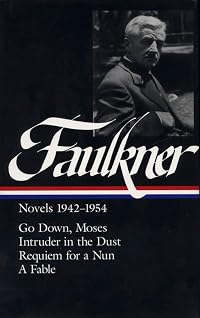
Novels 1942-1954 : Go Down, Moses / Intruder in the Dust / Requiem for a Nun / A Fable
by William Faulkner
On This Page
Description
The years 1942 to 1954 saw William Faulkner's rise to literary celebrity - sought after by Hollywood, lionized by the critics, awarded a Nobel Prize in 1950 and the Pulitzer and National Book Award for 1954. But despite his success, he was plagued by depression and alcohol and haunted by a sense that he had more to achieve - and a finite amount of time and energy to achieve it. This volume - the third in The Library of America's new, authoritative edition of Faulkner's complete works - show more collects the novels written during this crucial and fascinating period in his career. The newly restored texts, based on Faulkner's manuscripts, typescripts, and proof sheets, are free of the changes introduced by the original editors and are faithful to the author's intentions. In the four works included here, Faulkner delved deeper into themes of race and religion, and furthered his experiments with fictional structure and narrative voice; defying the odds, he continued to break new ground in American fiction. Go Down, Moses (1942) is a haunting novel made up of seven related stories that explore the intertwined lives of black, white, and Indian inhabitants of Yoknapatawpha County. It includes "The Bear", one of the most famous works in all American fiction, with its evocation of "the wilderness, the big woods, bigger and older than any recorded document". Characters from Go Down, Moses reappear in Intruder in the Dust (1948). Part detective novel, part morality tale, it is a compassionate story of a black man on trial and the growing moral awareness of a southern white boy. Requiem for a Nun (1951) is a sequel to Sanctuary. With an unusual structure combining novel and play, it tells the fate of thepassionate, haunted Temple Drake and the murder case through which she achieves a tortured redemption. Prose interludes condense millennia of local history into a swirling counterpoint. In A Fable (1954), Faulkner's recasting of the Christ story set during World War I, he wanted, he said, "to try to tell what I had found in my lifetime of truth in some important way before I had to put the pen down and die". The novel, which earned a Pulitzer Prize, is both an anguished spiritual parable and a drama of mutiny, betrayal, and violence in the barracks and on the battlefields. show lessTags
Recommendations


















Member Reviews
A Fable: Another very difficult read by William Faulkner. As in his other novels, I feel as a member of an extraterrestrial race trying to understand the language of humanity. Or maybe it's the other way around, Faulkner is from another (better) planet. Faulkner speaks for all of us, about all of us, but uses a language that has not yet been invented. Think about people living in Vienna in the 1820's who happened to listen to Beethoven's last quartets or piano sonatas. It took over a hundred years for these pieces to become routine pieces to play or record. Same here. We have to struggle with his writing because it comes from another place, space, world. But it does show profound knowledge of man's affairs and struggles.
The most amazing show more feature of his writing, to me, is the lack of time parameters. He reached the peak of artistic use of this technique with the beginning of Sound & Fury, but the Fable is a good example as well. What happens happens many times, in different parts of the book, and in the same sentence often one finds links to three or even more threads, episodes with a three-legged horse in Kansas are knitted together with a woman in France, 1918, a piece of bread, a minister and the FBI! Of course you will not get it, this is the whole point, this is a real BOOK not a story. To give an example, try to make a movie out of this parable and it will last 1/2 hour and suck for the most part. Instead, read Faulkner as you would read in a foreign language, with a pencil and paper on your bedside table, take notes, reread often. There is no rush, quite the opposite, the more you save for tomorrow the better your week will be! show less
The most amazing show more feature of his writing, to me, is the lack of time parameters. He reached the peak of artistic use of this technique with the beginning of Sound & Fury, but the Fable is a good example as well. What happens happens many times, in different parts of the book, and in the same sentence often one finds links to three or even more threads, episodes with a three-legged horse in Kansas are knitted together with a woman in France, 1918, a piece of bread, a minister and the FBI! Of course you will not get it, this is the whole point, this is a real BOOK not a story. To give an example, try to make a movie out of this parable and it will last 1/2 hour and suck for the most part. Instead, read Faulkner as you would read in a foreign language, with a pencil and paper on your bedside table, take notes, reread often. There is no rush, quite the opposite, the more you save for tomorrow the better your week will be! show less
read from 1997 til 2015...
Includes Go Down, Moses, Intruder in the dust, Requiem for a nun, A fable
"Go down, Moses", "Intruder in the dust", "Requiem for a nun", "A fable"
Ratings
Members
- Recently Added By
Lists

2022 Christmas Gifts
60 works; 13 members
Author Information

Born in an old Mississippi family, William Faulkner made his home in Oxford, seat of the University of Mississippi. After the fifth grade he went to school only off and on-lived, read, and wrote much as he pleased. In 1918, refusing to enlist with the "Yankees," he joined the Canadian Air Force, and was transferred to the British Royal Air Force. show more After the war he studied a little at the University, did house painting, worked as a night superintendent at a power plant, went to New Orleans and became a friend of Sherwood Anderson, then to Europe and back home to Oxford. By this time he had written two novels. The Sound and the Fury followed in 1929. Financial success came with Sanctuary in 1931, which he assisted in filming. Faulkner 's novels are intense in their character portrayals of disintegrating Southern aristocrats, poor whites, and African Americans. A complex stream-of-consciousness rhetoric often involves Faulkner in lengthy sentences of anguished power. Most of his tales are set in the mythical Yoknapatawpha County, Mississippi, and are characterized by the use of many recurring characters from families of different social levels spanning more than a century. His best subjects are the old, dying South and the newer materialistic South. As I Lay Dying (1930), is a grotesquely tragicomic story about a family of poor southern whites. With Absalom, Absalom! (1936); the difficult parts of his famous short novel "The Bear" (published in Go Down, Moses, 1942); and the allegorical A Fable (1954), a non-Yoknapatawpha novel set in France during World War I; Faulkner returned to an innovative and difficult style that most readers have trouble with. Yet, interspersed among such works are collections of easily read stories originally published in popular magazines. There seems to be a growing sentiment among critics that the Snopes trilogy-The Hamlet (1940), The Town (1957), and The Mansion (1959)-for the most part an example of Faulkner's "moderate" style, could well be among his most important works. Faulkner was awarded the 1949 Nobel Prize for literature "for his powerful and artistically independent contribution to the new American novel," but it would appear now that he also deserved to win that honor for his contribution to world literature. When reporting his death, the Boston Globe quoted Faulkner's having once told an interviewer: "Since man is mortal, the only immortality for him is to leave something behind him that is immortal since it will always move. That is the artist's way of scribbling "Kilroy was here" on the wall of the final and irrevocable oblivion through which he must some day pass." In addition to the Nobel Prize, Faulkner received the Howells Medal of the American Academy of Arts and Letters in 1950, and in 1951 he was given the National Book Award for his Collected Stories Collected Stories. For his novel A Fable he received the National Book Award for the second time, as well as the Pulitzer Prize in 1955. The Reivers (1962) was awarded the Pulitzer Prize in 1963. In 1957 and 1958, he was the University of Virginia's first writer-in-residence, and in January 1959 he accepted an appointment as consultant on contemporary literature to the Alderman Library of that university. Although Faulkner was not without honors in his lifetime and has received world recognition since then, it is surprising to learn that, when Malcolm Cowley edited The Portable Faulkner in 1946, he found that almost all of Faulkner's books were out of print. By arranging selections from the works to form a continuous chronicle, Cowley deserves much of the credit for making readers aware of the way in which Faulkner was creating a fictive world on a scale grander than that of any novelist since Balzac. William Faulkner died in Oxford, Mississippi, in 1962. (Bowker Author Biography) show less
Series
Belongs to Publisher Series
Library of America (073)
Work Relationships
Contains
Common Knowledge
- Canonical title
- Novels 1942-1954 : Go Down, Moses / Intruder in the Dust / Requiem for a Nun / A Fable
- Original publication date
- 1994-10-01
- Publisher's editor
- Blotner, Joseph; Polk, Noel
- Disambiguation notice
- This is an omnibus unique to the Library of America; therefore, all CK facts apply to this publication only.
Classifications
Statistics
- Members
- 511
- Popularity
- 58,764
- Reviews
- 4
- Rating
- (4.16)
- Languages
- English
- Media
- Paper
- ISBNs
- 2
- ASINs
- 1