The Bicycle Man
by Allen Say
On This Page
Description
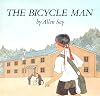
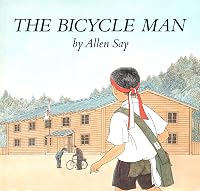
The amazing tricks two American soldiers do on a borrowed bicycle are a fitting finale for the school sports day festivities in a small village in occupied Japan.Tags
Recommendations















Member Reviews
What a gem of a book. This is a wonderful way to learn about Japanese culture through the eyes of a young boy who is describling a very special school dayl The description of the school in the south island of Japan located halfway up a tall green mountain is lush and beautitully rendered. How lovely to be able to see old sailing ships and hear the pounding of the waves for this vantage point.
The setting is a lovely spring day when the annual sportsday is held. The writer does an excellent joy of rendering the excitement of the day with special headbands worn indicating the team the child belongs. Coroeful flags and streamers adorn the poles carried with with chalk lines drawn. The principal sets the tone of sportsmanship and the idea of show more fun no matter who wins.
Then, there is a joint race of parents and teachers running alonside calling words of encouragement. And then, the winners approached the judges table to receive their prize from the principal. Wrapped in white paper and gold thread, each child walks to the table slowly recognizing the privilidge and honor that winning connotates.
There is a description of the family meal with attention to detail. More games are played in the afternon, with the fun of parents and teachers joining in the festivities.
And then the tone changes as two strangers, make the day important because they are American soldiers. One is very dark skinned, the other had "bright hair like fire." The author stresses physical characteristics to make the difference more profound. The World Was II is over and thus there is no fear of capture, harm or abandonment, simply the recognition that American soldiers are indeed strangers.
The principal gladly offers his bike to the tall black man who performs a series of stunts with the bike. Twisiting and turning, looking backward, leaping in the air with bike in hand, encourages the students to laugh. When the stunts are finished, a prize is given to the very tale American soldier. There is a sense of comradre and joy.
A special school day made all the more important by the inclusion of American Soliders, and two groups, previously at war, now have no need for weapons, only the sense of joy and revelry. show less
The setting is a lovely spring day when the annual sportsday is held. The writer does an excellent joy of rendering the excitement of the day with special headbands worn indicating the team the child belongs. Coroeful flags and streamers adorn the poles carried with with chalk lines drawn. The principal sets the tone of sportsmanship and the idea of show more fun no matter who wins.
Then, there is a joint race of parents and teachers running alonside calling words of encouragement. And then, the winners approached the judges table to receive their prize from the principal. Wrapped in white paper and gold thread, each child walks to the table slowly recognizing the privilidge and honor that winning connotates.
There is a description of the family meal with attention to detail. More games are played in the afternon, with the fun of parents and teachers joining in the festivities.
And then the tone changes as two strangers, make the day important because they are American soldiers. One is very dark skinned, the other had "bright hair like fire." The author stresses physical characteristics to make the difference more profound. The World Was II is over and thus there is no fear of capture, harm or abandonment, simply the recognition that American soldiers are indeed strangers.
The principal gladly offers his bike to the tall black man who performs a series of stunts with the bike. Twisiting and turning, looking backward, leaping in the air with bike in hand, encourages the students to laugh. When the stunts are finished, a prize is given to the very tale American soldier. There is a sense of comradre and joy.
A special school day made all the more important by the inclusion of American Soliders, and two groups, previously at war, now have no need for weapons, only the sense of joy and revelry. show less
During Sportsday at a Japanese school, two unexpected visitors appear at the school yard gate. These two visitors, U.S. soldiers, are like nothing most of the children have ever seen. The soldiers join in on the Sportsday fun as one soldier rides the principal's bicycle in the most daring and spectacular ways!
What surprised me most about this book was that it is not complete fiction - this is is something that actually happened during Allen Say's childhood.
What surprised me most about this book was that it is not complete fiction - this is is something that actually happened during Allen Say's childhood.
This book is not what I expected it to be about. It was a nice look inside a Japanese tradition and about the experience of these children with two American soldiers. Especially after World War II it is nice to see an uplifting portrayal of Japanese and Americans having fun together.
This book could be used for a bicycle celebration day at the public library to encourage children and their families to ride bikes.
This book could be used for a bicycle celebration day at the public library to encourage children and their families to ride bikes.
Good history, narrative, Japanese. Kids enjoyed bicycle stunts. Boring writing style mostly. Decent illustrations
The Bicycle Man by Allen Say is a really touching book because Say is reliving one of his favorite days while he grew up as a little boy living in Japan. It is Sportsday at his school, much like a field day or may day here in America where students compete in races in games to win prizes or respect from other students/grade levels. The children are competing when they see two Americans watching them. One is a tall African American and one is a tall red haired man, who are wanting to participate in the events. The African American impresses everyone with all the tricks he can do on his bicycle and ends up winning the top prize of the day awarded by the Japanese principal. This is a great book because the war between America and Japan had show more only been over a year, and friendships were already being established. show less
Still one of my favorite stories about a Japanese elementary school boy who encounters two GIs (one African American, one redhead) whose bicycle tricks win them friendship and praise, and bridge languages and postwar tensions. Beautifully illustrated.
This book was very interesting and a great window of another culture looking into another culture. The language of this story is very clear and descriptive."he looked like a small boy greeting a giant", descriptive language like this allows an immediate picture to form in your head. This book outlined how a culture could look into another and their perspective. "The principle walked up to the American and bowed." quotes like this show cultual diversity and communication by body language. The main moral of the story was "to never judge a book by the cover". As the Americans walked up to the school, students were scared, " I felt afraid" the main character said. Later the children realized that these men were great people and were glad to show more meet them. show less
Members
- Recently Added By
Lists

A Child's Book Tour of Japan
58 works; 4 members

Reading Rainbow
193 works; 10 members

Early Picture Books
467 works; 9 members
Author Information

35+ Works 11,538 Members
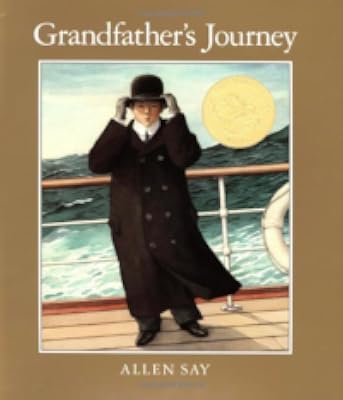
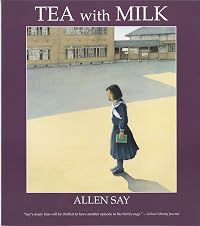
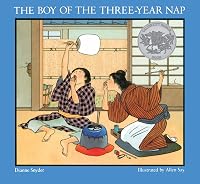
Allen Say was born in 1937 in Yokohama, Japan and grew up during the war, attending seven different primary schools amidst the ravages of falling bombs. His parents divorced in the wake of the end of the war and he moved in with his maternal grandmother, with whom he did not get along with. She eventually let him move into a one room apartment, show more and Say began to make his dream of being a cartoonist a reality. He was twelve years old. Say sought out his favorite cartoonist, Noro Shinpei, and begged him to take him on as an apprentice. He spent four years with Shinpei, but at the age of 16 moved to the United States with his father. Say was sent to a military school in Southern California but then expelled a year later. He struck out to see California with a suitcase and twenty dollars. He moved from job to job, city to city, school to school, painting along the way, and finally settled on advertising photography and prospered. Say's first children's book was done in his photo studio, between shooting assignments. It was called "The Ink-Keeper's Apprentice" and was the story of his life with Noro Shinpei. After this, he began to illustrate his own picture books, with writing and illustrating becoming a sort of hobby. While illustrating "The Boy of the Three-year Nap" though, Say suddenly remembered the intense joy I knew as a boy in my master's studio and decided to pursue writing and illustrating full time. Say began publishing books for children in 1968. His early work, consisting mainly of pen-and-ink illustrations for Japanese folktales, was generally well received; however, true success came in 1982 with the publication of The Bicycle Man, based on an incident in Say's life. "The Boy of the Three-Year Nap" published in 1988, and written by Dianne Snyder, was selected as a 1989 Caldecott Honor Book and winner of The Boston Globe-Horn Book Award for best picture book. (Bowker Author Biography) show less
Awards and Honors
Distinctions
Series
Belongs to Publisher Series
Common Knowledge
- Canonical title
- The Bicycle Man
- Important places
- Japan
- Dedication
- For Morita Sensei
- First words
- When I was a small boy I went to a school in the south island of Japan.
- Last words
- (Click to show. Warning: May contain spoilers.)We followed them with our eyes, until they disappeared around the bend in the road.
Classifications
Statistics
- Members
- 795
- Popularity
- 35,006
- Reviews
- 27
- Rating
- (3.80)
- Languages
- English
- Media
- Paper, Ebook
- ISBNs
- 15
- UPCs
- 3
- ASINs
- 3