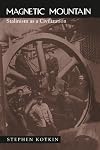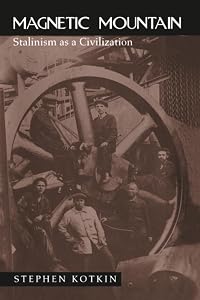
Magnetic Mountain: Stalinism as a Civilization
by Stephen Kotkin
On This Page
Description
This study is the first of its kind: a street-level inside account of what Stalinism meant to the masses of ordinary people who lived it. Stephen Kotkin was the first American in 45 years to be allowed into Magnitogorsk, a city built in response to Stalin's decision to transform the predominantly agricultural nation into a "country of metal." With unique access to previously untapped archives and interviews, Kotkin forges a vivid and compelling account of the impact of industrialization on a show more single urban community. Kotkin argues that Stalinism offered itself as an opportunity for enlightenment. The utopia it proffered, socialism, would be a new civilization based on the repudiation of capitalism. The extent to which the citizenry participated in this scheme and the relationship of the state's ambitions to the dreams of ordinary people form the substance of this fascinating story. Kotkin tells it deftly, with a remarkable understanding of the social and political system, as well as a keen instinct for the details of everyday life. Kotkin depicts a whole range of life: from the blast furnace workers who labored in the enormous iron and steel plant, to the families who struggled with the shortage of housing and services. Thematically organized and closely focused, Magnetic Mountain signals the beginning of a new stage in the writing of Soviet social history. show lessTags
Recommendations









Member Reviews
Stephen Kotkin's "Magnetic Mountain" is a Foucault-inspired attempt at describing the civilization known as Stalinism from the 'bottom up', and to give expression to the language, experience and ideology of the common people living in that society. At the same time, the book, his PhD work, criticizes a lot of prior historical theory on the USSR in general and the Stalinist period in particular. This forms a significant part of the book, but is relegated entirely to the footnotes, making it particularly worthwhile in this case to pay attention to those.
Kotkin's description of the creation of the enormous steel plant and factory city of Magnitogorsk, his pars pro toto for the period, is extremely extensive, even including a host of show more technical details and a history of the factory itself. This is interesting enough at first, but the depth to which he analyzes it does not really match the novelty of the subject, so that it easily gets boring after a while.
The second part of the book is much more interesting, and is Kotkin's description of the city Magnitogorsk. He writes about the enormous efforts expended to create a somewhat viable city in barren and inhospitable terrain, and the constant lack of supplies, personnel and training that hampers every effort at improvement. Recreation, the housing situation, medical facilities, cultural development: every aspect of life in the city is chronicled. Because of the Foucaultian approach, his emphasis is in particular on the way that the people regarded themselves and the society around them, and the Stalinist project of 'building socialism' they were a part of. The last two chapters are devoted to describing the political situation, including of course an extensive account of the Great Purges of 1937-1939.
Even aside from the ineffectual first half, the book has some serious flaws though. Kotkin spends a lot of time analyzing the effects and meaning of the shortage-based planned economy of the period, and while his demonstration of how this shortage was fundamental to keeping the regime in power and keeping ideological control is excellent, his understanding of economics is much less so. He is also quite strongly pro-capitalist, and regularly approaches the subject in the condescending tone of one who knew all along that socialism must fail. What makes this even more dubious is that he takes over without criticism Stalin's definition of socialism as state property of everything but personal assets, which is controversial to say the least.
Equally, despite a lot of heavy-handed criticism for Lewin, Fitzpatrick and Getty on the point of their analysis of the Purges and its cause (as well as the general causes of Stalinism), he does not really present an alternative explanation of the Great Purges either. He spends a lot of words showing the way the Purges took place, but there is no real theory of its underlying causes, except tentatively noting that it might be construed as a Party backlash against the technical bureaucracy which increasingly made it obsolete. But this does not account for why the Purges mainly took place within Party ranks.
Kotkin must be commended for putting Stalinism as such a bit more in an international perspective, which has rarely been done, emphasizing the degree to which Stalin could use (or believe himself) the idea of the USSR as a completely surrounded and constantly beleaguered state. Yet at the same time Kotkin seems to draw the conclusion from the general period of economic planning in the major world nations of those days that such interventionism must necessarily lead to a totalitarian mindset. This, at least, is strongly the tendency of his afterword to the Purges chapter.
This socio-economic blindness on his part, whether it is dismissing class analysis, positing capitalism as natural and inescapable, or critiquing interventionism is what seriously flaws his otherwise strong contribution to the historiography of the USSR. show less
Kotkin's description of the creation of the enormous steel plant and factory city of Magnitogorsk, his pars pro toto for the period, is extremely extensive, even including a host of show more technical details and a history of the factory itself. This is interesting enough at first, but the depth to which he analyzes it does not really match the novelty of the subject, so that it easily gets boring after a while.
The second part of the book is much more interesting, and is Kotkin's description of the city Magnitogorsk. He writes about the enormous efforts expended to create a somewhat viable city in barren and inhospitable terrain, and the constant lack of supplies, personnel and training that hampers every effort at improvement. Recreation, the housing situation, medical facilities, cultural development: every aspect of life in the city is chronicled. Because of the Foucaultian approach, his emphasis is in particular on the way that the people regarded themselves and the society around them, and the Stalinist project of 'building socialism' they were a part of. The last two chapters are devoted to describing the political situation, including of course an extensive account of the Great Purges of 1937-1939.
Even aside from the ineffectual first half, the book has some serious flaws though. Kotkin spends a lot of time analyzing the effects and meaning of the shortage-based planned economy of the period, and while his demonstration of how this shortage was fundamental to keeping the regime in power and keeping ideological control is excellent, his understanding of economics is much less so. He is also quite strongly pro-capitalist, and regularly approaches the subject in the condescending tone of one who knew all along that socialism must fail. What makes this even more dubious is that he takes over without criticism Stalin's definition of socialism as state property of everything but personal assets, which is controversial to say the least.
Equally, despite a lot of heavy-handed criticism for Lewin, Fitzpatrick and Getty on the point of their analysis of the Purges and its cause (as well as the general causes of Stalinism), he does not really present an alternative explanation of the Great Purges either. He spends a lot of words showing the way the Purges took place, but there is no real theory of its underlying causes, except tentatively noting that it might be construed as a Party backlash against the technical bureaucracy which increasingly made it obsolete. But this does not account for why the Purges mainly took place within Party ranks.
Kotkin must be commended for putting Stalinism as such a bit more in an international perspective, which has rarely been done, emphasizing the degree to which Stalin could use (or believe himself) the idea of the USSR as a completely surrounded and constantly beleaguered state. Yet at the same time Kotkin seems to draw the conclusion from the general period of economic planning in the major world nations of those days that such interventionism must necessarily lead to a totalitarian mindset. This, at least, is strongly the tendency of his afterword to the Purges chapter.
This socio-economic blindness on his part, whether it is dismissing class analysis, positing capitalism as natural and inescapable, or critiquing interventionism is what seriously flaws his otherwise strong contribution to the historiography of the USSR. show less
I have read a number of histories of both communism and he Soviet Union - most of them focus on politics or the life of dissidents - this book describes life, highs and lows for normal people. The resulting stories - from shock workers to French wrestling are engrossingly surreal. Mandatory reading for anyone interested in Soviet History.
school reading
Ratings
Members
- Recently Added By
Lists

r/AskHistorians' Recommended Books
1,068 works; 19 members

01
20 works; 1 member
Author Information

18+ Works 2,007 Members
Stephen Mark Kotkin was born on February 17, 1959. He is a historian, academic and author. Kotkin graduated from the University of Rochester in 1981 with a B.A. in English. He studied Russian and Soviet history under Reginald E. Zelnik and Martin Malia at the University of California, Berkeley, where he earned his M.A. in 1983 and his Ph.D. in show more 1988, both in history. Starting in 1986, Kotkin traveled to the former Soviet Union several times for academic research and fellowships. He was a visiting scholar at the Russian Academy of Sciences (1993, 1995, 1998, 1999, 2012). He joined the faculty at Princeton University in 1989, and was the director of in Russian and Eurasian Studies Program for 13 years (1995-2008). He is currently the John P. Birkelund '52 Professor in History and International Affairs at Princeton. He is also a W. Glenn Campbell and Rita Ricardo-Campbell National Fellow at Stanford University's Hoover Institution. He was a finalist for the 2015 Pulitzer Prize in Biography with his title Stalin - Vol. 1 : Paradoxes of Power, 1878-1928. (Bowker Author Biography) show less
Common Knowledge
- Canonical title
- Magnetic Mountain: Stalinism as a Civilization
- Original publication date
- 1997
- Epigraph
- I propose a toast to simple, ordinary, modest people, to the “little cogs” who keep our great state machine in motion. . . . No one writes about them, they have no high titles and few offices, but they are the people who ... (show all)maintain us. . . . I drink to the health of these people.
Joseph Stalin
Classifications
- Genres
- History, Nonfiction, General Nonfiction
- DDC/MDS
- 947.87 — History & geography History of Europe Eastern European Counties and Russia Belarus
- LCC
- DK651 .M159 .K675 — History of Europe, Asia, Africa and Oceania Russia. Soviet Union. Former Soviet Republics – Poland History of Russia. Soviet Union. Former Soviet Republics Local history and description Russia (Federation). Russian S.F.S.R.
- BISAC
Statistics
- Members
- 174
- Popularity
- 188,901
- Reviews
- 3
- Rating
- (3.89)
- Languages
- English
- Media
- Paper, Ebook
- ISBNs
- 5
- ASINs
- 3