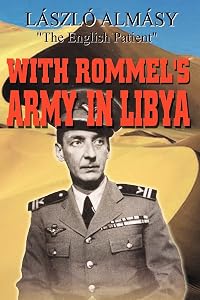
With Rommel's Army in Libya
by Laszlo Almasy
On This Page
Description
The name László Almásy gained worldwide recognition as the "English Patient" through the novel and motion picture bearing that title. The real Almásy was a polyglot, cosmopolitan Hungarian who fell under the spell of the Sahara. He spent most of his adult life exploring large tracts of the Libyan Desert - often accompanied by British colleagues - and became one of the foremost experts on this part of the world, publishing several books in French, German, and Hungarian on his expeditions. show more He developed an uncanny ability for finding his way around the vast emptiness, by automobile and small airplane. Even the Bedouins acknowledged his skills, naming him Abu Ramla, the "Father of the Sands." It was because of this familiarity with the Libyan Desert that he ended up serving for two years under General Erwin Rommel in the Afrika Korps in North Africa. He became a commander of long-range desert patrols and led a number of secret, high-risk missions through the Sahara. Based on his diaries, With Rommel's Army in Libya was published in Budapest in 1943. It was placed by the Communists on the index of forbidden books after World War II. Copies of it were removed from public libraries and destroyed. The authorship of this supposedly treasonous book was one of the charges brought against Almásy before the People's Court, but thanks to the efficiency of the censors, not even the prosecuting attorney could find a copy to present as evidence. The defense had to provide a copy to show that the charges were false. show lessTags
Member Reviews
Though his name was only relatively recently made famous by Ondaatje's The English Patient and the film that followed, Laszlo Almasy was a dedicated explorer of the African deserts who was recruited by German forces because of his knowledge of the Sahara. This book is his most famous, and was at one point falsely held against him as proof of his loyalty to Hitler. In reality, the book did more to prove the falsity of this claim, even after it had been banned in Germany as a forbidden book, when the defense attorney was finally able to find a copy.
Through this book, Almasy's utter love of exploration and travel both come across on nearly each page. While war serves as a very real backdrop to the text, what is most striking is the show more author's love and knowledge of many very different cultures and languages, and his clear appreciation for the same, as well as his love for the Sahara and the untouched landscapes he travels through. The book is engaging not just as a relic of history, but as the record of a real and engaging man who was caught up in a war because of his love for the African landscape. His love of people and cultures makes the text nearly heartbreaking in its outright celebration of life and diversity, even moreso when readers consider the context in which it was written and the false reputation and associations which eventually cost Almasy his life.
In truth, this is a short read, and it will disappoint readers who are interested more in WWII than in military logistics of movement and travel. But for readers who are interested in men caught up in war, in travel writing, in personal accounts of travelling with a military force, and in the Sahara, this will be as engaging as it is documentary and humorous. And, probably, for readers of the English Patient as well, this is a surprising and detailed look backward into the associated history.
For readers who are interested, searching out this book won't be wasted time. Recommended. show less
Through this book, Almasy's utter love of exploration and travel both come across on nearly each page. While war serves as a very real backdrop to the text, what is most striking is the show more author's love and knowledge of many very different cultures and languages, and his clear appreciation for the same, as well as his love for the Sahara and the untouched landscapes he travels through. The book is engaging not just as a relic of history, but as the record of a real and engaging man who was caught up in a war because of his love for the African landscape. His love of people and cultures makes the text nearly heartbreaking in its outright celebration of life and diversity, even moreso when readers consider the context in which it was written and the false reputation and associations which eventually cost Almasy his life.
In truth, this is a short read, and it will disappoint readers who are interested more in WWII than in military logistics of movement and travel. But for readers who are interested in men caught up in war, in travel writing, in personal accounts of travelling with a military force, and in the Sahara, this will be as engaging as it is documentary and humorous. And, probably, for readers of the English Patient as well, this is a surprising and detailed look backward into the associated history.
For readers who are interested, searching out this book won't be wasted time. Recommended. show less
Members
- Recently Added By
Lists

Books I Want to Read
36 works; 1 member
Author Information

8 Works 57 Members
Common Knowledge
- People/Characters
- László Almásy; Erwin Rommel
- Important places
- Libya; Africa; North Africa
- Important events
- World War II (1939 | 1945); North African Campaign (1940-06-10 | 1943-05-13)
Classifications
- Genres
- History, Nonfiction, General Nonfiction, Travel
- DDC/MDS
- 940.5423 — History & geography History of Europe History of Europe 1918- Military history of World War II Campaigns and battles by theatre
- LCC
- D766.93 .A413 — History of Europe, Asia, Africa and Oceania History (General) World War II (1939-1945)
- BISAC
Statistics
- Members
- 8
- Popularity
- 2,501,240
- Reviews
- 1
- Rating
- (4.00)
- Languages
- English, Hungarian
- Media
- Paper
- ISBNs
- 2